
What is a content marketing lead timeline?
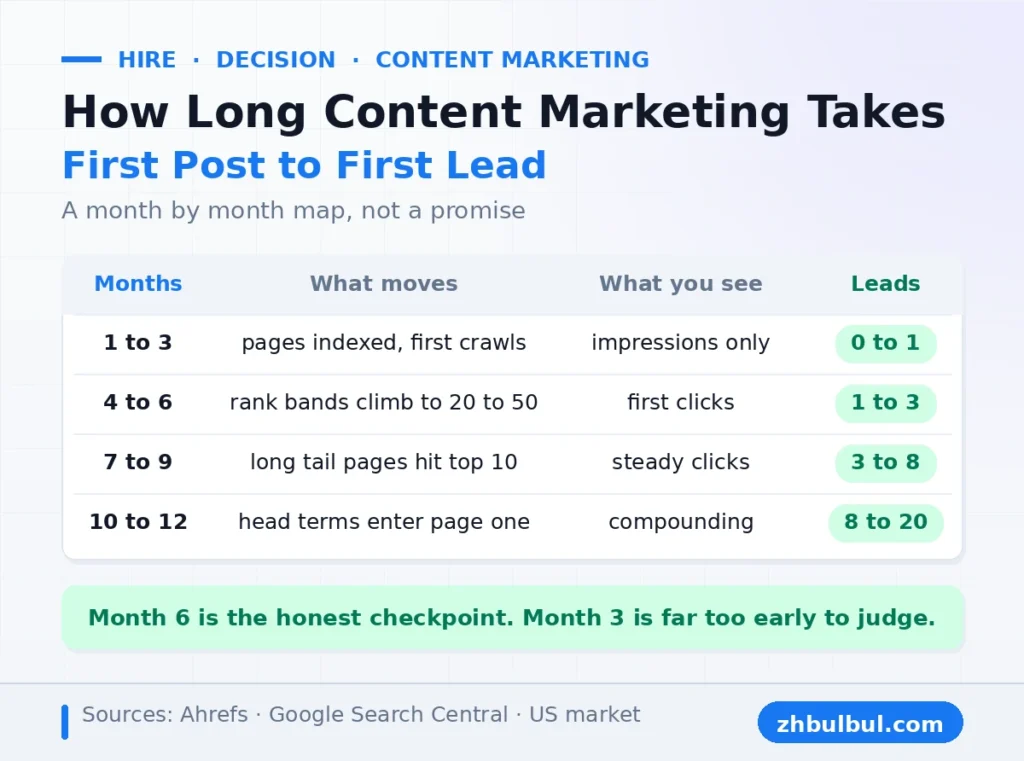
A content marketing lead timeline is the gap from first post to first sale call. The gap runs 6 to 12 months for most small firms. Rank comes first, traffic second, leads last. Each stage has its own clock.
Search work moves in stages. Google must crawl the page first. Google must then rank it. That rank must hold long enough to earn clicks. Only then does a buyer read and call.
Lead timelines split into four stages. Each stage feeds the next. A stall at stage one stops the whole chain.
The four stages of a lead timeline are listed below.
- Index Stage: the index stage puts your page in the Google index, often in days.
- Rank Stage: the rank stage moves that page onto page one, often in months.
- Click Stage: the click stage turns rank into real reads.
- Lead Stage: the lead stage turns reads into calls and forms.
A firm that buys SEO content writing buys all four stages. Most price only the first.
How long does content marketing take to bring leads?
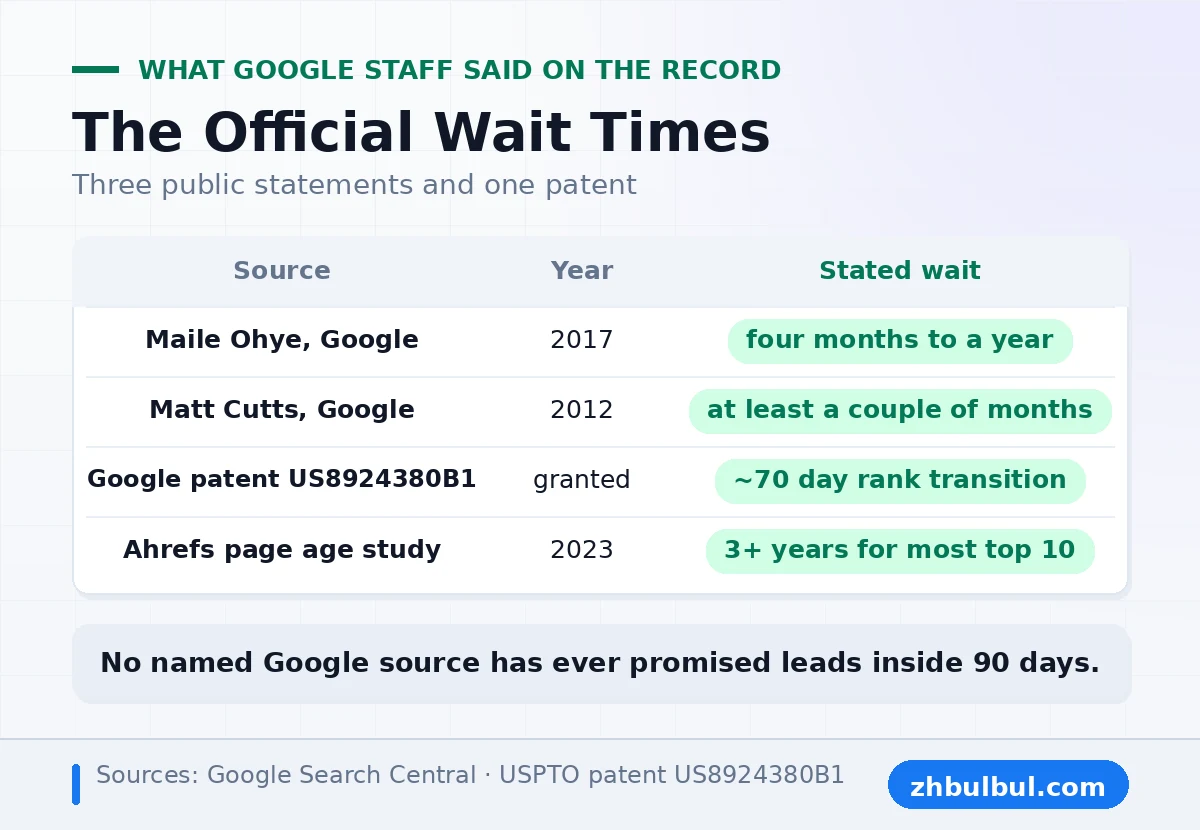
Plan 6 to 12 months for steady leads. Plan 3 to 4 months for the first stray lead. Google’s own Maile Ohye put the wait at four months to a year. Nothing since has cut that range.
Maile Ohye held the developer advocate role at Google. Her number came in a Google video. It did not come from a vendor blog. Matt Cutts ran web spam at Google then. He put the floor at a couple of months.
Lead speed also tracks your page count. Lead speed tracks your buyer type too. A dentist with 15 pages waits less than a SaaS firm with 15 pages.
| Source | Year | Stated wait |
|---|---|---|
| Maile Ohye, Google | 2017 | 4 months to a year |
| Matt Cutts, Google | 2012 | at least a couple of months |
| Ahrefs, 2 million pages | 2020 | 61% of top 10 pages are 3+ years old |
| Google patent US8924380B1 | 2015 | rank shift near day 70 |
The patent line is the one most guides miss. Google filed a rank transition method. The method holds a new page down, then moves it. The dip runs near 20 days. The shift lands near day 70.
What does month by month look like?
Month 1 buys index and baseline. Month 3 buys first page one hits on long tail words. Month 6 buys the first steady leads. Month 12 buys volume that pays the bill.
Monthly targets keep a plan alive. The traffic chart looks flat for months. A flat chart with rank gains under it is a healthy plan. A flat chart with no rank gains is a broken one.
The table below assumes 4 posts a month. It also assumes a site with some history. A brand new domain adds 3 to 4 months to each row.
| Month | Pages live | What to expect | Leads |
|---|---|---|---|
| 1 | 4 | Pages indexed, first impressions | 0 |
| 2 | 8 | Long tail ranks at 30 to 60 | 0 |
| 3 | 12 | First page one long tail hits | 0 to 1 |
| 4 | 16 | Impressions up 3x from month 1 | 1 to 2 |
| 6 | 24 | Head terms enter the top 20 | 2 to 5 |
| 9 | 36 | Cluster ranks lift as a group | 5 to 10 |
| 12 | 48 | Steady flow, head terms on page one | 10 or more |
Lead counts above fit a US local service firm. The deal size there sits near 500 dollars. A firm with a 50,000 dollar deal sees fewer leads. It also sees better ones.
What did Ahrefs find about how fast new pages rank?
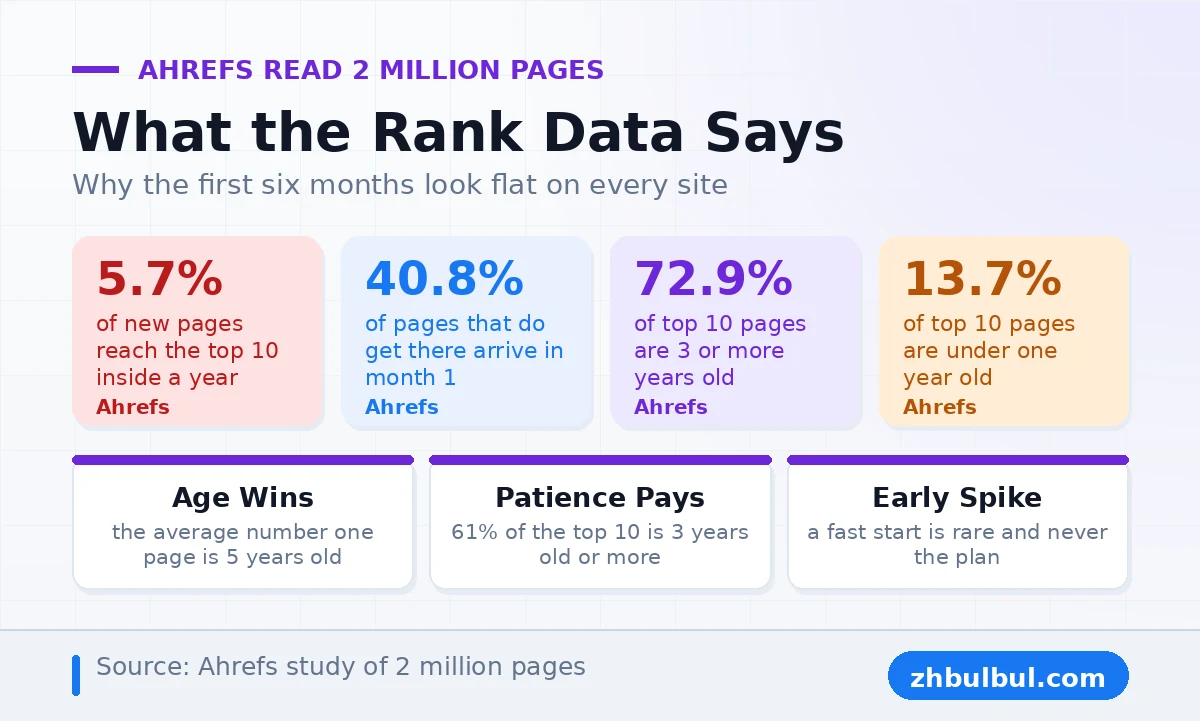
Ahrefs tracked 2 million new pages for a year. Only 5.7 percent reached the top 10 for any word. Filtered to real English pages, the rate rose to 6.11 percent. Most new pages never rank at all.
Ahrefs also read the age of top 10 pages. Pages under one year old fill 13.7 percent of those slots. Pages over 3 years old fill 72.9 percent. The average page at rank 1 is near 5 years old.
Age is not the cause. Age is a proxy for links, edits and proof. A page that earns those in month 3 beats a page that coasted.
| Ahrefs finding | Number |
|---|---|
| New pages that reach top 10 in a year | 5.7% |
| Same, filtered to English non-empty pages | 6.11% |
| Winners that got there inside month 1 | 40.82% |
| Top 10 pages over 3 years old | 72.9% |
| Top 10 pages under 1 year old | 13.7% |
Read the third row twice. Of the pages that did win, 40.82 percent won fast. A page that shows nothing by month 6 rarely turns later.
What early signs show the plan works before leads land?
Watch impressions, not traffic. Watch rank bands, not rank 1. Watch the count of words each page ranks for. All three move months before the first lead does.
Search Console holds every one of these free. Impressions rise first. Google tests a new page on low volume words. Clicks follow once rank crosses about 15.
Early signs beat late signs on a slow plan. The four below give you a month 2 answer. The old way waits until month 8.
The four early signs of a live plan are listed below.
- Impression Lift: impression lift shows Google now tests your page on real searches.
- Rank Band Shift: rank band shift moves a page from 55 to 25. That shift precedes page one.
- Query Spread: query spread counts the words one page ranks for. That count climbs on a live plan.
- Deep Page Entry: deep page entry means new pages rank faster than your old ones did.
Query spread is the sign owners ignore. A page ranks for 4 words in month 2. The same page ranks for 40 words in month 5. That page is on track, even at rank 30.
What does a content plan cost while you wait?
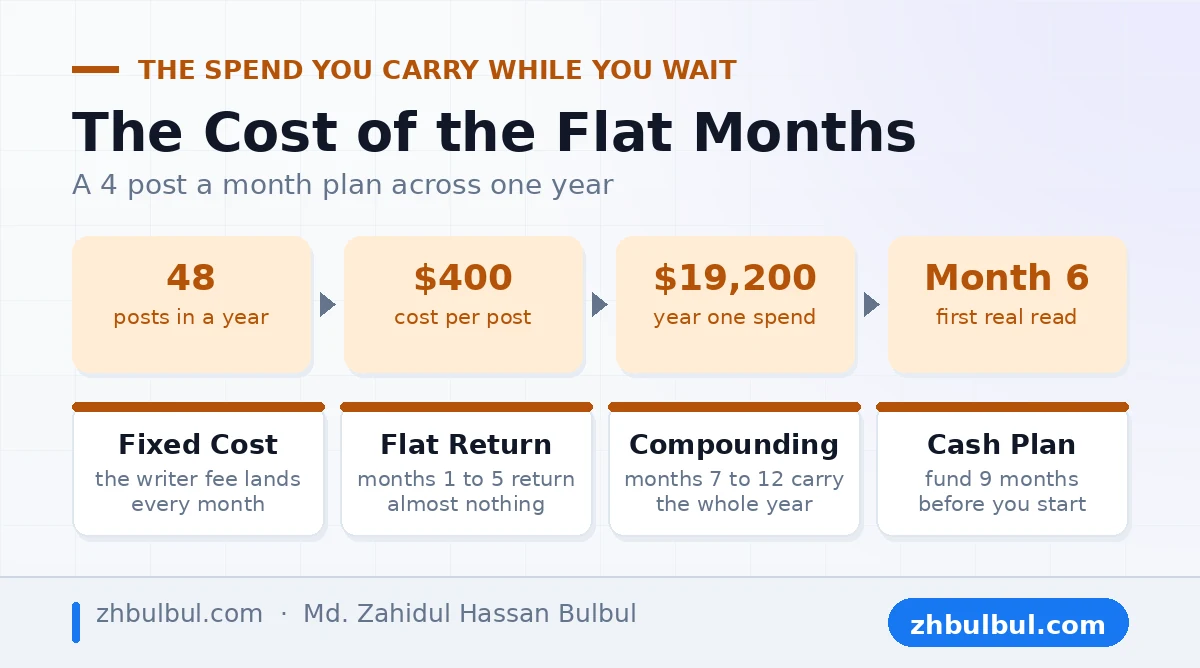
Budget 1,200 to 4,000 dollars a month for a small US firm. That covers 4 posts, tools and edits. Carry that spend for 12 months before you judge the plan.
Cost per post drives the range. A long researched post from a US writer runs 250 to 400 dollars. Four of those plus tools lands near 1,500 dollars a month.
Spend is the part owners plan worst. They fund 3 months of a 12 month plan. Then they read the flat chart as failure.
| Line item | Monthly cost |
|---|---|
| 4 posts at $300 | $1,200 |
| Rank tracker and audit tool | $100 to $200 |
| Image and edit time | $100 to $300 |
| Optional writer retainer | $500 to $2,000 |
| Common total | $1,400 to $3,700 |
Total spend over 12 months runs 16,800 to 44,400 dollars. Weigh that against one closed deal. A firm with a 12,000 dollar deal breaks even on 2 to 4 leads.
A guide on how to hire an SEO content writer sets the rate bands behind that total.
What makes one site faster than another?
Domain age, link count, page count and buyer type set the speed. A 6 year old site with 200 links leads in month 4. A fresh domain with no links waits past month 9.
Site history does most of the work. Google trusts a domain that has ranked before. New pages on that domain clear the dip faster.
Speed factors split into two piles. One pile you control. The other pile you inherit.
The four speed factors of a content plan are listed below.
- Domain History: domain history sets your floor. You cannot buy more of it.
- Link Count: link count lifts every page at once. You can earn more of it.
- Cluster Depth: cluster depth speeds each new page. You control it fully.
- Deal Size: deal size sets how few leads make the plan a win.
Cluster depth is the fastest lever you own. Read how many articles for topical authority for the page count your theme needs.
When do you kill a content plan?
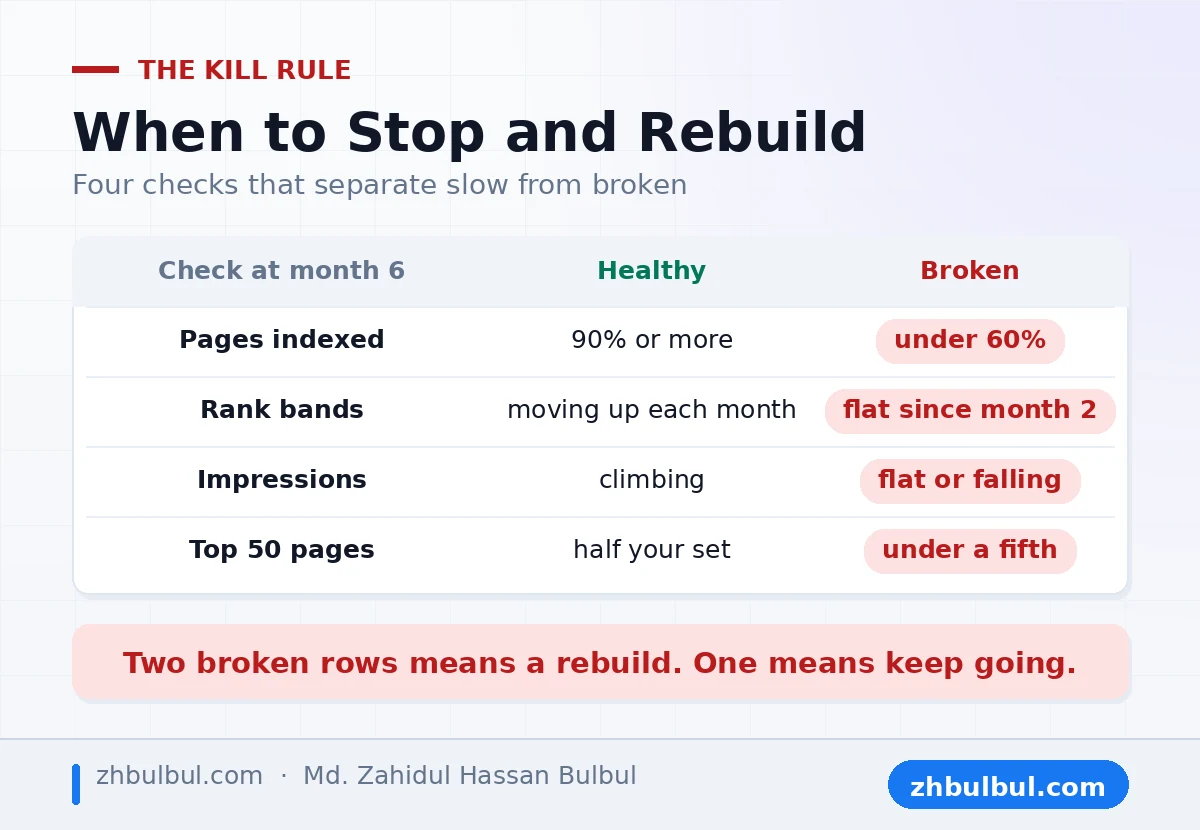
Kill the plan when month 6 shows no rank band shift. The same test needs no impression lift either. Keep it when either one moves, even with zero leads. Rank motion precedes leads by 3 to 6 months.
Set the kill rule before month 1. An owner who sets it in month 6 sets it from fear. Data plays no part by then.
The rule below uses two free Search Console numbers. Run it once a quarter. Write the answer down.
| Check at month 6 | Impressions up? | Rank bands up? | Call |
|---|---|---|---|
| Both flat | No | No | Stop and rebuild the plan |
| One moves | Yes or No | The other | Hold 3 more months |
| Both move | Yes | Yes | Fund 6 more months |
| Leads landed | Yes | Yes | Raise the pace |
Row one does not mean SEO failed. Row one means the plan aimed at words you cannot win yet. Owners who read is SEO worth it the wrong way quit on row two.
What breaks a timeline most often?
Four things break the clock. A pace that drops after month 2 breaks it hardest. Words that are too broad break it next. Thin pages and zero links break the rest.
Pace drops hurt for one reason. Rank builds on a cluster, not on a page. A cluster half built ranks like a cluster not built.
Timeline breaks repeat across firms in the same order. The four below cover most stalls.
The four common timeline breaks are listed below.
- Pace Drop: pace drop cuts 4 posts a month to 1. That drop stretches a 12 month plan to 4 years.
- Head Term Aim: head term aim points 12 pages at words that need 200 links.
- Thin Page Build: thin page build ships 600 word pages that answer nothing new.
- Zero Link Work: zero link work leaves the whole site with no outside proof.
Head term aim is the costly one. A new site that targets “SEO services” burns a year. The same site ranks in month 3 for a tighter word. One example is “SEO services for dental clinics in Ohio”.
How do you shorten the wait?
Shorten it with long tail words first. Build a tight cluster. Write one page per buyer ask. Add internal links from day one. These cut the first lead date by 2 to 3 months.
Long tail words carry lower link needs. A young site can win them. Each win also feeds the cluster. That cluster later lifts the head term.
Speed work is cheap during the build. The same work costs triple as a fix later.
The five ways to shorten the wait are listed below.
- Long Tail Start: long tail start picks words with clear buyer intent and few rivals.
- Cluster Order: cluster order ships the pillar first, then the money pages.
- Link Web Build: link web build joins each new page to 6 or more siblings.
- Old Page Fix: old page fix updates pages that already sit at rank 11 to 20.
- Proof Add: proof add puts real numbers, names and dates on every page.
Old page fix pays fastest of the five. A page at rank 12 needs a small push. A new page needs the whole climb. The pillars of SEO strategy put that fix work ahead of new builds.
What do you settle before you start the clock?
Settle five things before the first post ships. Fix the budget months, the pace, and the kill rule. Fix the lead target and the report date too. Those five stop the month 5 panic.
Each answer below is short on purpose. Put them on one page. Share that page with whoever signs the checks.
Plan terms hold better in writing than in a call. The five asks below cover the ones that cause fights later.
How soon does the first lead land?
The first lead lands near month 3 or 4 for most local firms. That lead comes from a long tail page. It does not come from the head term. One lead is proof of the pipe, not proof of scale.
First leads often arrive from words you never targeted. Google matches a page to a close ask. That match happens when nothing better exists.
Does a new domain wait longer?
A new domain waits 3 to 4 months longer at each stage. Ahrefs found pages under one year old hold just 13.7 percent of top 10 slots. Age buys links and edit history. Both take real time.
New domains also lack a link web. That web speeds each new page. Every page you add fixes a little of it.
How many pages before leads start?
Most small firms see first leads near page 12. Steady leads start near page 25. Page count matters less than cluster fit. So 25 pages on one theme beat 60 pages on six themes.
Page count and lead count track loosely. One money page can outproduce 20 blog posts. The match of intent does that work.
Does paid search shorten the wait?
Paid search buys leads on day one. Paid search also buys data for the content plan. Paid clicks do not lift organic rank. Run both when cash allows, and let paid data pick your build order.
Paid keyword data names the words that convert. That list beats any volume tool for build order.
What do you report to the boss each month?
Report impressions, rank bands, query spread and leads, in that order. Put traffic fourth, because traffic lags rank. Add one line on what ships next month.
Monthly reports fail when they lead with traffic. Owners who want how to grow your business online tracked well read rank bands first.

