
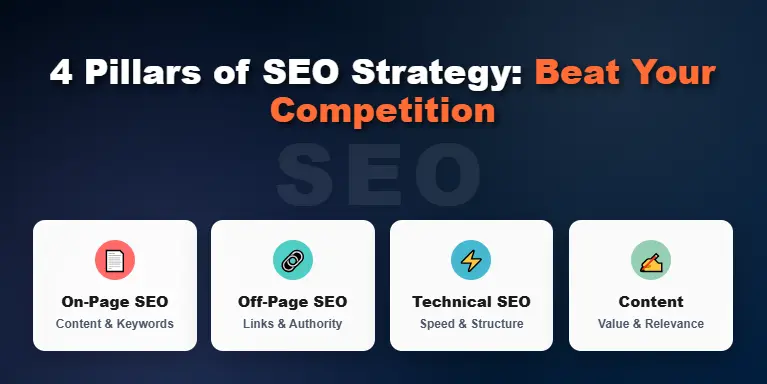
Most SEO advice names four pillars. Few sources agree on what the four are. That gap confuses the people who most want a plan.
The guide fixes that gap. The guide names the four. Then it maps each one to a stage of search. Then it gives you a fix-first rule.
The model earns its place since search rewards balance. A fast site with thin text stalls. A deep page on a dark site stays dark. Four pillars, four fault lines.
The true importance of SEO lies in how these four pillars work together to build long-term authority.
What are the 4 pillars of SEO?
The 4 pillars of SEO are technical SEO, on-page SEO, content, and off-page SEO. Technical SEO makes a page reachable. On-page SEO makes it readable. Content makes it worth a read. Off-page SEO makes it trusted.
Nine of the 14 top pages use these same four. Each one does a job the rest can not do. Each fails on its own.
The 4 pillars of SEO split the work by owner too. A dev owns most tech work. A writer owns content. An SEO owns on-page. That split fits staff plans, not just study.
The four pillars of SEO and their core jobs are listed below.
- Technical SEO: technical SEO opens the crawl path to your page.
- On-Page SEO: on-page SEO labels the page so search reads it right.
- Content: content answers the query with facts the reader wants.
- Off-Page SEO: off-page SEO earns proof from other sites.
Why do the 4 pillars of SEO matter?
The 4 pillars of SEO matter since search failure has four split causes. A rank drop traces back to one pillar. To name that pillar turns a vague fault into a task with a fix.
Most sites do not fail all at once. They fail in one place. Three pillars work fine.
The 4 pillars of SEO stop waste too. Some sites buy links while their pages block bots. That spend buys a signal Google can not use. Repair order changes the return on the same cash.
The four gains from the pillar model are listed below.
- Fault Split: fault split points to one pillar, not to 200 rank factors.
- Spend Order: spend order sends cash to the broken pillar first.
- One Owner: one owner gives each pillar to one role.
- Proof Of Gain: proof of gain gives each pillar its own metric.
Why do sources disagree on the 4 pillars of SEO?
Sources disagree since the model has no owner. Google never published the model. Agencies coined it. Each one grouped the same tasks in a new way. The tasks stay fixed. The labels move.
Four rival groups show up across the top pages. Each one hides the same work under a new name.
The 4 pillars of SEO drift for a second cause. The trade adds new goals over time. User experience joined the list after 2020. So did analytics. Neither one replaced a pillar. Both fold into one.
| Model | The four named | Who uses it |
|---|---|---|
| Canonical | Technical, on-page, content, off-page | 9 of 14 top pages |
| Structure split | Structure, content, backlinks, technology | Torchlight, SCORE |
| Stages model | Technical, content, off-page, analytics | GeeksforGeeks |
| Experience model | Technical, content, authority, user experience | Explore Digital |
| Outcome model | Content, backlinks, conversion, analytics | Connor Gillivan |
Use the first row. The other four fold into it. Analytics sits in each pillar as its measure layer. User experience sits in on-page and tech work. Trust is off-page under a new name.
How does Google use the 4 pillars to rank a page?
Google reads the four pillars in order, not at once. A bot fetches the page. An indexer stores it. A ranker scores it. Each stage reads one pillar. Then it hands the page on.
One of the 14 top pages explains this chain. The order makes the four a plan, not a list.
The 4 pillars of SEO map to that chain well. A pillar that fails early blocks each pillar after it. That one fact sets the repair order below.
The four stages and the pillar each one reads are listed below.
- Crawl Stage: the crawl stage reads technical SEO to reach the URL.
- Index Stage: the index stage reads on-page SEO to file the topic.
- Rank Stage: the rank stage reads content to score the answer.
- Trust Stage: the trust stage reads off-page SEO to weigh the source.
What is technical SEO?
Technical SEO is the work that lets search reach, draw, and store a page. Technical SEO covers crawl access, index rules, speed, mobile view, and site shape. The pillar creates no rank on its own.
Technical SEO acts as a gate. A page behind a shut gate scores zero. Good text can not open that gate. An SEO service owns this pillar on most sites.
Technical SEO holds the three Core Web Vitals too. None of the 14 top pages name them. Google names all three in its own docs. Each one has a pass mark.
The five parts of technical SEO with their pass marks are listed below.
- Crawl Access: crawl access lets a bot fetch the URL.
- Index Control: index control tells Google which URLs to store.
- Largest Contentful Paint: largest contentful paint tracks load speed. The pass mark is 2.5 seconds.
- Interaction to Next Paint: interaction to next paint tracks response lag. The pass mark is 200 milliseconds.
- Cumulative Layout Shift: cumulative layout shift tracks visual jump. The pass mark is 0.1.
A technical SEO audit service covers this pillar from end to end.
What is on-page SEO?
On-page SEO is the label work in one page. On-page SEO covers the title tag, the meta description, heading order, URL words, and image alt text. The pillar tells search what the page covers.
On-page SEO is the cheapest pillar to fix. Most of it takes minutes per page. None of it needs a dev.
On-page SEO does the job of a translator too. A page states its topic in prose. On-page fields state that topic where a parser looks first.
The six on-page parts by weight of effect are listed below.
- Title Tag: the title tag names the topic in 60 characters.
- Heading Order: heading order runs H1 to H2 to H3.
- Meta Description: the meta description sells the click, not the rank.
- URL Words: URL words repeat the topic in short form.
- Internal Links: internal links pass topic context between your pages.
- Image Alt Text: image alt text names what the image shows.
Strong on-page work starts with one rule. One page owns one term. A topical map holds that rule in place.
What is SEO content?
SEO content is text built to answer a search query in full. SEO content covers the first question. Then it covers the next ones. Depth, truth, and fresh data split it from filler.
All 14 top pages name content as a pillar. Few define what makes content rank.
SEO content is the one pillar that scales too. Tech fixes end. Content compounds. Each new page opens new queries and links back to the rest.
The five marks of content that ranks are listed below.
- Intent Match: intent match answers the question the searcher asked.
- Answer Spot: answer spot puts the answer in the first two lines.
- Attribute Depth: attribute depth covers cost, process, risk, and rivals.
- Information Gain: information gain adds a table, a rule, or a number.
- Source Credit: source credit names the origin of each stat.
Volume with no plan wastes cash. The page count flows from the topic. Topical authority sets that count. If you want to scale this process, consider whether you need to hire an SEO content writer.
What is off-page SEO?
Off-page SEO is each trust signal earned off your own site. Off-page SEO covers backlinks, brand mentions, reviews, and citations. Google reads these as proof that your page has earned its rank.
Off-page SEO is the slowest pillar. It is also the hardest to fake. Bought links carry the top risk in the model.
Off-page SEO breaks ties too. Two pages can match on text and tech health. Trust alone then splits them.
The four off-page signals by weight are listed below.
- Earned Backlinks: earned backlinks come from sites the page helped.
- Brand Mentions: brand mentions name the firm with no link.
- Reviews: reviews on other sites feed trust and local rank.
- Citations: citations list the firm name, address, and phone.
What is the difference between technical SEO and on-page SEO?
Technical SEO serves the bot. On-page SEO serves the parser. Technical SEO works at site level and rules access. On-page SEO works at page level and rules sense. The two share speed and mobile view.
Shared ground causes most of the mix-up. Page speed sits in both camps. Speed shifts crawl budget and reader acts at once.
Technical SEO differs in who fixes it too. A dev ships tech work through code. A writer ships on-page work through the editor.
| Question | Technical SEO | On-page SEO |
|---|---|---|
| Scope | Whole site | Single page |
| Serves | Crawler and indexer | Parser and reader |
| Typical owner | Developer | Writer or SEO |
| Fix speed | Days to weeks | Minutes to hours |
| Failure result | Page never appears | Page appears for the wrong query |
How do the 4 pillars of SEO work together?
The 4 pillars of SEO form a chain, not a set. Each pillar gates the next. Tech health lets content reach the index. Indexed content earns links. Links raise the worth of each page after it.
Half of the top pages state that the four connect. None show which way the flow runs.
The 4 pillars of SEO compound in one direction only. Strength early adds up fast. Strength late can not repair an early break.
The three chain effects that shape results are listed below.
- Gate Test: the gate test stops all worth when tech SEO blocks the bot.
- Boost Test: the boost test raises the return on content once trust rises.
- Decay Test: the decay test erodes rank as peers publish fresh work.
Which pillar of SEO should you fix first?
Fix the pillar that blocks the stage you fail at. A page absent from the index fails technical SEO. A page indexed but never shown fails content. A page shown but ranked past 20 fails off-page SEO.
Seven of the top pages ask this in their question block. None answer it with a rule. The check takes one report in Google Search Console.
The 4 pillars of SEO answer at four speeds too. That gap decides what you fix in week one against month six.
| Symptom in Search Console | Broken pillar | First action |
|---|---|---|
| URL not indexed | Technical | Check robots.txt, canonical tag, and server code |
| Indexed, zero impressions | On-page | Rewrite title tag and headings to match the query |
| Impressions, position 30 to 90 | Content | Rebuild the page against the query behind it |
| Position 5 to 20, low clicks | On-page | Rewrite the title tag and meta description |
| Position 5 to 20, stalled | Off-page | Earn links and mentions for that page |
How do you measure each pillar of SEO?
Each pillar carries its own metric. Technical SEO tracks indexed pages. On-page SEO tracks click rate. Content tracks impressions and mean position. Off-page SEO tracks linked domains. One number per pillar blocks false gains.
Six of the 14 top pages mention analytics. None assign a metric per pillar.
The 4 pillars of SEO ripen on four clocks too. A tech fix shows in days. A link push shows in months. One clock for all four creates false alarms.
| Pillar | Primary metric | Source | Time to move |
|---|---|---|---|
| Technical | Indexed URLs | Search Console Pages report | 3 to 21 days |
| On-page | Click-through rate | Search Console Performance | 7 to 30 days |
| Content | Impressions and average position | Search Console Performance | 30 to 120 days |
| Off-page | Referring domains | Ahrefs or Semrush | 90 to 270 days |
Where does E-E-A-T fit across the 4 pillars?
E-E-A-T runs through all four pillars and not in one. E-E-A-T stands for experience, expertise, authoritativeness, and trust. Content proves skill. Off-page SEO proves trust. On-page and tech work carry the proof.
One of the 14 top pages gives E-E-A-T a heading. To treat it as a fifth pillar breaks the model. No one role owns it.
E-E-A-T has real carriers on a page too. Each carrier sits in a pillar you fix anyway.
The four E-E-A-T carriers and their home pillars are listed below.
- Author Box: the author box names credentials and sits in content.
- Citation Links: citation links credit first sources and sit in content.
- Person Schema: person schema states author identity in code.
- Trade Mentions: trade mentions confirm repute off site.
A guide on semantic SEO covers entities, context, and search intent.
Where does semantic SEO fit in the 4 pillars?
Semantic SEO sits in the content pillar and shifts how you plan it. Semantic SEO groups pages by entity and topic, not by keyword. Search reads topics as linked ideas. Page networks beat lone pages.
None of the 14 top pages cover semantic SEO. That gap explains a common trap. Sites publish a lot and still stall.
Semantic SEO sits at the core of SEO content writing. Depth stops at word count. Depth starts at attribute reach across a group of pages.
The three semantic units that shape the content pillar are listed below.
- Central Entity: the central entity names the one thing a page spans.
- Attribute Reach: attribute reach answers cost, process, risk, and peers.
- Contextual Border: the contextual border closes a page with a grouper question.
Sites that plan this way hire for it. The questions to ask an SEO content writer split topic planners from word count fillers.
What are the most common mistakes in each pillar?
Each pillar fails in a set way. Technical SEO fails through blocked crawls. On-page SEO fails through a doubled target. Content fails through thin reach. Off-page SEO fails through bought links.
Three of the top pages list mistakes. None sort them by pillar. That sort is what makes a fault list of use.
The 4 pillars of SEO share one root error too. Teams work the pillar they enjoy. The pillar that blocks them waits.
The four costliest mistakes by pillar are listed below.
- Blocked Crawl: a blocked crawl hides pages behind noindex tags from a test site.
- Doubled Target: a doubled target puts two pages on one query.
- Thin Reach: thin reach skips cost, process, and peers.
- Bought Links: bought links breach Google spam policy and risk a manual action.
Small sites feel these worst. One broken pillar eats the whole spend. The case for small business SEO rests on the cheap pillars first.
Is AI search visibility a fifth pillar of SEO?
No. AI search is a new surface, not a new pillar. AI answers pull from indexed pages. The same four pillars decide whether a model cites you. The fetch layer changed. The inputs did not.
Pew Research Center reported in July 2025 that AI Overviews show in about 18 percent of US Google searches. Pew found that about 88 percent of those summaries cite three or more sources.
AI search rewards two things the four pillars build. Clear, short answers come from content. Crawl access comes from technical SEO.
The three shifts AI search makes in the current pillars are listed below.
- Answer Pull: answer pull favors pages that answer in two lines.
- Entity Clarity: entity clarity favors pages with schema and one steady name.
- Source Credit: source credit favors pages that name first-hand data.
How do you turn the 4 pillars of SEO in to a working strategy?
Turn the four in to a plan by work in chain order. Fix tech access first. Correct on-page labels next. Rebuild content third. Earn trust fourth. Then track each pillar with its own metric.
Order counts more than effort. Work on a late pillar returns little. An first break holds the rest down.
The 4 pillars of SEO need a review rhythm too. One pass per pillar per quarter catches decay first. Teams that skip the rhythm rebuild the same faults each year. The questions below cover what teams ask next.
How long does each pillar take to work?
Tech fixes show in 3 to 21 days. On-page edits show in 7 to 30 days. Content gains show in 30 to 120 days. Off-page trust shows in 90 to 270 days. That spread explains a common misread. One report date judges three pillars wrong.
Which pillar gives the fastest wins?
On-page SEO gives the fastest wins. A title tag rewrite moves click rate in weeks. The cost is one edit block. Pages at spot 5 to 20 gain the most.
Can a site rank with weak technical SEO?
Yes, on small sites. A 20-page site with clean links copes with weak tech work. A bot reaches each page anyway. Sites past 500 pages lose crawl speed fast. Tech debt then caps growth.
Can a site rank without off-page SEO?
Yes, for low-rivalry queries. Long-tail questions with weak peers rank on content alone. Head terms with cash value stay shut. Each page on that first page holds links.
Do all sites need all four pillars equally?
No. Weight shifts with site age and rivalry. A new site spends most effort on content and tech health. An old site with deep content moves spend toward trust.
Which pillar matters most for a new site?
Content matters most for a new site. A new domain has no trust to spend. Reach becomes the one lever. Technical SEO ranks next, since index faults waste each page.
How often should you review each pillar?
Review technical SEO each month. Review the other three each quarter. Tech faults appear with no warning after plugin updates. Content and trust shift slow enough for a quarterly pass.
Can you manage all four pillars yourself?
Yes, on a small site. One person handles four pillars under 50 pages. Past that size the four split in skill. Most owners keep content in house and hire out the rest.
Do the 4 pillars apply to local SEO?
Yes, with one add-on. Local search adds the Google Business Profile to off-page SEO. Citations and reviews weigh more than links. Local SEO for small business turns on that gap.

