
What is topical authority?
Theme depth is the trust a site earns on one theme. Google reads that trust from full theme reach. A site with full reach ranks for words it never chased. The trust sits at theme level, not at site level.
Google named this in 2023. The Search Central blog called it a topic authority system. That post framed it for news asks first.
Theme depth rests on three parts. Each part is a thing you build, not a score you buy.
The three parts of theme depth are listed below.
- Ask Set: the ask set names each ask buyers type on your theme.
- Page Count: the page count is your share of that set.
- Link Web: the link web joins those pages so Google reads one group.
A topical map vs keyword list sets the ask set. A key word list does not.
What is domain authority?
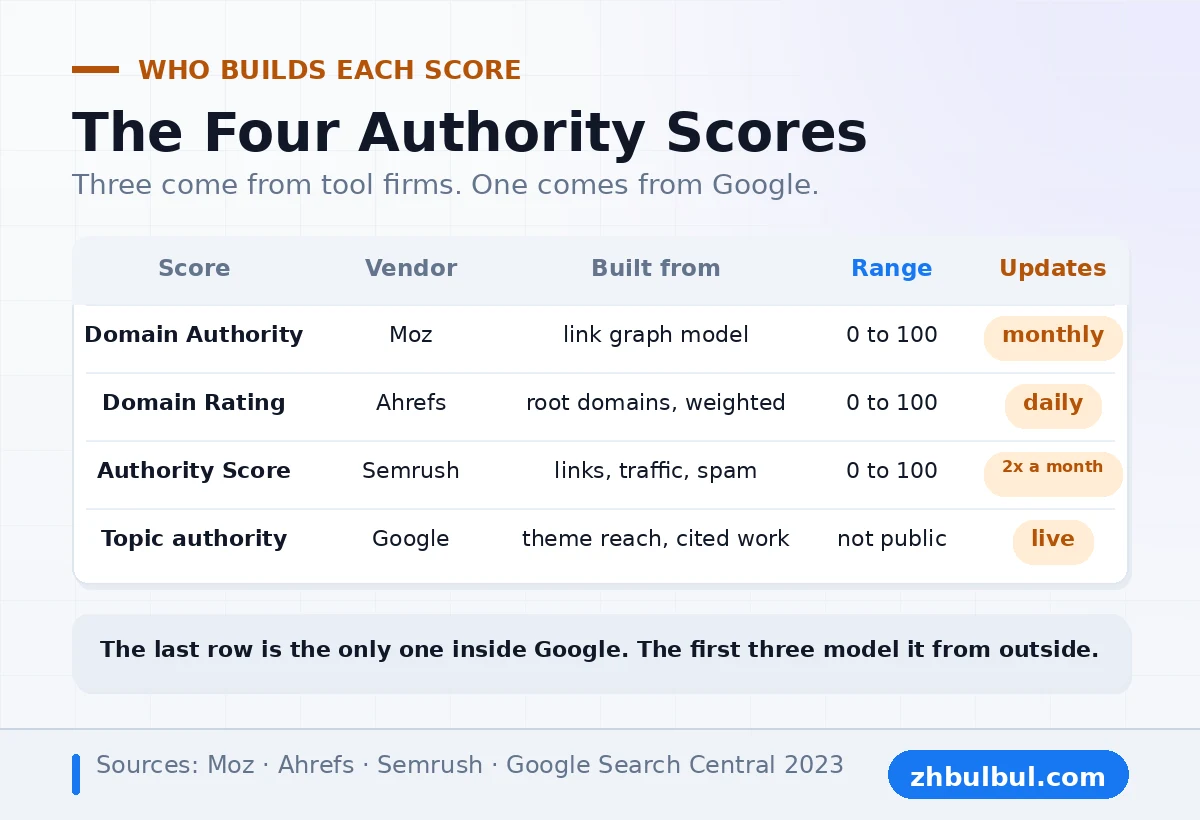
DA is a score built by a tool firm. Moz built the first one in 2010. Ahrefs sells Domain Rating. Semrush sells Authority Score. None of the three sits inside Google. Each runs on link data alone.
Each tool builds its score from link data. Ahrefs builds Domain Rating from the count and strength of root domains. Semrush blends 3 pillars and 8 factors. Semrush moves that score twice a month.
Tool scores do one job well. They rank sites against each other on link strength. That job helps. That job is not the same job as a page rank.
| Score | Vendor | Built from | Range | Update rate |
|---|---|---|---|---|
| Domain Authority | Moz | link graph model | 0 to 100 | monthly |
| Domain Rating | Ahrefs | linking root domains, weighted | 0 to 100 | daily |
| Authority Score | Semrush | links, traffic, spam, 8 factors | 0 to 100 | twice a month |
| Topic authority | theme reach, cited work | not public | live |
The last row is the only one Google runs. The first three are models of Google, built from outside.
What is the real difference between topical authority and domain authority?
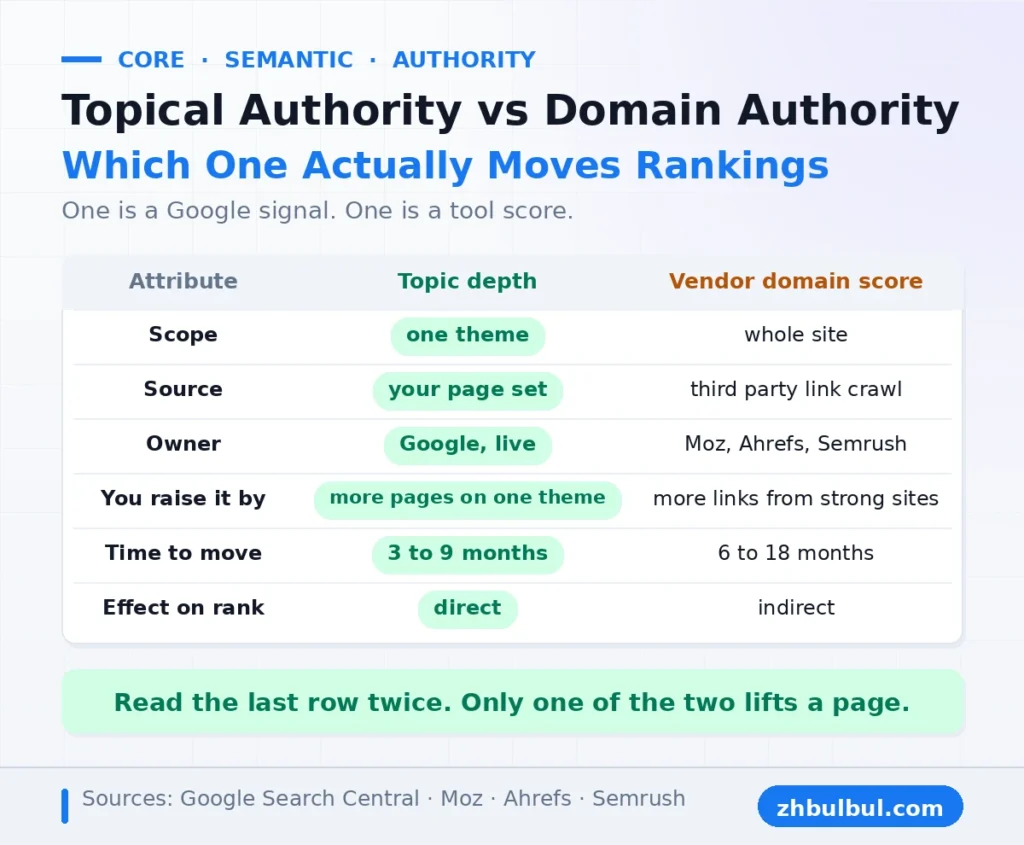
Theme depth is per theme. A tool score is per site. Theme depth comes from reach on one theme. A tool score comes from links across all themes. One tells you what you can rank for. The other tells you how strong your links look.
Scope is the split that matters. A site with DR 35 and 44 pages on one theme wins. A site with DR 70 and 3 pages on it loses.
The table below sets the two side by side. Read the last row first, because it drives the whole plan.
| Attribute | Topic depth | Vendor domain score |
|---|---|---|
| Scope | one theme | whole site |
| Source | your page set | third party link crawl |
| Owner | Google, live | Moz, Ahrefs, Semrush |
| Built from | coverage, entities, links | links only, mostly |
| You raise it by | more pages on one theme | more links from strong sites |
| Time to move | 3 to 9 months | 6 to 18 months |
| Effect on rank | direct | indirect |
Read the bottom row again. A tool score has no direct lift. A tool score shows a cause, and the cause is links.
Does Google use domain authority?
Google does not use any tool score. John Mueller said so in 2020. His words were plain. Google does not use DA in its algorithms. He said the same in 2016 and again in 2022. The line has held since.
Gary Illyes said the same in 2015 and 2016. Both men worked on Search at Google. Both spoke on the public record.
Two claims often blur here. Google does not read Moz DA. Google does hold a site wide quality score of its own.
The two claims to keep apart are listed below.
- Tool Score Claim: tool score claim says Google reads Moz or Ahrefs numbers. That claim is false.
- Site Signal Claim: site signal claim says Google holds its own site wide score. That claim now has proof.
The second claim held no proof for years. Then a leak landed in 2024.
What did the 2024 Google API leak show?
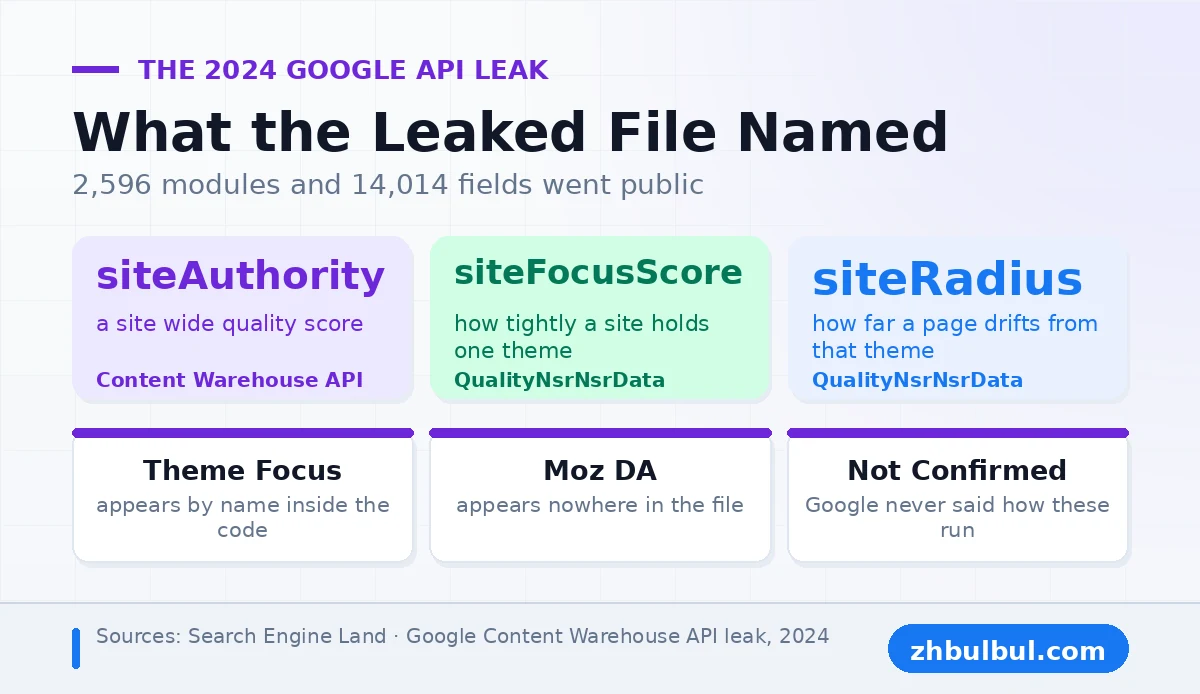
A Google Content Warehouse API file leaked in 2024. Search Engine Land and others read it in full. The file held 2,596 modules and 14,014 fields. One field carried the name siteAuthority. That name had never surfaced in public before.
The leak also held two names that matter more. One is siteFocusScore. The other is siteRadius. Both sit inside a module called QualityNsrNsrData.
Site focus and site radius read as theme measures. Site focus rates how tight a site holds one theme. Site radius rates how far a page sits from that theme.
| Leaked name | What it reads as |
|---|---|
| siteAuthority | a site wide quality score |
| siteFocusScore | how tightly a site holds one theme |
| siteRadius | how far a page drifts from that theme |
| QualityNsrNsrData | the module that holds all three |
Google did not confirm how these run in live search. The names alone still shift the case. Theme focus appears in the code. Moz DA does not.
Which one moves rankings?
Theme depth moves rankings. Tool scores show a cause of rankings. Graphite measured pages with high theme depth. Those pages gain traffic 57 percent faster. Build the depth and the score follows. The rank lift starts at page level.
Cause and report blur daily in SEO. Links raise both your rank and your DR. Your DR did not raise your rank.
The order of work settles the case. Depth first, links second, score never.
The three moves in rank order are listed below.
- Depth Move: depth move adds pages until your theme set is full.
- Link Move: link move earns cites from sites in your field.
- Score Move: score move is no move at all, since no one edits a tool score.
A site that wants rank reads how many articles for topical authority before it buys one link.
When does domain authority still help you?
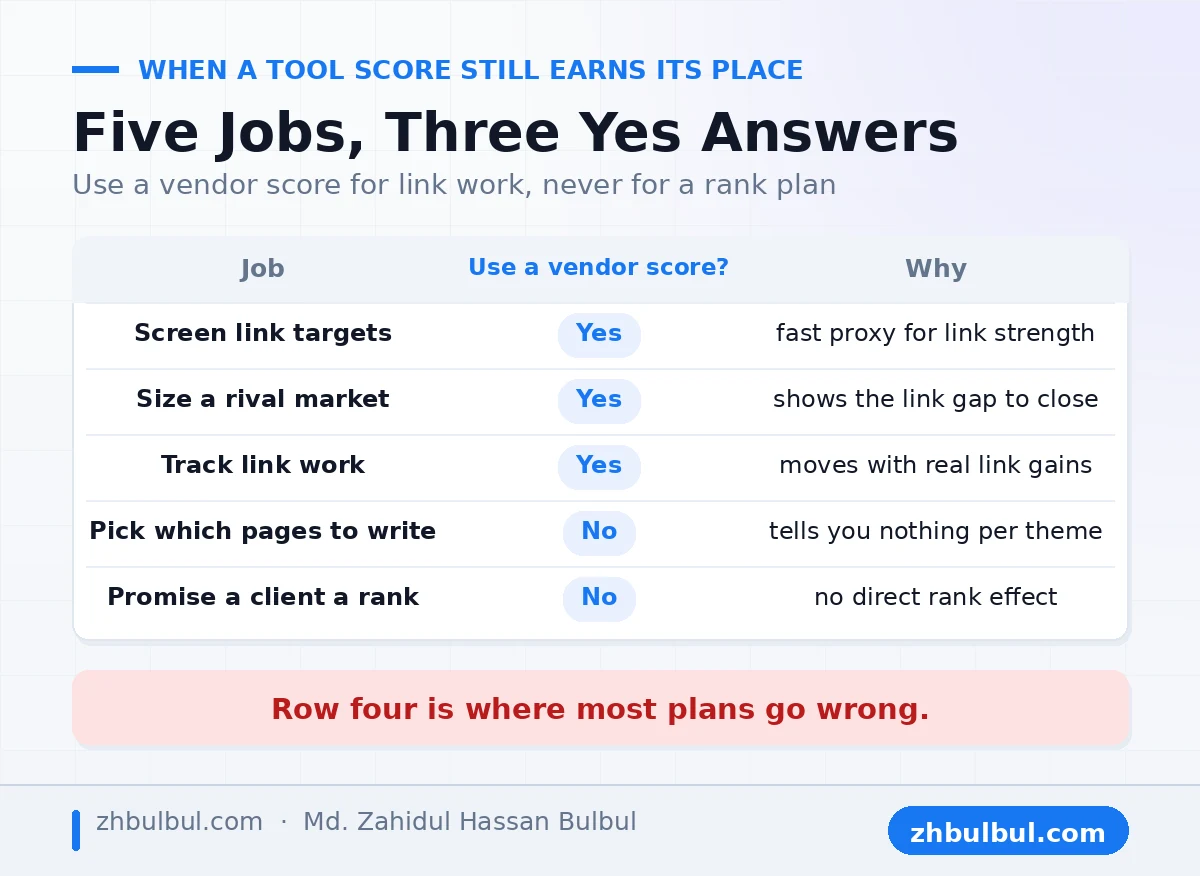
Tool scores help in three jobs. Use them to screen link targets. Use them to size a rival before you enter a market. Use them to track link work over quarters. None of the three is a rank plan.
A screen check is the honest use. A quick DR read tells you whether a guest post target has real links. That saves hours.
Tool scores also serve as a shared word between teams. A client who hears DR 22 and DR 65 grasps the gap fast.
| Job | Use a vendor score? | Why |
|---|---|---|
| Screen link targets | Yes | fast proxy for link strength |
| Size a rival market | Yes | shows the link gap you must close |
| Track link work | Yes | moves with real link gains |
| Pick which pages to write | No | tells you nothing per theme |
| Promise a client a rank | No | no direct rank effect |
Row four is where most plans go wrong. A pillars of SEO strategy plan picks pages from the ask set, not from a score.
How do you measure your own topic depth?
Measure it with three free checks. Count the asks in your theme set. Count the pages you have on it. Divide one by the other. That ratio is your real score. No tool sells this number.
Google gives you the ask set free. People Also Ask, related searches and rival headings hold most of it. An hour of work fills a sheet.
Depth checks take a half day. The four below give you a number you can defend to a client.
The four steps of a depth check are listed below.
- Ask Harvest: ask harvest lists each buyer ask on your theme.
- Page Match: page match ties each ask to a live page on your site.
- Gap Count: gap count is the asks with no page behind them.
- Rival Floor: rival floor is the page count your top rival holds on the theme.
Your ratio and your gap count both beat DR as a plan input. An SEO consultant who leads with DR sells a report, not a plan.
How do you build topical authority in 90 days?
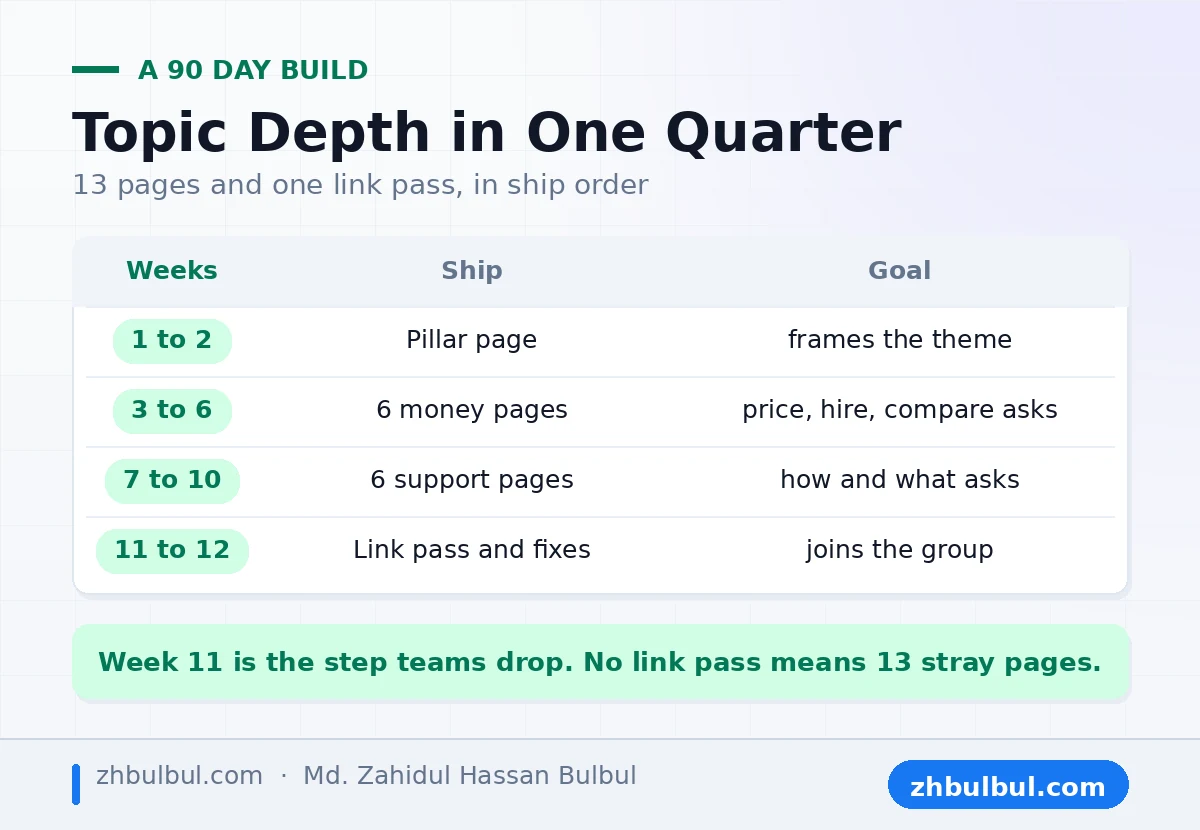
Ship the pillar page in week 1. Ship 12 support pages by week 10. Link each support page to the pillar and to 2 siblings. Google reads a full group faster than 12 stray posts.
90 days will not fill a broad theme. 90 days will fill a slice of one. Pick the slice with buyer intent and few rivals.
Build order changes the payoff curve. The plan below front loads the pages that earn.
| Weeks | Ship | Goal |
|---|---|---|
| 1 to 2 | Pillar page | frames the theme |
| 3 to 6 | 6 money pages | price, hire, compare asks |
| 7 to 10 | 6 support pages | how and what asks |
| 11 to 12 | Link pass and fixes | joins the group |
The link pass in week 11 is the step teams drop. A group with no internal links reads as 13 stray pages. The SEO service job is that pass as much as the drafts.
What do you settle before you chase either score?
Settle five things before the next sprint. Fix the theme, the ask set, and the page target. Fix the link target and the report metric too. Those five keep the plan off tool scores.
Each answer below is short on purpose. Write them at the top of your build sheet.
Plan terms hold better in writing than in a call. The five asks below cover the ones that cause fights later.
Does a high DR site rank on any topic?
A high DR site ranks fast on themes it already covers. A high DR site still loses on themes it never wrote about. Forbes ranks on money words and loses on niche trade words. Links lift a site. Links do not fill a theme.
Site strength cuts the wait. Site strength does not cut the work.
Can a low DR site beat a high DR site?
A low DR site beats a high DR site on a narrow theme. Full reach on 34 asks beats 3 pages from a strong brand. Google ranks pages, not logos. Scope wins where raw link count cannot.
Small sites win this way each week. The win needs one theme and real depth on it. A local SEO for small business push runs on that same rule.
Which score do you report to a client?
Report rank bands, ask spread and leads. Report DR only as a link work metric. A client who tracks DR month to month tracks noise. Swap the score for a count of ranked pages.
Tool scores move on crawl runs you did not cause. That motion wastes half a status call. A guide on how to increase online presence lists the counts worth a slide.
Does buying links raise topical authority?
Bought links raise nothing safe. Google treats paid links as a link scheme. The risk lands on the whole site, not on one page. Theme depth comes from pages and cites you earn. The upside never covers that risk.
Paid link networks also break the theme signal. Links from off theme sites push your site radius wider.
How often do these scores update?
Ahrefs moves Domain Rating each day. Semrush moves Authority Score twice a month. Moz moves monthly. Google’s own signals move live, which is why a tool score lags your real rank. None of the three tracks what Google saw today.
Lag alone rules out tool scores for weekly calls. Read is SEO worth it for small businesses for metrics that hold up over a year.

