
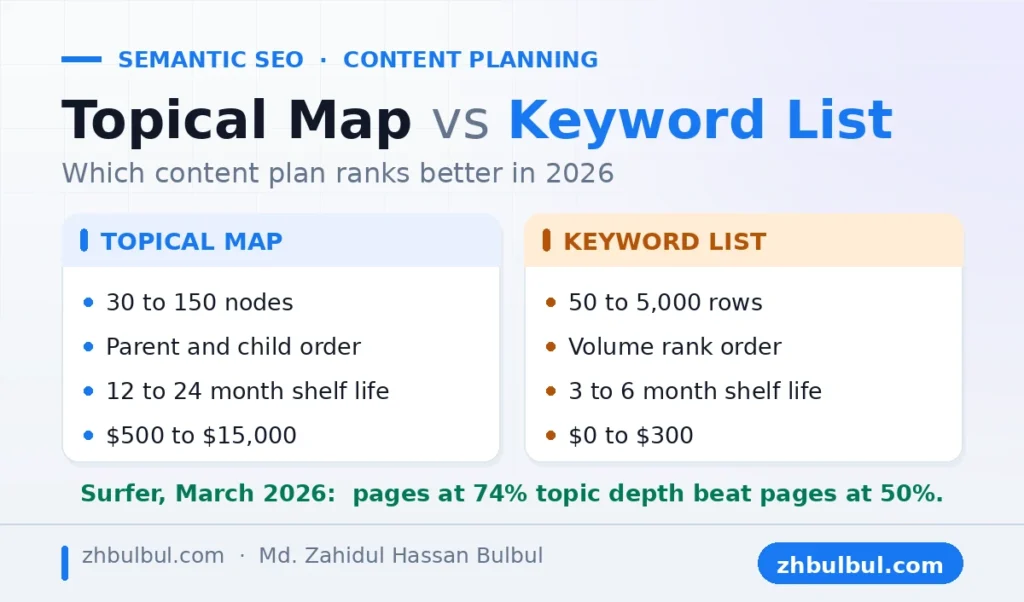
Most content plans live as a row of terms in a sheet. A row of terms tells you what to write next. A topical map tells you what to own.
Surfer studied 1 million search results in March 2026. Pages that cover 74 percent of a topic beat pages at 50 percent. Depth moves rank. Term count does not.
A topical map holds each sub topic in one field. A keyword list holds search terms and their volume. Both plans sit in a sheet. Only one sets the shape of a site.
The two plans cost far apart sums. The right pick rests on three things. Those three are site age, spend and patience.
What is a topical map?
A topical map is a full plan of each sub topic in one field. The map names each sub topic. The map also names its parent and its child nodes. Each node turns to one page. A map holds 30 to 150 nodes.
The map also holds an order. The core holds the nodes that earn cash. The outer set holds the nodes that earn trust. Koray Tuğberk Gübür named this split. The name comes from his semantic SEO method. A map with no split is a flat pile of post ideas.
Each node owns one macro context. Two contexts on one node means two pages. The map holds the full field. No node repeats the work of another.
What is a keyword list?
A keyword list is a sheet of search terms. Each row holds volume, rank hardness and intent. The list ranks terms by size or by ease. A writer picks the top row. Then the writer writes.
A keyword list also comes out of a tool in minutes. Ahrefs, Semrush and Google Search Console all build one. The file costs near zero. The file needs no field study. Speed is the real gain here.
A keyword list holds no parent and no child. A flat list still lifts a young site. Read how to increase online presence with one. Row 4 knows nothing about row 40. The writer holds the shape in his head. Or the site grows with no shape at all.
Why does a topical map beat a keyword list?
A topical map beats a keyword list on depth. Search engines score topic depth, not term count. A map makes depth a number you track. A list leaves depth to luck. Surfer named topic depth the top on page signal in March 2026.
The map also fixes five faults that a flat list creates. Each fault costs clicks. Each one stays hard to spot in a rank tracker.
The five gains of a topical map over a keyword list are listed below.
- Depth Score: depth score turns a vague plan into one tracked number.
- Twin Cut: twin cut stops two pages from one shared query.
- Brief Speed: brief speed rises, since each node names its own angle.
- Link Logic: link logic falls out of the map on its own.
- Cite Odds: cite odds climb in AI search, where fact depth drives the pick.
Surfer polled SEO pros in July 2025. 88 percent call topical authority key to rank. 98 percent rate keyword groups medium to high in worth. The trade is not map or list. The trade is a map with a list in it, or a bare list.
What are the core parts of a topical map?
A topical map holds four parts. The parts are the source context, the core section, the outer section and the node grid. Each part answers a different job. Drop one part and the map stops work as a plan.
The map also needs a source context first. Source context names the cash you make. Source context also names the reader you serve. A site that sells SEO content writing builds one map. A software site builds a whole other map.
The four core parts of a topical map are listed below.
- Source Context: source context names the product, the buyer and the proof.
- Core Section: core section holds the nodes closest to the sale.
- Outer Section: outer section holds the nodes that pull broad clicks.
- Node Grid: node grid lists each page with its term, intent and links.
Each node on the grid holds six fields. The fields are the term and the intent. The next two are the parent node and the word range. The last two are the link plan and the status. A node with blank fields is a wish. A full node is a plan.
How do you build a keyword list?
A keyword list comes from three steps. Pull seed terms from a tool. Then filter by volume. Then sort by worth. Total time runs 2 to 4 hours. The output is a queue.
A keyword list also grows stale fast. Volume shifts each quarter. Rank hardness shifts as new pages land. A list from March rarely holds in October.
Most teams stop at the sort step. The list then drives 12 months of posts. No one looks at it twice. A stale list plus a fast writer yields 40 posts. Only 4 of them rank.
How do search engines read topic depth?
Search engines read topic depth as a share. The share is how much of a field a page and a site answer. Surfer tied that share to rank in March 2026. Pages at 74 percent depth beat pages at 50 percent.
Topic depth also works at two levels. Page level depth counts the sub questions in one URL. Site level depth counts the nodes with a live page. Both levels matter. The site level moves slower.
Oncrawl ran a case study in February 2021. Oncrawl points at Healthline as proof. Healthline holds more than 265 articles for the term apple. Depth at that scale sets the ceiling. Each rival starts from there.
How do you score your topic depth as a number?
Topic depth score equals your live nodes over your total map nodes. Then times that by 100. Surfer puts the win line at 74 percent. A map with 60 nodes wants 45 live pages. That crosses the line.
Topic depth score also gives a real spend count. Take the gap. Times it by your cost per post. The plan turns to a quote. A 15 page gap at 300 dollars per post costs 4,500 dollars.
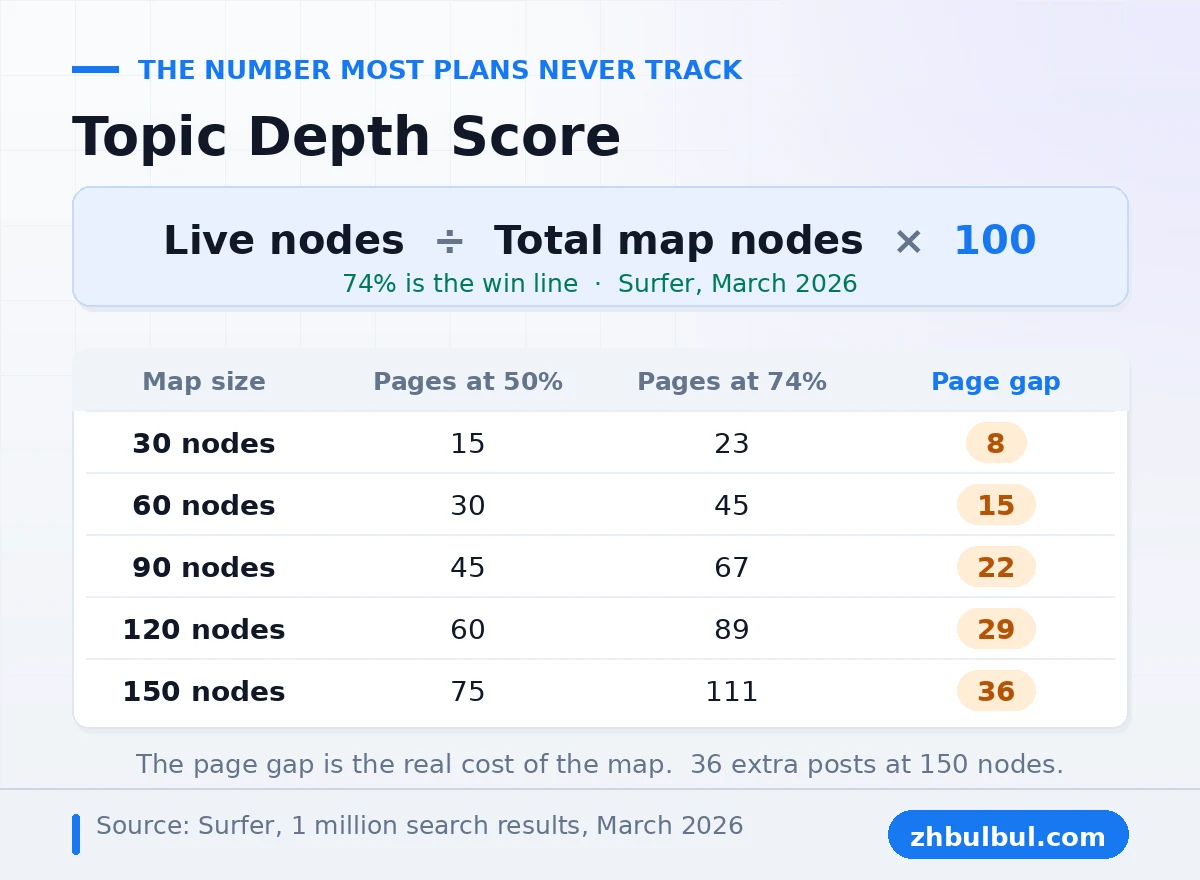
| Map size | Pages at 50 percent | Pages at 74 percent | Page gap |
| 30 nodes | 15 | 23 | 8 |
| 60 nodes | 30 | 45 | 15 |
| 90 nodes | 45 | 67 | 22 |
| 120 nodes | 60 | 89 | 29 |
| 150 nodes | 75 | 111 | 36 |
The gap column is the real cost of a map. A 150 node map wants 36 more posts than a half done plan. That count belongs in the spend talk on day one.
What separates a topical map from a keyword list?
A topical map and a keyword list split on seven points. The units differ. The order and the output differ too. One shapes a site. The other fills a queue.
The map also lives through a tool change. Nodes stay true when volume data shifts. A keyword list dies the moment its volume column goes stale.
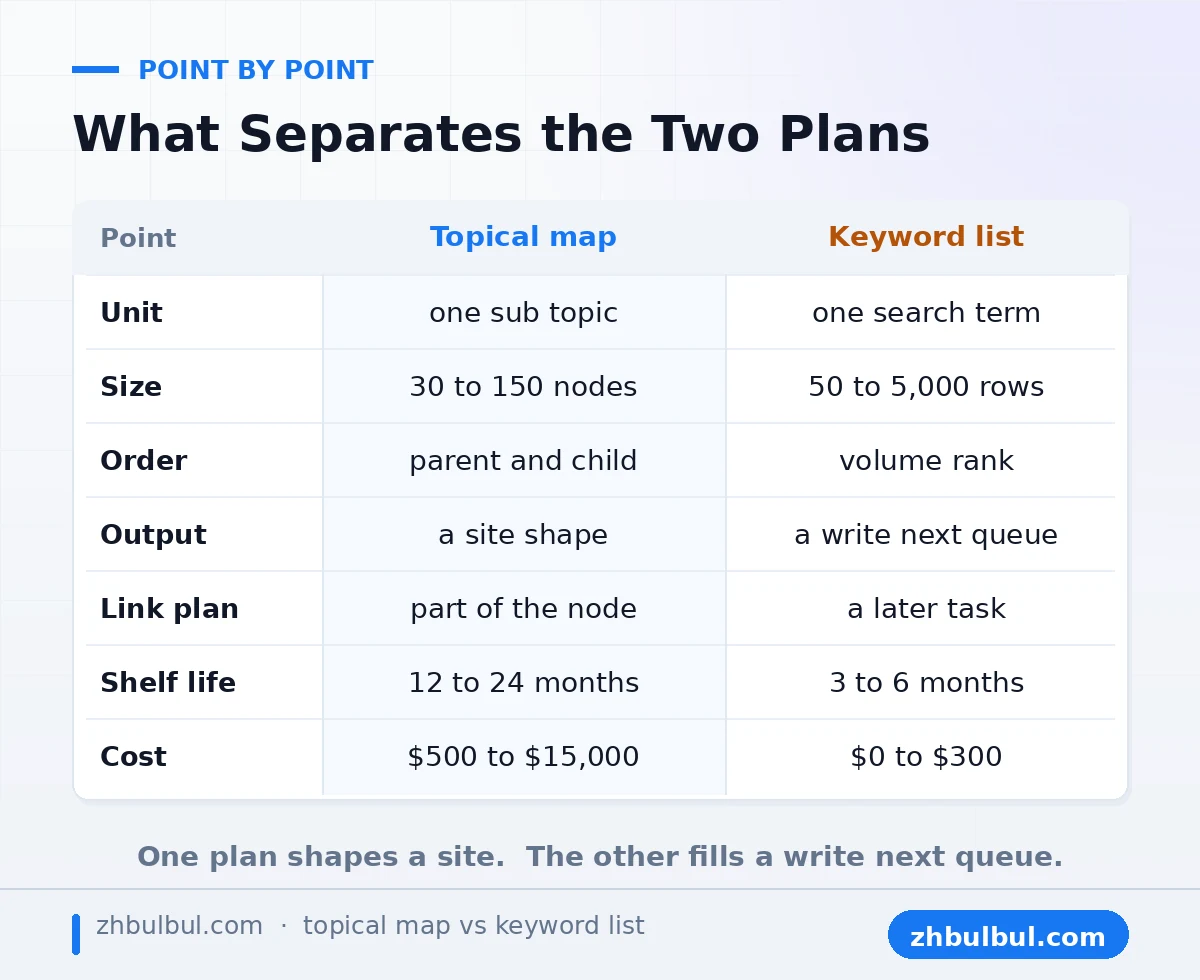
| Point | Topical map | Keyword list |
| Unit | one sub topic | one search term |
| Size | 30 to 150 nodes | 50 to 5,000 rows |
| Order | parent and child | volume rank |
| Output | a site shape | a write next queue |
| Link plan | part of the node | a later task |
| Shelf life | 12 to 24 months | 3 to 6 months |
| Cost | 500 to 15,000 dollars | 0 to 300 dollars |
The cost row explains the debate. A keyword list runs near free. A topical map is a real line item. Teams pick the list on price. Then they blame the writer for flat clicks.
When does a keyword list beat a topical map?
A keyword list beats a topical map in five cases. New sites, small budgets and wide niches all favour the list. Fixed client briefs and test phases do too. Most guides on this topic sell the map. Five real cases still favour the plain list.
A keyword list also fits a team below 1,000 dollars a quarter. A map with 45 pages costs more than that in writer fees.
The five cases where a keyword list wins are listed below.
- Site Age: site age below 3 months leaves too little crawl past.
- Spend Cap: spend cap below 1,000 dollars buys 4 posts, not a map.
- Field Count: field count above 3 splits depth and breaks the math.
- Client Work: client work with a fixed brief pays per post, not per plan.
- Test Phase: test phase on a new offer wants 5 fast posts.
A map still wins the long run in each case. Small sites face this call first. Read is SEO worth it for that math. The point is the order. Run the list first. Learn the field. Then draw the map from what the data taught you.
How do you turn a keyword list into a topical map?
A keyword list turns into a topical map in six steps. Group the terms, name the parents and fill the gaps. Then cut the twins, order the build and set the links. Total time runs 8 to 20 hours for a 60 node map.
A keyword list also gives you a head start here. Terms in the sheet turn to nodes. The work left is the shape. The hard research is over.
The six steps that turn a keyword list into a topical map are listed below.
- Term Group: term group sorts each row into 6 to 12 buckets by intent.
- Parent Name: parent name gives each bucket one grouper node.
- Gap Fill: gap fill adds the sub topics the tool never surfaced.
- Twin Cut: twin cut merges rows that answer one query.
- Build Order: build order ranks nodes by cash first and volume second.
- Link Set: link set writes the parent, child and sibling links per node.
Step 3 does the heavy lift. Keyword tools surface terms with search volume. A field holds hundreds of sub topics at near zero volume. Those quiet nodes carry fact depth. AI search rewards fact depth. Gap fill adds close to 30 percent of a full map.
A done for you topical map service ships the full plan for your niche.
What does a topical map cost in 2026?
A topical map costs 0 dollars to 15,000 dollars. TopicalMap.com quotes 500 to 2,500 dollars for a freelance pro. The same vendor quotes 2,500 to 15,000 dollars for an agency. Upkeep runs 10 to 30 percent of build cost each year.
The map also holds a hidden cost after the build. Each node still wants a post. Each node wants a brief and an edit pass. The map is the cheap part.
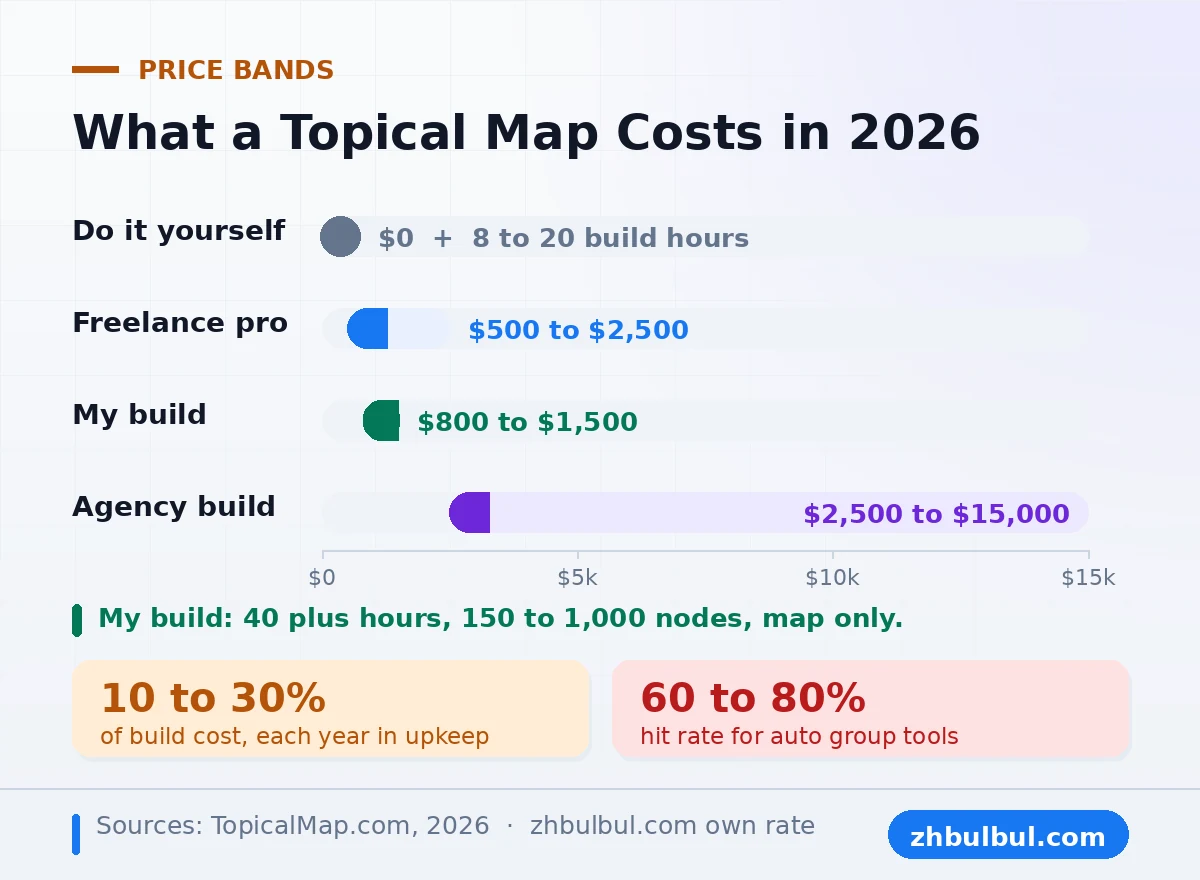
| Build route | Price band | Source of the figure |
| Do it yourself | 0 dollars plus 8 to 20 hours | own time |
| Freelance pro | $500 to $2,500 | TopicalMap.com |
| My own build | $800 to $1,500 | zhbulbul.com |
| Agency build | $2,500 to $15,000 | TopicalMap.com |
| Yearly upkeep | 10 to 30 percent of build | TopicalMap.com |
| Auto group tool | 60 to 80 percent right | TopicalMap.com |
My own price band runs 800 to 1,500 dollars for one map. One build takes me 40 hours or more. Divide those two numbers and the rate lands near 20 to 37 dollars an hour. The price sits inside the freelance band above. The map size does not.
My maps also run 150 to 1,000 nodes and past it. A 1,000 node map asks for 740 live pages at 74 percent depth. Count a build that size in years. What I hand over is the map itself. Every node carries its parent and its child. I price briefs and a publish calendar apart.
The hit rate row matters more than the price rows. Auto group tools land 60 to 80 percent right. A 60 node map from a tool holds 12 to 24 wrong nodes. Human review is not optional at that error rate.
How long does a topical map take to work?
A topical map takes 4 to 12 months to move real clicks. Oncrawl ran a case study in 2021. One site turned the corner in 145 days. Interingilizce.com grew from 10,000 clicks to 200,000 clicks.
The map also pays nothing in month one. Depth rises only as pages go live. A map with 8 live nodes out of 60 sits at 13 percent. Depth that low sits far off the 74 percent line.
Thruuu ran a topic group case study in 2023. The site moved from near zero to 30 clicks per day. That headline reads as 100x. The true story is a small base with real growth. An honest read of the math saves you from a bad forecast.
What risks come with a topical map?
A topical map holds three risks. Node clash, thin pages and a stalled build all sink the plan. TopicalMap.com found 150 topics that clash in 373 groups. Clash at that rate wastes 40 percent of a spend.
The map also fails when the build stops halfway. A half built map ranks worse than a tight 10 post list. Depth below the 74 percent line earns no credit. The spend still leaves your account.
The three main risks of a topical map are listed below.
- Node Clash: node clash sends two pages at one query, which splits rank.
- Thin Page: thin page fills a node with 400 words and no fact.
- Stall Risk: stall risk hits any map past 60 nodes on a thin spend.
Each risk has one fix. Node clash dies at the twin cut step. Thin pages die at the brief stage. Stall risk dies when you size the map to the cash you hold.
How does a topical map win cites in AI search?
A topical map wins AI cites on fact depth. Surfer checked 57,000 URLs in March 2026. Pages cited in AI Overviews held 31 percent fact depth. Pages left out held 24 percent. The gap is 7 points of raw fact density.
The map also feeds the query fan out that AI search runs. Surfer reports a 161 percent lift in cite odds. The lift lands on one kind of site. That site ranks for the main query and its fan out sub queries. A map builds those sub query pages on purpose. A list hits them by luck.
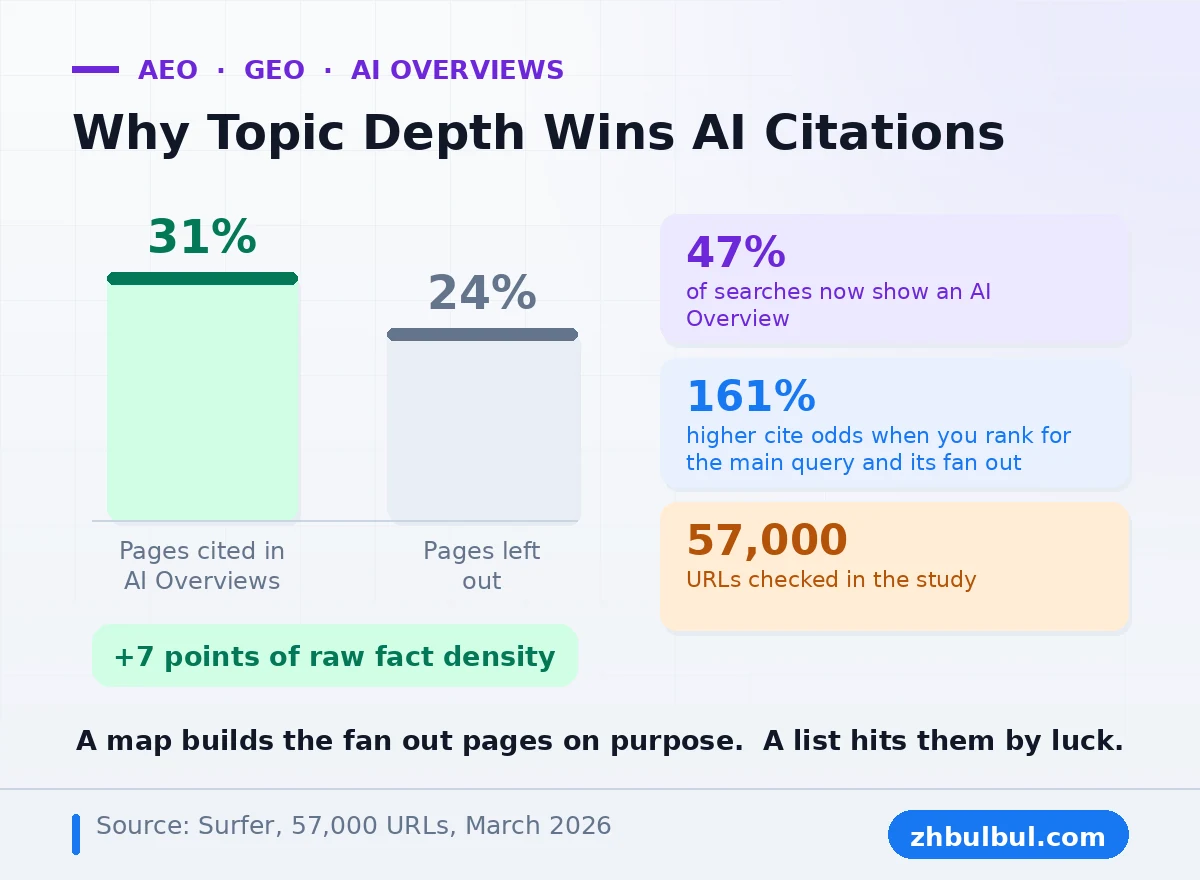
Surfer found AI Overviews on 47 percent of the searches it checked. Half of all search now runs through a layer that reads a full site. Depth across nodes is the input that layer scores. The same logic drives the pillars of SEO strategy.
Answer Engine Optimization and Generative Engine Optimization rest on this rule. Both ask one question. Does the site hold the facts for the full question tree? Or just the top query?
Which tools build a topical map?
Four tool types build a topical map. Keyword tools, group tools, crawl tools and a plain sheet each cover part of the job. No one tool does the full build. Human review closes the gap each time.
The map also lives fine in Google Sheets. The tool matters less than the node grid. The six fields in each node matter most.
The four tool types for a topical map are listed below.
- Keyword Tool: keyword tool supplies the seed terms and their volume.
- Group Tool: group tool sorts terms by shared SERPs at a 60 to 80 percent hit rate.
- Crawl Tool: crawl tool audits your live pages against the map.
- Plain Sheet: plain sheet holds the node grid, the status and the links.
Surfer polled SEO pros in July 2025 and found the real block. 76 percent name the content workflow as their top problem. Research came second. A map fixes the workflow. Each node ships with its own brief. Most SEO copywriting services charge extra for that brief.
What changes for topical maps in the next 12 months?
Three shifts hit topical maps through 2027. AI Overview share rises. Cite fights tighten, and cheap volume terms lose worth. Surfer measured AI Overviews on 47 percent of searches in March 2026. That share climbs each quarter.
The map also gains worth as link costs rise. Surfer cites an AuthorityHacker poll of 755 link buyers. Costs run up to 83 dollars per link. Topic depth is the one rank input you buy once. Then you keep it.
Volume based picks lose ground fastest. Zero volume sub topics carry the facts that AI answers pull from. A keyword list filters those rows out by design. The volume column reads zero. That filter is the largest gap between the two plans.
What should you do after you pick your content plan?
Pick the plan that fits your spend today. Then build in order. A map with 60 nodes wants 45 live pages and 8 to 20 build hours. Start with 10 posts from the core. Check depth each 90 days.
The map also wants a hire plan behind it. Read the questions to ask an SEO content writer first. Never hand 45 briefs to a stranger. The nine answers below cover the rest of the build.
How many topics go in the first map?
Start with 30 to 60 nodes. A 30 node map crosses the 74 percent line at 23 live pages. That target stays in reach in two quarters. Two posts per week gets you there. Maps past 100 nodes stall most small teams.
Which topic do you write first?
Write the core node closest to the cash first. Core nodes carry buyer intent. Core nodes pay back in 90 days. Outer nodes pull more clicks. Outer nodes pay back in 6 to 12 months. Order by revenue. Then order by volume.
Do you still track keywords after the map?
Yes. A topical map holds a keyword list in it. Each node holds one target term and its volume. The map adds the parent, the child and the link plan. Drop the terms and you lose your rank tracker.
How often do you update a topical map?
Update the map each 90 days. TopicalMap.com puts yearly upkeep at 10 to 30 percent of build cost. A 90 day cycle catches new sub topics and dead nodes early. Full rebuilds run each 18 to 24 months.
Can a small site win with a topical map?
Yes. A small site wins faster with a narrow map. A 30 node map in one tight field wins. A 150 node map over four fields loses. Depth in one field is the point. Small sites hold an edge here. Focus costs them nothing.
What word count fits each map entry?
Match word count to the node, not to a house rule. Core nodes with buyer intent run 1,200 to 2,000 words. Outer nodes that answer a broad question run 2,500 to 4,000 words. Thin nodes below 800 words drag the group score.
Do you need new pages for each node?
No. Merge any two nodes that answer one query. TopicalMap.com found 150 topics that clash in 373 groups. Merge work at the plan stage costs an hour. The same merge after publish costs a redirect. It also costs rank.
How do you brief a writer from the map?
Copy the six node fields to the brief. The fields are the term, the intent and the parent node. The last three are the word range, the link plan and the source list. A full node makes a brief in 10 minutes. That speed is the quiet payoff of a map.
What proves the map works?
Track three numbers each 90 days. The numbers are depth percent, cited pages in AI Overviews and clicks per live node. Depth rises as you publish. Clicks per node rise past the 74 percent line. Not before. Read both together. Bring the data to your SEO consultant. Or run it against the SEO service checklist yourself.

