
What are the three ways to hire a content writer?
Three routes cover the whole market. A solo pro bills per word or per hour. A shop bills a flat sum each month. A staff hire draws pay plus perks. Each route trades cash for speed and grip.
Route choice sets your cost floor for a year. Route choice also sets your start date.
Hire routes split on one axis. Some routes hold fixed cost. Some do not.
The three hire routes are listed below.
- Solo Pro: the solo pro takes work per post with no fixed cost.
- Content Shop: the content shop takes a set fee each month for a set count of posts.
- Staff Hire: the staff hire takes pay and the load that rides with it.
A guide on how to hire an SEO content writer walks the vet steps once you pick a route.
What does each route cost per article?
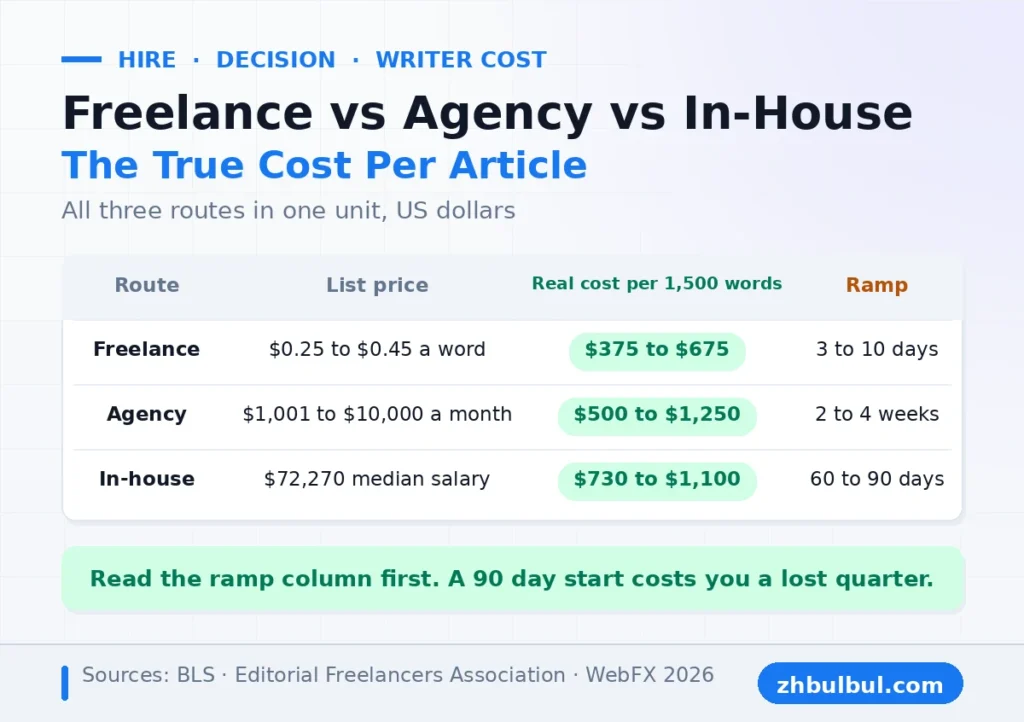
Put all three in one unit. A solo pro runs 375 to 675 per 1,500 word post. A shop runs 500 to 1,250. A staff hire runs 730 to 1,100 once you load the pay. All sums here are US dollars.
Rates here come from named 2025 and 2026 wage data. Each row names its source in the next few sections.
Cost per post lines the three routes up fair. The list price does not.
| Route | List price | Real cost per 1,500 word post | Ramp |
|---|---|---|---|
| Freelance | $0.25 to $0.45 per word | $375 to $675 | 3 to 10 days |
| Agency | $1,001 to $10,000 per month | $500 to $1,250 | 2 to 4 weeks |
| In-house | $72,270 median salary | $730 to $1,100 | 60 to 90 days |
Read the ramp column first. A route that starts in 90 days costs you a lost quarter.
Why does an in-house salary understate the real cost?
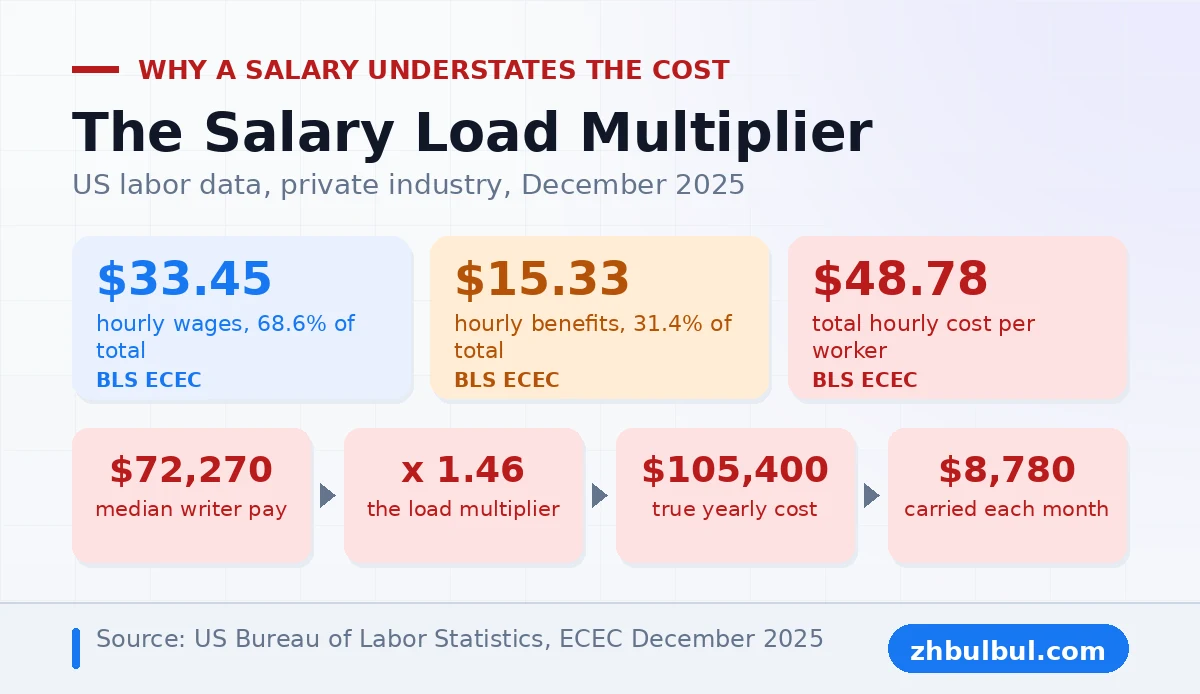
Pay is 68.6 percent of what a staff hire costs. Perks add the rest. US labor data puts total pay at 48.78 per hour. Wages make up 33.45 of that. Multiply any pay figure by 1.46.
Bureau of Labor Statistics data from December 2025 sets those shares. The report covers private work across the US.
Pay load is the line that wrecks in-house math. A 72,270 pay rate costs near 105,000 once loaded.
| Line | Hourly | Share of total |
|---|---|---|
| Wages | $33.45 | 68.6% |
| Benefits | $15.33 | 31.4% |
| Total | $48.78 | 100% |
Load the median writer pay and the sum lands near 105,400 a year. Split that over 12 months. You then carry 8,780 each month.
What does a freelance writer charge in 2026?
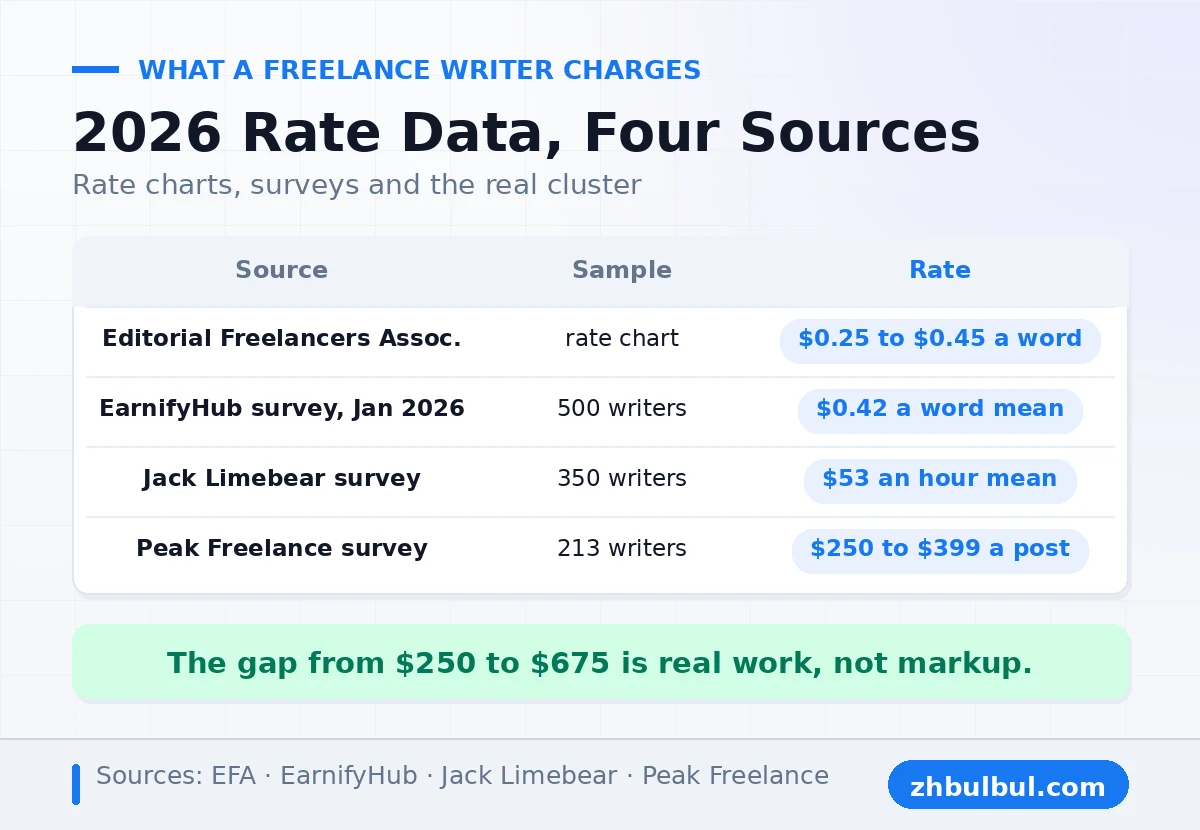
A solo pro charges 25 to 45 cents per word for blog work. The Editorial Freelancers Association lists that band for 2026. A survey of 500 writers put the mean at 42 cents. Hourly work starts near 53.
Rate charts hold the widest public band. Blog work for hire reads 25 to 45 cents per word.
Solo rates cluster tighter than the charts show. A survey of 213 writers found a top band. Most charged 250 to 399 for a 1,500 word post.
| Source | Sample | Rate |
|---|---|---|
| Editorial Freelancers Association, 2026 | rate chart | $0.25 to $0.45 per word |
| EarnifyHub survey, January 2026 | 500 writers | $0.42 per word mean |
| Jack Limebear survey | 350 writers | $53 per hour mean |
| Peak Freelance survey | 213 writers | $250 to $399 per 1,500 words |
The gap from 250 to 675 is real work, not markup. A pro who runs SERP checks and builds a brief costs more.
What does an agency retainer cost?
A shop bills a flat fee each month. A 2026 study of 350 US firms put the mean fee at 5,001 to 10,000. A poll of shops put 38 percent at 1,001 to 2,500. Hourly shop work averages 125.
Fee size tracks scope, not post count. A 2,500 fee often buys 4 posts plus a rank report.
Shop fees hold an account layer you also fund. A project lead, an editor and a plan lead all bill against your fee.
| Retainer band | Share of shops | Typical monthly output |
|---|---|---|
| $1,001 to $2,500 | 38% | 2 to 4 posts |
| $2,501 to $5,000 | common | 4 to 8 posts |
| $5,001 to $10,000 | mean band | 8 to 12 posts |
Divide the fee by the post count first. A shop at 2,500 for 4 posts prices each post at 625.
At what article count does in-house win?
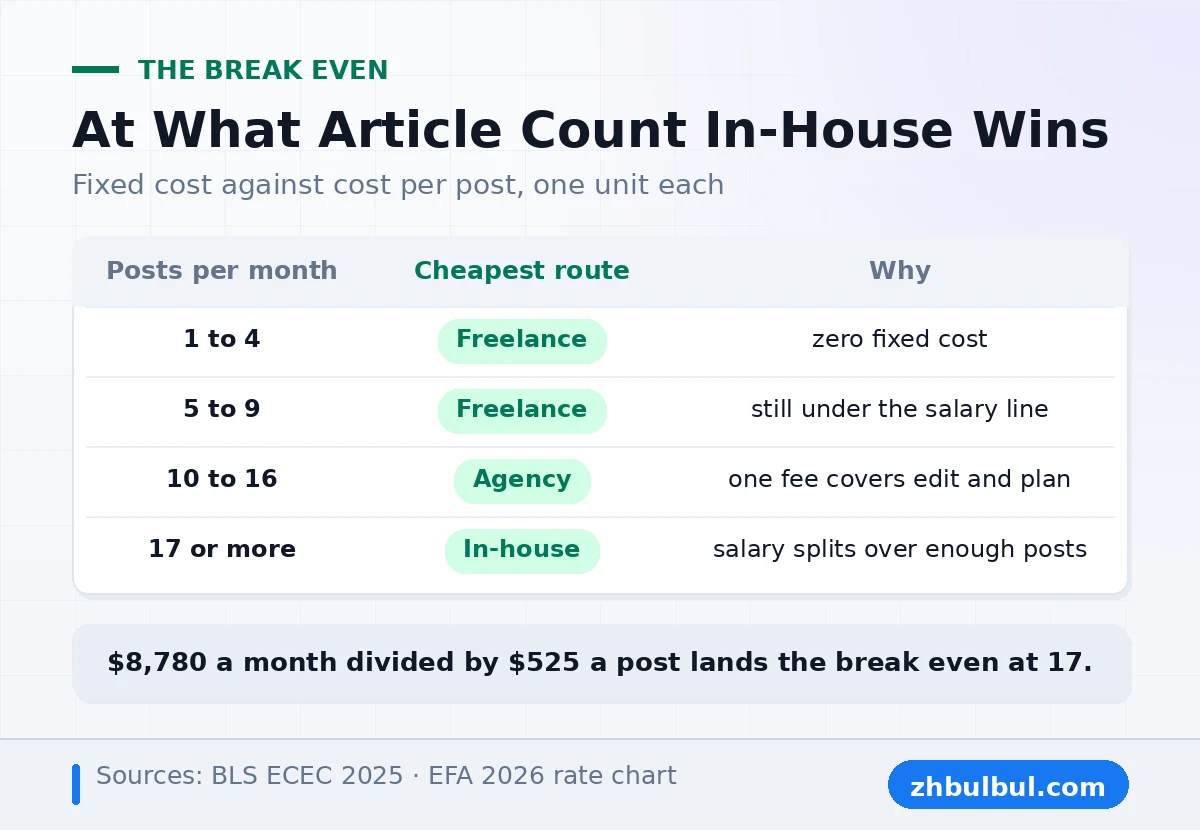
In-house wins above 17 posts a month. A loaded staff hire costs 8,780 a month. A solo pro at 35 cents per word costs 525 per post. Divide one by the other. The break even lands at 17.
Break even math needs both sides in one unit. Fixed cost sits on one side. Per post cost sits on the other.
Post count is the whole case for a staff hire. Below the break even, a staff hire idles on your payroll.
| Posts per month | Cheapest route | Why |
|---|---|---|
| 1 to 4 | Freelance | zero fixed cost |
| 5 to 9 | Freelance | still under the salary line |
| 10 to 16 | Agency | one fee covers edit and plan |
| 17 or more | In-house | salary splits over enough posts |
Few small firms ship 17 posts a month. A plan from how long content marketing takes leads runs 4 posts a month for a year.
How fast can each route start?
A solo pro starts in 3 to 10 days. A shop starts in 2 to 4 weeks. A staff hire starts in 60 to 90 days. Speed counts because rank clocks run from your first live page.
Hire time is a cost most plans skip. 90 lost days push your first lead one full quarter out.
Ramp time also differs from start time. A staff hire needs a month more to learn your trade.
The three ramp gates are listed below.
- Search Gate: the search gate is the time to find and vet a pro.
- Start Gate: the start gate is the time from yes to first draft.
- Fit Gate: the fit gate is the time until drafts need light edits only.
A SEO content writing hire clears all three gates fast when the brief is ready first.
What does each route give you beyond words?
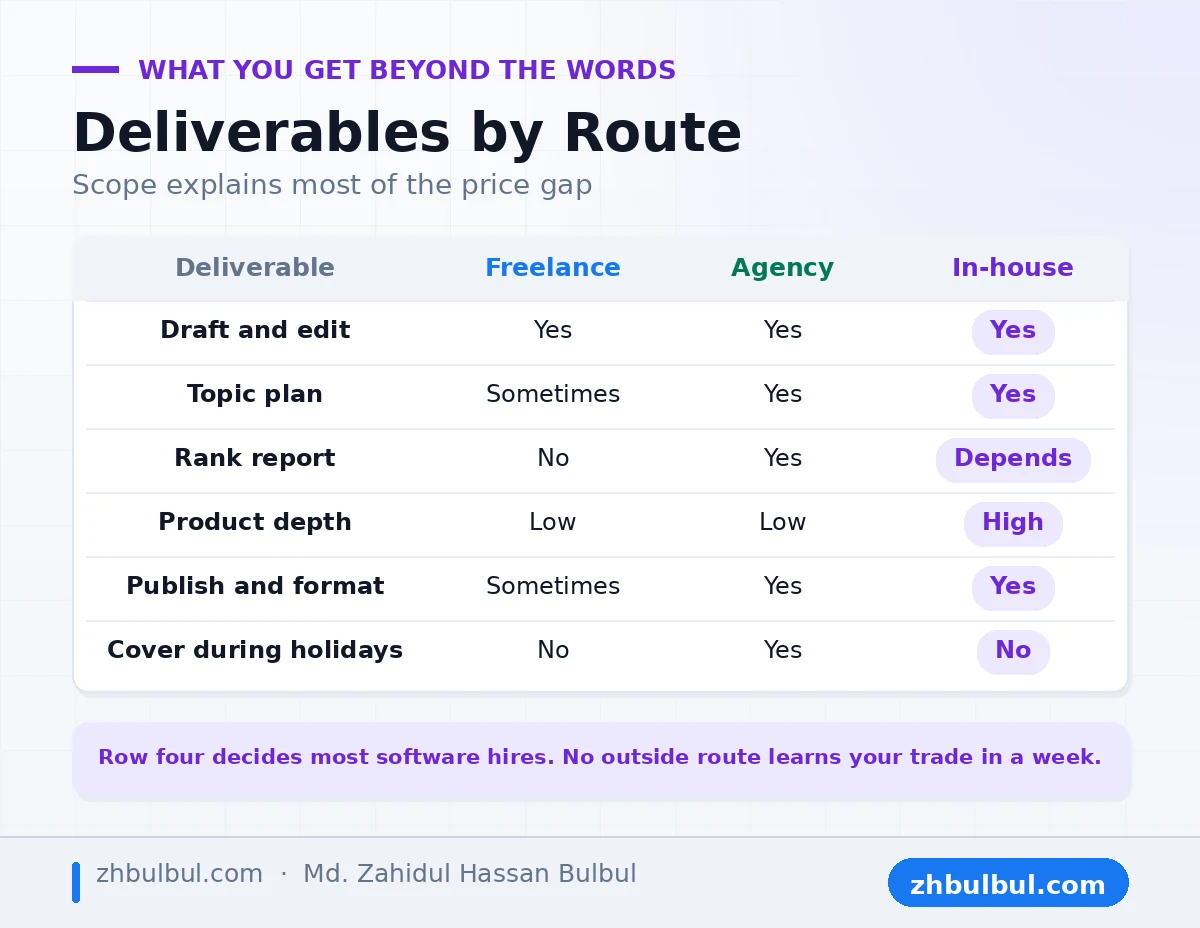
Words are the cheap part. A solo pro gives you words plus a key word pick. A shop gives you a plan, an editor and a report. A staff hire gives you trade depth no one else can match.
Scope explains most of the price gap. A 375 post and a 1,250 post do not cover the same work.
Extras hold real value in some months and none in others. A firm with a plan lead on staff funds the shop layer twice.
| Deliverable | Freelance | Agency | In-house |
|---|---|---|---|
| Draft and edit | Yes | Yes | Yes |
| Topic plan | Sometimes | Yes | Yes |
| Rank report | No | Yes | Depends |
| Product depth | Low | Low | High |
| Publish and format | Sometimes | Yes | Yes |
| Cover during holidays | No | Yes | No |
Row four decides most software hires. A best SEO copywriting services shortlist still cannot learn your trade in a week.
Which route fits your monthly article count?
Match the route to post count, not to budget mood. Run 1 to 4 posts with a solo pro. Run 5 to 16 posts with a shop. Run 17 or more with staff plus one solo pro for spill.
Count bands beat gut calls on this question. Each band has one route that wins on cost. Each band has one that wins on speed.
Mixed routes work better than most owners expect. Firms often keep one staff editor and three solo pros.
The four count bands are listed below.
- Test Band: the test band runs 1 to 4 posts a month with one solo pro.
- Build Band: the build band runs 5 to 9 posts with two solo pros.
- Scale Band: the scale band runs 10 to 16 posts with a shop.
- Engine Band: the engine band runs 17 or more posts with staff.
Ask any shortlist the questions to ask an SEO content writer before the band picks itself.
What breaks each route most often?
Each route fails in its own way. Solo pros vanish. Shops swap your top writer for a green one. Staff burn out on one theme. Plan for the fail mode you can live with. Guards cost less than a restart.
Fail modes repeat across firms and years. Each one has a cheap guard you set at the start.
Risk sits in its own place per route. The table below pairs each break with a guard.
| Route | Main break | Guard |
|---|---|---|
| Freelance | writer goes quiet | keep 2 writers warm |
| Freelance | rate jumps at renewal | lock a 6 month rate |
| Agency | senior swapped for junior | name the writer in the contract |
| Agency | output drops in month 4 | tie fee to shipped posts |
| In-house | one person owns all knowledge | write the brief system down |
| In-house | burnout on one theme | rotate themes each quarter |
Row three costs firms the most cash. A shop that pitches with a top writer often staffs a green one.
My SEO pricing page shows the freelance route in full detail.
What do you settle before you sign with any route?
Settle six things before any contract. Fix the post count, the word count, and the cost per post. Fix the rights, the edit rounds, and the exit terms. Those six stop each common fight.
Each answer below is short on purpose. Put all six on one page. Send that page with the offer.
Deal terms hold better in writing than in a call. The five asks below cover the ones that cause fights later.
Can one route cover everything?
No route covers all of it at a small firm. A solo pro seldom runs plans. A shop seldom learns your trade. Staff seldom cover peak months. Mix two routes and the gaps close.
Mixed hires cost less than one full stack route. A staff editor plus two solo pros beats a mid tier shop. That mix wins on cost and on depth.
Does a cheap rate ever pay off?
A 5 cent per word rate costs more than it saves. Cheap drafts need a full rewrite. Rewrite time from a staff editor runs 44 an hour. Three hours of that wipes the gain. The math turns against you fast.
Cheap rates also skip source work. A draft with no named source fails the first fact check.
What happens when your writer quits?
A solo pro exit costs you 2 to 4 weeks. A staff exit costs you 60 to 90 days and a rehire. A shop exit costs one notice term. Keep a live brief system to cut all three.
Brief systems hold the knowledge that walks out the door. A pro who reads your brief ships a fit draft in week one.
Do you own the work in each route?
Ownership rests on the words in the contract. Work for hire terms hand you full rights. A licence hands you use only. Staff work belongs to the firm by default in the US.
Rights terms cost nothing to fix before you sign. The same fix costs a lawyer fee after.
Which route scales fastest?
A shop scales fastest from 4 to 12 posts a month. Solo pros scale next, one hire at a time. Staff scales slowest, since each hire runs 60 to 90 days. Speed and cost pull against each other.
Scale plans fail when the count jumps ahead of the brief system. Read earn money writing online for the writer side of this market.

