
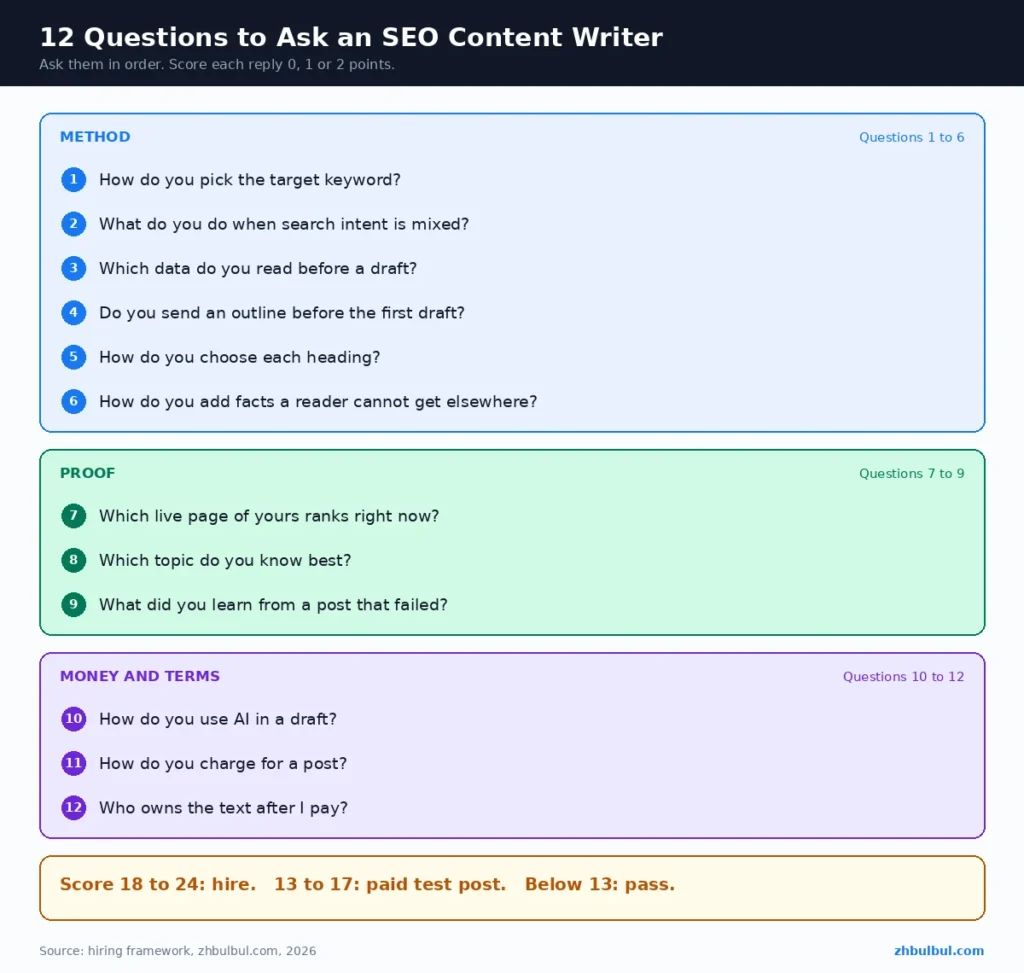
The 12 questions to ask an SEO content writer test method, proof and terms. They show you what a price quote hides. An SEO content writer sets the cap on what your site can rank for. A quote never shows that cap. Twelve plain questions show it in one call.
The 12 questions are split into three blocks. Questions 1 to 6 test method. Questions 7 to 9 test proof. Questions 10 to 12 test money and rights. Together, the three blocks give you a score you can act on.
An SEO content writer works in a crowded market. Elna Cain’s 2025 survey found 84% of firms now outsource content. Upwork data shows 78% of CEOs rate top freelancers as equal to or better than full time staff. The pool is huge. The skill gap inside it is wider.
The hire guide below holds more than a list of questions. You get the strong reply for each question. You get the weak reply that should end the call. You get a 24 point score card and 2026 US pay data. Most guides stop at the list. This one does not.
What are the 12 questions to ask an SEO content writer?
The 12 questions cover keyword choice, search intent, data and outlines. They also cover headings, info gain, live proof and topic depth. The last four cover failure, AI use, price and rights. Each question points at one part of the craft. Weak craft shows up in the reply in ten seconds.
The 12 questions are listed below.
- Keyword Choice: Keyword choice asks how the writer picks one target term and proves demand for it.
- Search Intent: Search intent asks what the writer does when the top ten hold mixed page types.
- Data Input: Data input asks which numbers the writer reads before a draft.
- Outline First: Outline first asks whether the writer sends a plan before the draft.
- Heading Source: Heading source asks where each H2 comes from.
- Info Gain: Info gain asks how the writer adds facts the top ten lack.
- Live Proof: Live proof asks which page the writer ranks right now.
- Topic Depth: Topic depth asks which field the writer knows best.
- Failed Post: Failed post asks what the writer learned when a page flopped.
- AI Use: AI use asks where a tool helps and where a human must own the text.
- Price Model: Price model asks how the writer charges and what the number covers.
- Text Rights: Text rights asks who owns the words after you pay.
The table below maps each question to the trait it tests.
| # | Question | What it tests |
| 1 | How does the writer pick the target keyword? | Method |
| 2 | What does the writer do when search intent is mixed? | Method |
| 3 | Which data does the writer read before a draft? | Method |
| 4 | Does the writer send an outline before the first draft? | Method |
| 5 | How does the writer choose each heading? | Method |
| 6 | How does the writer add facts a reader cannot get elsewhere? | Method |
| 7 | Which live page does the writer rank right now? | Proof |
| 8 | Which topic does the writer know best? | Proof |
| 9 | What did the writer learn from a post that failed? | Proof |
| 10 | How does the writer use AI in a draft? | Terms |
| 11 | How does the writer charge for a post? | Terms |
| 12 | Who owns the text after you pay? | Terms |
Why are the right questions important before you hire?
The right questions cut hire risk because they test method, not talk. A warm call proves nothing. Method drives rank.
An SEO content writer can hold a clean site, a fast reply rate and a kind tone. They can still fail to rank one page. Deadlines break most deals. Jack Limebear’s 2025 survey of 350 writers found 35.4% name harsh deadlines as their top reason to turn down work. You screen out that clash when you probe process first.
The reasons the right questions matter are listed below.
- Risk Cut: Risk cut moves the test from charm to craft, so a smooth call cannot mask thin skill.
- Cost Guard: Cost guard catches a wrong fit in one hour, not after four paid posts.
- Speed Gain: Speed gain shows you in minutes whether the writer needs training or none.
- Fit Check: Fit check matches the writer’s field, pace and price to your own plan.
How does the writer pick the target keyword?
A strong writer picks one keyword per page and proves demand for it first. The writer should name a data source. Ahrefs, Semrush and Google Search Console all work.
Keyword choice counts less for the tool and more for the rule. One page owns one main term. Two pages must never chase the same term.
Strong: “I check volume first. Then I open the top ten. If two of the top five are shop pages, I tell you a blog post cannot win that term.”
Weak: “I write around your topic and the keywords come out on their own.”
Rank starts at term choice. A great draft on the wrong term still loses. This one question kills more bad hires than the other eleven. A topical map beats a flat keyword list at this step.
What does the writer do when search intent is mixed?
A strong writer reads the top ten and copies the page format Google ranks now. Search intent shows up in page format, not in the words of the term.
Search intent turns a term into a page type. A term with three guides and seven shop pages is a shop term. A blog post there will not rank.
Strong: “I sort the top ten by page type. If the split is even, I build a mixed page. If it leans to shops, I move the term to a service page.”
Weak: “Intent is just what the user wants. I write for the user.”
Mixed intent traps small sites. Google picked the format long ago. Your writer must read that choice, not fight it.
Which data does the writer read before a draft?
A strong writer reads the live SERP, the People Also Ask box and your Google Search Console. Search Console counts most, and few writers ask for it.
Google Search Console shows terms you never chose. Those terms show what Google thinks your site is about.
Strong: “Send me Search Console for the last 6 months. I want terms with impressions and no clicks. Those are the fast wins.”
Weak: “I just need the keyword and the word count.”
A writer who skips your data cannot see your gaps. They hand you a page Google ranks for someone else.
Does the writer send an outline before the first draft?
Yes. A strong writer sends an outline first and waits for your green light. The outline is where you catch faults for free.
An outline costs one email to fix. A draft costs a full rewrite. A wrong angle is cheap at plan stage and dear at draft stage.
Strong: “You get the H1, each H2, each H3 and the word target per block. I do not start the draft until you sign off.”
Weak: “I send the finished piece. Then you tell me what to change.”
A sample outline settles this on the call. A real writer has one on hand. It shows their thought process better than any live post.
How does the writer choose each heading?
A strong writer builds each heading from a real search, not from a guess. Headings do two jobs at once.
A heading tells Google what each block covers. It also feeds AI answer boxes. Those boxes pull short blocks that match a question. So a heading that reads as a real question wins both jobs.
Strong: “Each H2 comes from People Also Ask, a related search, or a term in your Search Console. I do not invent a heading.”
Weak: “I use catchy subheads to hold the reader.”
Heading source is easy to test live. Pick one heading from their sample post and ask where the phrase came from. A strong writer names the source at once. Heading choice sits inside the 4 pillars of SEO strategy.
How does the writer add facts a reader cannot get elsewhere?
A strong writer names the source of new value before they write a word. Info gain means your page holds facts the top ten lack.
Info gain earns the rank. Google rewards the gap, not the summary. Fresh data counts. A real test counts. So does a client number.
Strong: “I pull three stats with named sources and dates. I add one thing you own: a client result, a screen shot or a price table.”
Weak: “I read the top five and write a better version.”
A rewrite of the top five gives Google no reason to rank you above the top five. New value is the whole game.
Which live page does the writer rank right now?
A strong writer names a live URL and a term where that URL sits on page one. Proof beats claims.
A live URL plus a term lets you check the claim in thirty seconds. Any writer can show a slick PDF. Few can name a page.
Strong: “This URL ranks third for that term in the US. Type it in and check.”
Weak: “All my work is under NDA. I cannot share URLs.”
NDAs are real, and they are the most common excuse in the trade. A writer with five years of work has one page they can name. Zero named pages is a hard stop. The same proof rule applies when you choose an SEO consultant.
Which topic does the writer know best?
A strong writer names one narrow field, not five broad ones. Topic depth beats topic range.
Topic depth builds a term bank. A writer with 40 posts in one field knows the terms, the sources and the reader questions.
Strong: “B2B SaaS tools. I have 60 posts in that field since 2022.”
Weak: “I write in any niche. Health, finance, tech, travel, crypto.”
Field match helps where you can get it. Where you cannot, ask how long they need to learn your field. A good reply runs two to four weeks of paid study, not zero.
What did the writer learn from a post that failed?
A strong writer names a real flop and the cause behind it. Each writer with real years has posts that never ranked.
A flop is normal. The lesson is the signal. How a writer reads their own loss tells you how they will read yours.
Strong: “I wrote a 3,000 word guide on a term where Google only ranks tools. It never broke the top 50. Now I check page format before I quote.”
Weak: “All my posts rank well.”
A writer with no flops has no history or no honesty. Both cost you money. This question shows how they think when work goes wrong.
How does the writer use AI in a draft?
A strong writer states where AI helps and where a human must own the text. Google does not ban AI text.
Google’s spam policy targets content built to game rank, whatever the tool. So the honest reply is a workflow reply, not a yes or a no.
Strong: “I use AI for outline options and a first pass on research. I write each draft myself. I check each stat against the source. I name the source in the post.”
Weak: “I never touch AI.” Or: “AI writes it and I clean it up.”
A workflow reply shows the seams. Ask which step the tool touches and which step it never touches. A writer who cannot draw that line has not thought about it.
How does the writer charge for a post?
A strong writer quotes one number and lists what the number covers. Three price models exist in the trade.
The three price models are listed below.
- Per Word: Per word suits short posts and gives you a clean cost per page.
- Per Post: Per post suits most blog work and caps your spend up front.
- Per Hour: Per hour suits edits, audits and work with no fixed scope.
Strong: “40 cents per word. That covers the term pick, the outline, the draft, two edit rounds, meta title, meta description and internal link picks.”
Weak: “Around 5 to 8 cents per word, but it depends.”
Edit rounds belong in the contract. Two rounds is the norm. Zero rounds means each fix costs extra. Free rounds with no cap means the quote hides the cost. My guide on how to choose an SEO copywriting service breaks down each price model.
Who owns the text after you pay?
You own it, and a strong writer puts that line in the contract before the first bill. Rights pass in full when you pay.
Full rights are the standard term in the trade. The writer may keep a link as a sample. They must not resell the text.
Strong: “Full rights pass to you on the last bill. I keep the right to link to the live page as a sample.”
Weak: “It is my work. I license it to you.”
A license means the writer can sell the same page to a rival. Ask for one clear line in the contract. A writer who fights that line is the wrong hire.
How do you score the 12 replies?
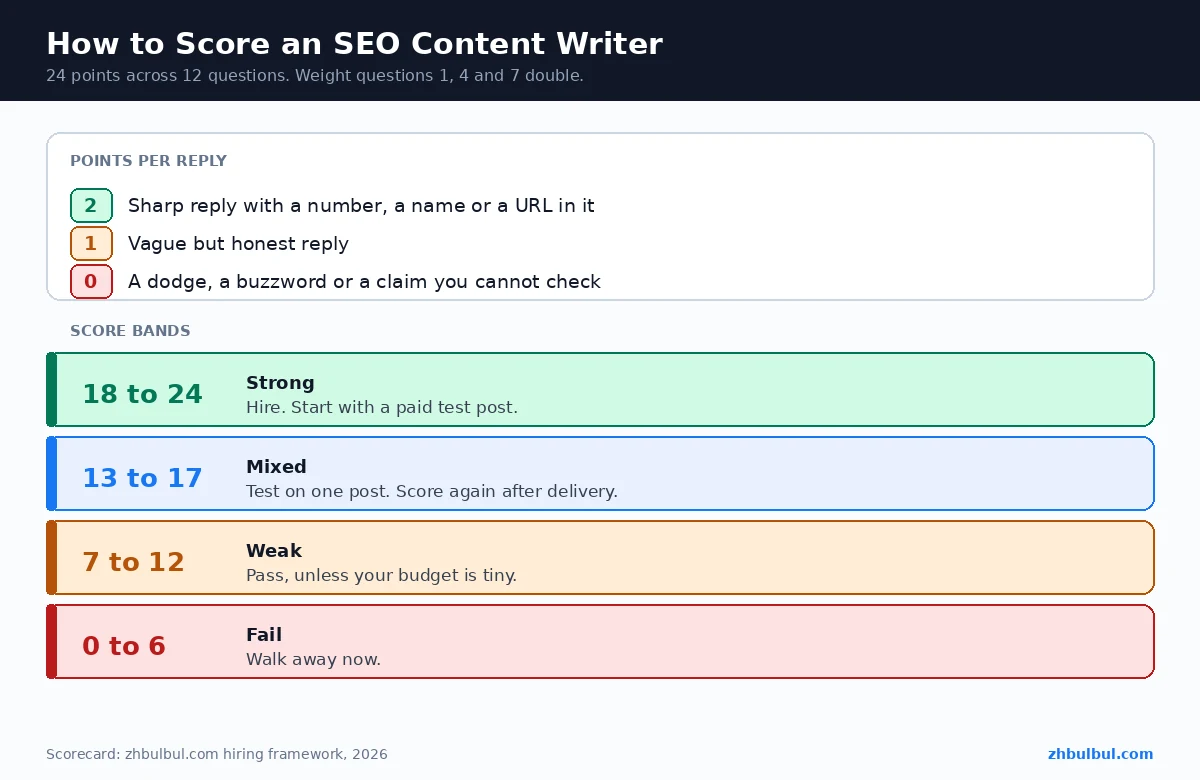
You score each reply 0, 1 or 2 points, so the scale runs from 0 to 24. The score turns a gut read into a number.
The score bands are listed below.
- Two Points: Two points go to a sharp reply with a number, a name or a URL in it.
- One Point: One point goes to a vague but honest reply.
- Zero Points: Zero points go to a dodge, a buzzword or a claim you cannot check.
| Score | Band | Action |
| 18 to 24 | Strong | Hire. Start with a paid test post. |
| 13 to 17 | Mixed | Test on one post. Score again after they deliver. |
| 7 to 12 | Weak | Pass, unless your budget is tiny and you can edit. |
| 0 to 6 | Fail | Walk away now. |
Questions 1, 4 and 7 carry double weight when you must cut the call short. Those three cover term choice, outline habit and live proof.
What do weak replies sound like?
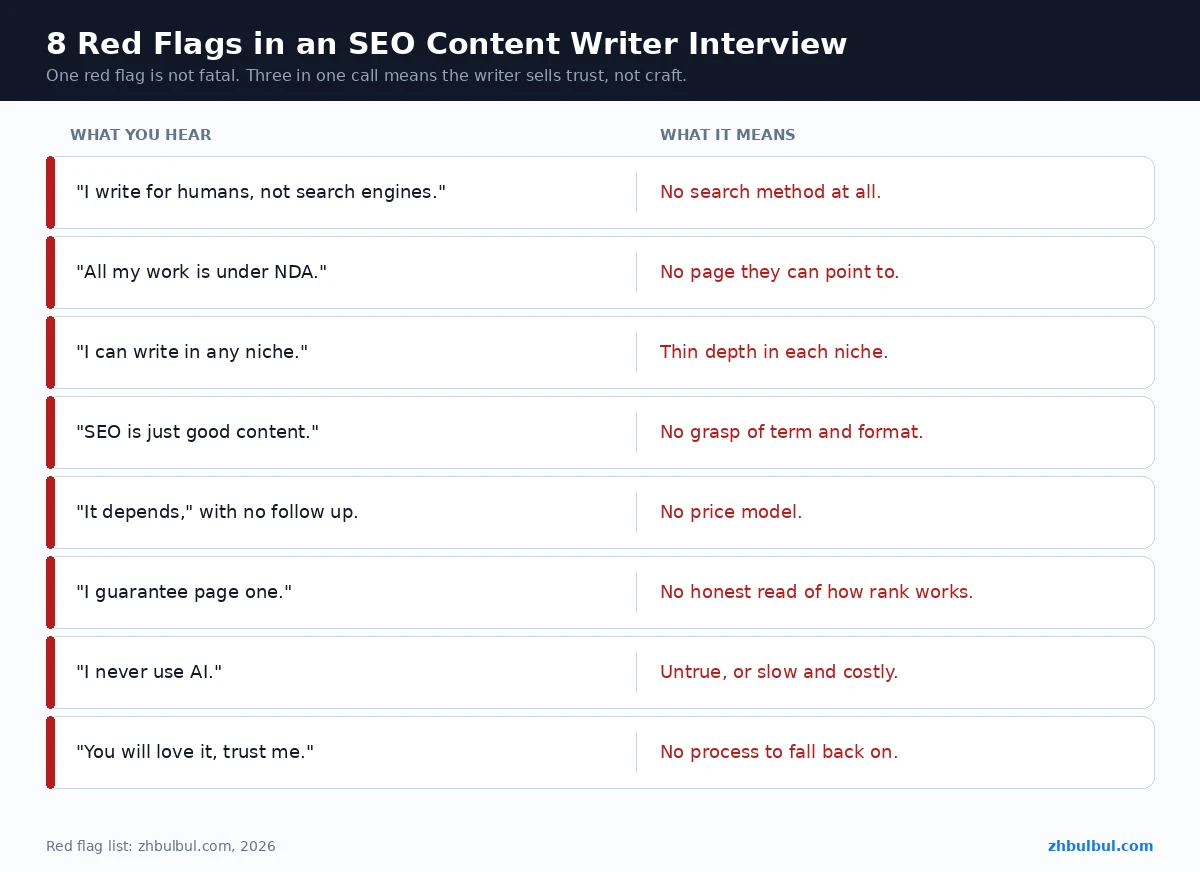
Weak replies share one trait, since they hold no number, no name and no URL. The phrase below tells you what the writer lacks.
| Red flag phrase | What it really means |
| “I write for humans, not search engines.” | No search method at all. |
| “All my work is under NDA.” | No page they can point to. |
| “I can write in any niche.” | Thin depth in each niche. |
| “SEO is just good content.” | No grasp of term and format. |
| “It depends,” with no follow up. | No price model. |
| “I guarantee page one.” | No honest read of how rank works. |
| “I never use AI.” | Untrue, or slow and costly. |
| “You will love it, trust me.” | No process to fall back on. |
One red flag is not fatal. Three red flags in one call means the writer sells trust, not craft.
How much should you pay a US SEO content writer in 2026?
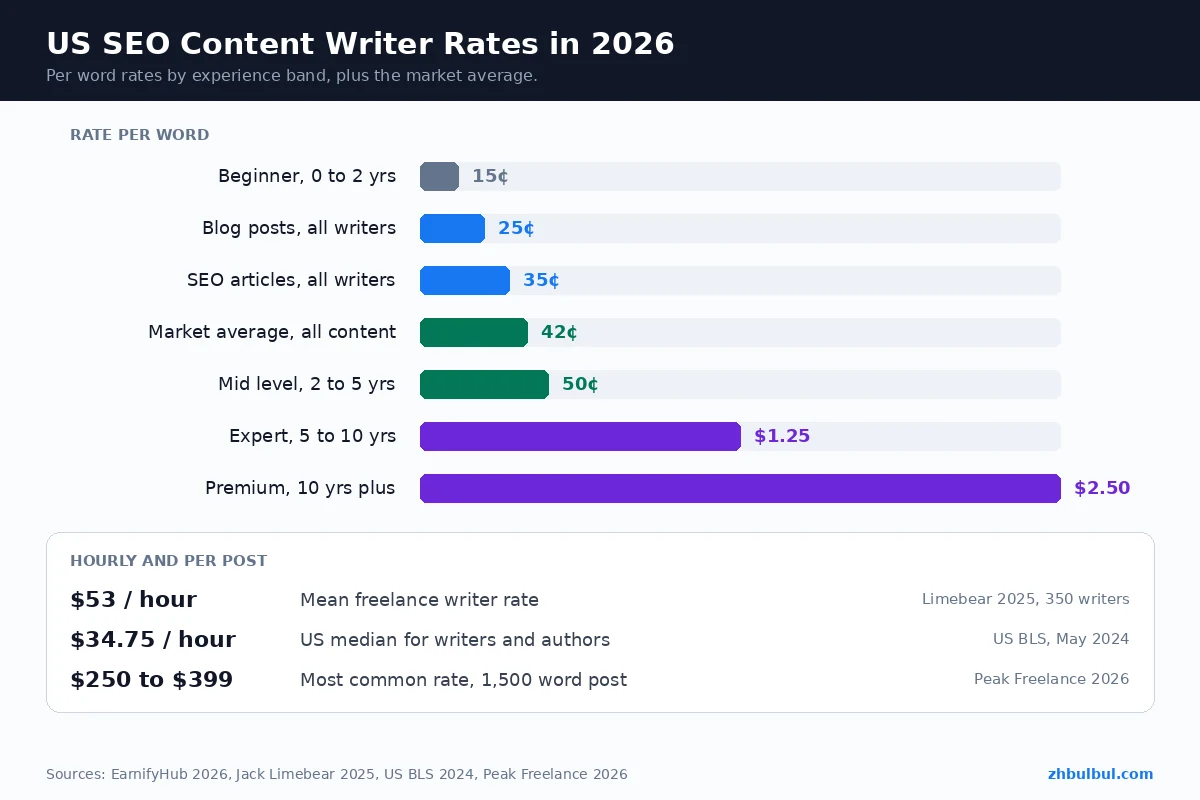
US rates sit between 25 and 50 cents per word for solid mid level work, and expert rates run past a dollar. The table below holds the 2026 numbers.
| Rate | Scope | Source |
| 42 cents per word | All content types | EarnifyHub 2026 |
| 35 cents per word | SEO articles | EarnifyHub 2026 |
| 25 cents per word | Blog posts | EarnifyHub 2026 |
| 25 to 40 cents per word | Blog posts | EFA 2026 |
| 15 cents per word | Writer with 0 to 2 years | EarnifyHub 2026 |
| 50 cents per word | Writer with 2 to 5 years | EarnifyHub 2026 |
| $1.25 per word | Writer with 5 to 10 years | EarnifyHub 2026 |
| $2.50 and up per word | Writer with 10 years plus | EarnifyHub 2026 |
| $53 per hour | Mean hourly rate | Limebear 2025 |
| $34.75 per hour | Median hourly pay | US BLS, May 2024 |
| $250 to $399 | One 1,500 word post | Peak Freelance 2026 |
Source key: EarnifyHub 2026 polled 500 freelancers and 450 writers. EFA is the Editorial Freelancers Association. Limebear 2025 polled 350 writers. Peak Freelance 2026 polled 213 writers. US BLS is the US Bureau of Labor Statistics.
Hourly bands tell the same story.
| Hourly band | Share of writers | Source |
| $25 to $49 | 34.9% | Limebear 2025 |
| $75 or more | 15.4% | Limebear 2025 |
| $100 or more | 5.1% | Limebear 2025 |
| $1,000 or more per post | 8% | Peak Freelance 2026 |
The bands above read as a floor, not a target. A 2,000 word SEO post at 35 cents per word costs 700 dollars. The same post from a new hand at 15 cents costs 300 dollars, and it often needs a rewrite. Cheap drafts cost more once you count your own edit hours.
Can a paid test post replace a long contract?
Yes. A paid test post gives you real proof at low cost, and it guards the writer too. Set the test at one post and pay the full rate.
A free test draws weak writers and repels strong ones. Money buys you their real pace, not their sales pace.
The five points that judge a test post are listed below.
- Outline First: Outline first means the plan reached you before the draft did.
- Draft Match: Draft match means the draft held the shape the outline promised.
- Named Source: Named source means each stat carries a source and a date.
- Real Heading: Real heading means each H2 traces back to a live search.
- Quote Held: Quote held means the edit rounds stayed inside the price.
Four out of five earns a three post trial. Five out of five earns a long deal. Rank data comes later. A new post needs 8 to 16 weeks to settle. Judge craft at week one. Judge rank at month four.
What should you do after you hire your SEO content writer?
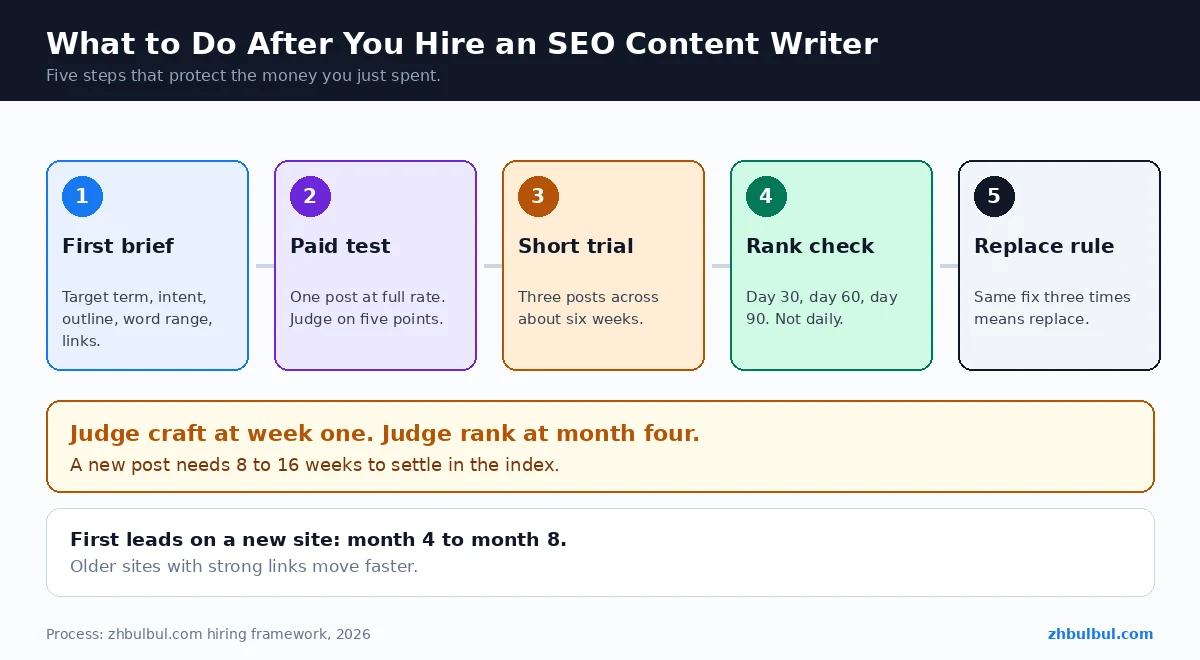
You send a brief, run a paid test and hold a short trial. Then you check rank on a schedule and replace on repeat faults. The hire is step one. The steps below guard the money you just spent.
The steps that follow the hire are listed below.
- First Brief: First brief sets the term, the intent read, the outline, the word range and the links.
- Paid Test: Paid test buys one post at full rate and scores it on five points.
- Short Trial: Short trial runs three posts across near six weeks.
- Rank Check: Rank check lands at day 30, day 60 and day 90, never daily.
- Replace Rule: Replace rule fires when the same fix comes back three times.
The sections below answer the questions buyers ask once the writer starts.
How do you write the first content brief?
A content brief holds six parts. The parts are the target term, the intent read and the outline. The last three are the word range, the internal links and the source list. Send it before the first draft. One page is enough. Template: how to write an SEO content brief.
How long should the trial period run?
A trial should run across three posts and near six weeks. Three posts show whether the craft holds. Six weeks show how the writer takes feedback.
How often should you check rank?
Check rank at day 30, day 60 and day 90. Daily checks tell you nothing. New pages bounce in the index for weeks before they settle.
When should you replace a writer?
Replace a writer when the same fix comes back three times. One repeat is a slip. Three repeats is a habit. Habits cost more than a fresh search.
Should you hire a freelance writer or an agency?
Hire a freelance writer for depth in one field and an agency for volume in many fields. Freelance rates cost less per post. An agency costs less of your time. Full breakdown: freelance vs agency vs in house.
Can you train an in house writer instead?
Yes, when you publish more than eight posts per month. Below that count, a freelance writer costs less. They also learn faster because they see more sites.
How many posts build topical authority?
Plan for 20 to 30 posts in one topic before you expect real lift. Depth in one field beats spread across five. See how many articles build topical authority.
How long does content need to bring leads?
Expect the first leads between month four and month eight on a new site. Older sites with strong links move faster. Full timeline: how long content marketing takes.
Where do you find an SEO content writer?
Look in three places. Read the bylines on posts that rank for your terms. Search LinkedIn by niche. Ask other site owners for names. Job boards give volume and low signal. My own SEO content writing service starts with the same 12 questions in reverse.
Can one writer cover a whole topical map?
No. One writer covers one branch well. A map with 200 topics needs a team, or a slow pace of two posts per week for two years.
How long should the hire call run?
Forty five minutes covers all 12 questions with room for follow ups. Book one hour. Send three questions in advance and keep nine for the live call, because canned replies hide the gaps.
Do these questions work for an agency too?
Yes, and you ask them of the person who will write your posts. The person who sells the contract rarely writes the draft. Ask for the writer by name before you sign.


3 Responses