
What is traditional SEO?
The old way matches strings. A writer picks a key word. A writer then places that key word in the title, the first line and the tags. Rank came from match count and link count.
Match logic ran search for a decade. Google read a page as a bag of words. A page with the right words in the right slots won.
Old way work has a fixed shape. Each step ties back to one string.
The four steps of the old way are listed below.
- Term Pick: the term pick names one key word with high volume.
- Slot Fill: the slot fill puts that key word in the title, the H1 and the URL.
- Word Count Match: the word count match copies the length of the top page.
- Link Push: the link push aims outside links at that one page.
None of those steps is wrong. Each step is now half the job.
What is semantic SEO?
The new way matches things, not strings. A writer names one main thing. A writer then covers each fact and each ask tied to that thing. Google reads the whole page as one theme, then ranks it.
Things carry traits and links to other things. A page that states those traits reads as full.
New way work starts one step earlier. The plan comes before the draft, not after.
The four steps of the new way are listed below.
- Thing Pick: the thing pick names the one theme the page owns.
- Ask Harvest: the ask harvest lists each ask a buyer types on that theme.
- Fact Fill: the fact fill answers each ask with a named source and a number.
- Group Link: the group link joins the page to each sibling page on the theme.
A topical map vs keyword list is the tool that holds those asks in order.
A guide on semantic SEO covers entities, context, and search intent.
What changed inside Google search?
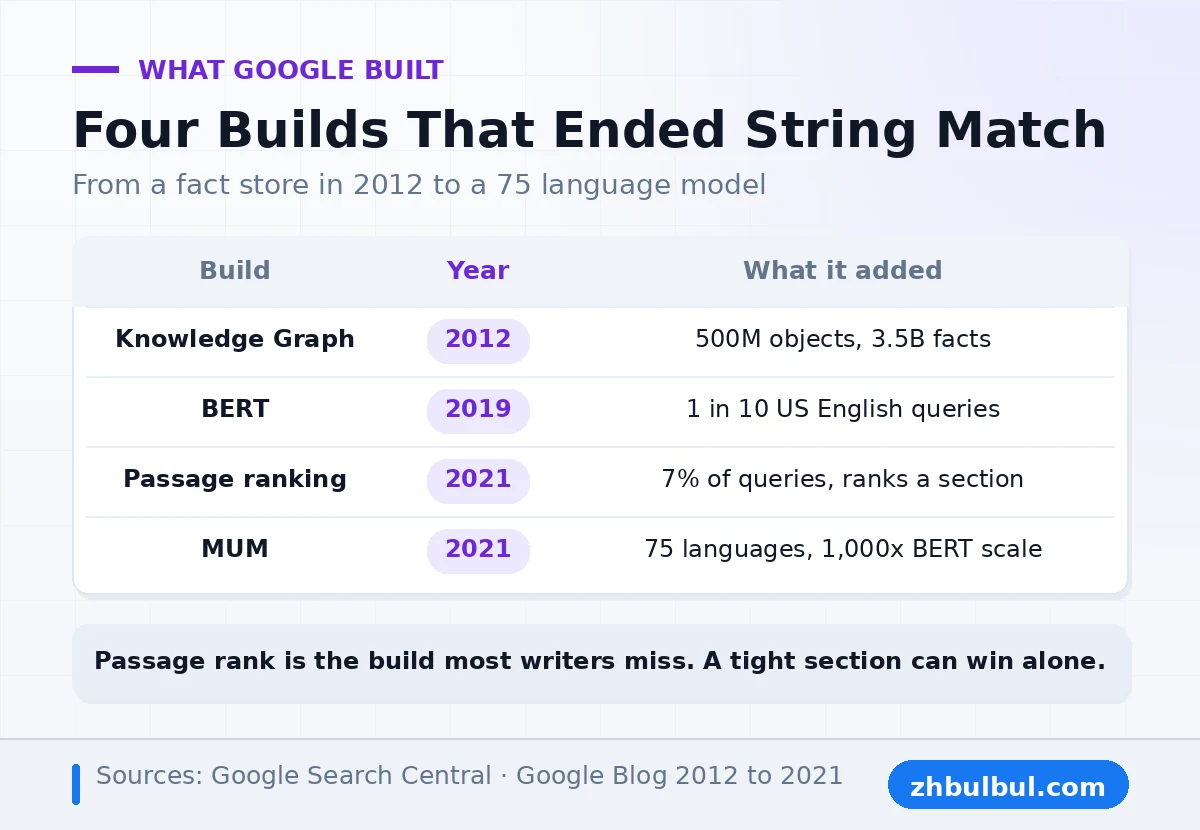
Four Google builds moved search off strings. Knowledge Graph shipped in 2012 with 500 million things. BERT shipped in 2019 and touched one in 10 US English searches. MUM shipped in 2021 across 75 tongues.
Knowledge Graph gave Google a fact store. Google logged 3.5 billion facts at launch. Search then linked a name to a thing.
Language models closed the gap after that. BERT read word order and small words. Google said 15 percent of daily asks are brand new.
| Build | Year | What it added |
|---|---|---|
| Knowledge Graph | 2012 | 500M objects, 3.5B facts |
| BERT | 2019 | 1 in 10 US English queries, word order |
| Passage ranking | 2021 | 7% of queries, ranks a section |
| MUM | 2021 | 75 languages, 1,000x BERT scale |
Passage rank is the build most writers miss. Google can rank one part of a long page. A tight section can win on its own.
What is the real difference in how you write?
The old way writes for a string. The new way writes for a set of asks. The old way pads to a word count. The new way stops when the asks run out. Length is a result, not a target.
Draft shape changes first. A new way draft leads with the answer, then the proof.
Both ways still use the key word. The new way just stops there.
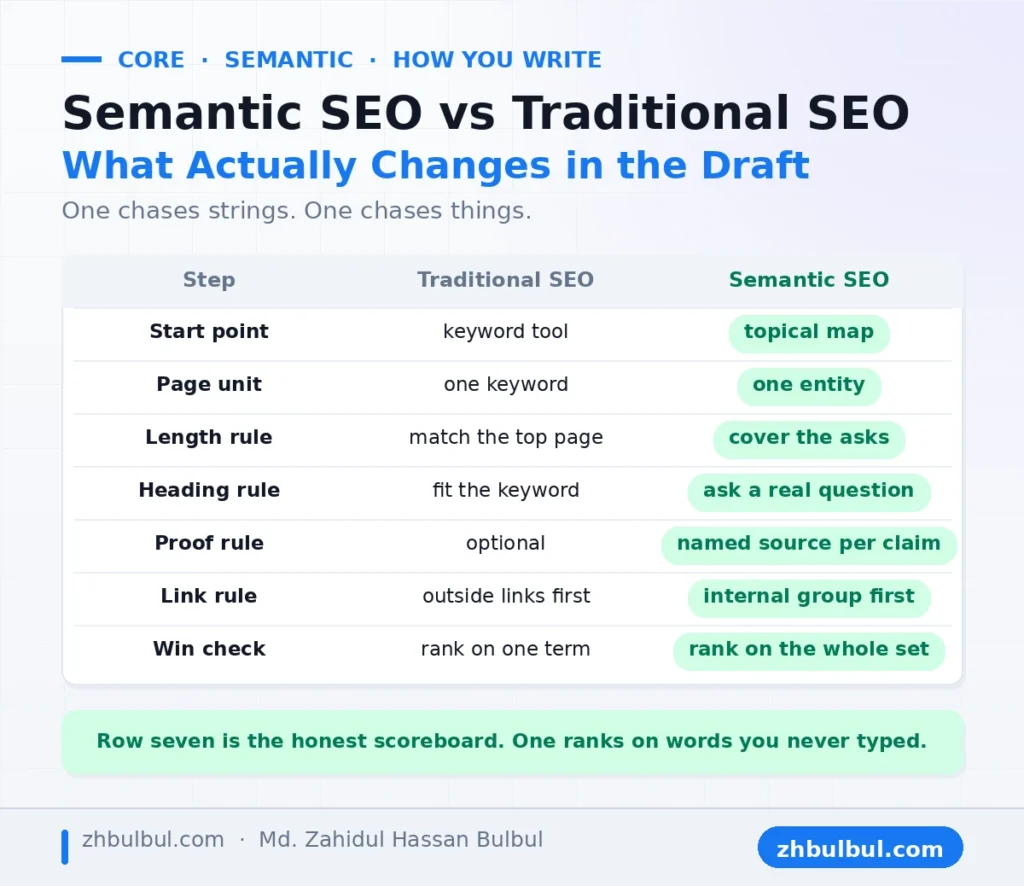
| Step | Traditional SEO | Semantic SEO |
|---|---|---|
| Start point | keyword tool | topical map |
| Page unit | one keyword | one entity |
| Length rule | match the top page | cover the asks |
| Heading rule | fit the keyword | ask a real question |
| Proof rule | optional | named source per claim |
| Link rule | outside links first | internal group first |
| Win check | rank on one term | rank on the whole set |
Row seven is the honest scoreboard. A new way page ranks on words you never typed into a tool.
What does a semantic rewrite look like on one paragraph?
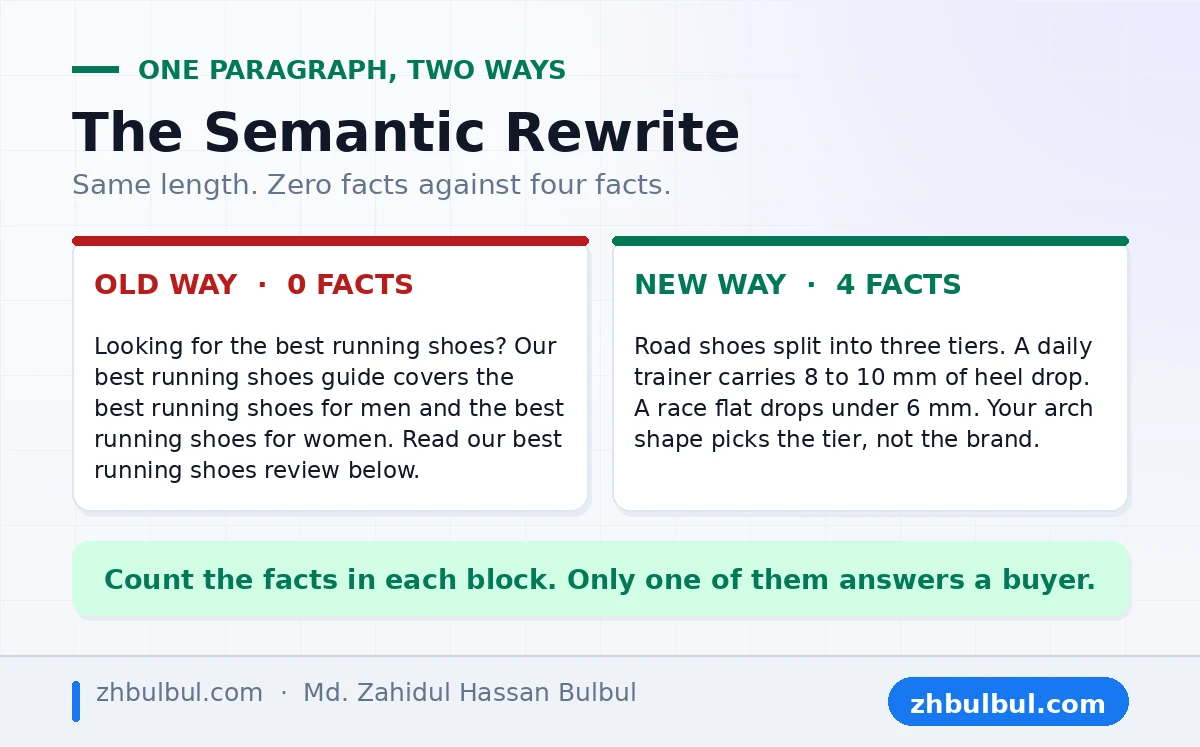
Watch one paragraph move. The old draft repeats the term four times and states no fact. The new draft names the thing, states a number, and answers the ask. Same length, four times the useful load.
Rewrites teach faster than rules. The table below holds one before and one after.
Both drafts run near 40 words. Only one of them answers a buyer.
| Old way draft | New way draft |
|---|---|
| Looking for the best running shoes? Our best running shoes guide covers the best running shoes for men and the best running shoes for women. Read our best running shoes review below. | Road shoes split into three tiers. A daily trainer carries 8 to 10 mm of heel drop. A race flat drops under 6 mm. Your arch shape picks the tier, not the brand. |
Count the facts in each cell. The left cell holds zero. The right cell holds four, and each one a buyer can act on.
How does the writing workflow change step by step?
The new way front loads the work. Step one builds the ask list. Step two picks the one thing the page owns. Step three drafts answers first. Step four adds the group links. Research now takes half the hours.
Front loaded work feels slower in week one. Draft time then drops, because the brief holds the answers.
Workflow order is the whole change. The same writer ships a better page from a better brief.
The five workflow shifts are listed below.
- Plan First: the plan first shift moves the map ahead of the draft.
- Answer First: the answer first shift puts the reply in line one of each section.
- Source Per Claim: the source per claim shift names a study before each number.
- Ask Headings: the ask headings shift turns each H2 into a real user question.
- Group Links: the group links shift ties the page to its siblings at draft time.
Read how many articles for topical authority for the page count that a full ask list needs.
Why does semantic SEO win in AI Overviews?
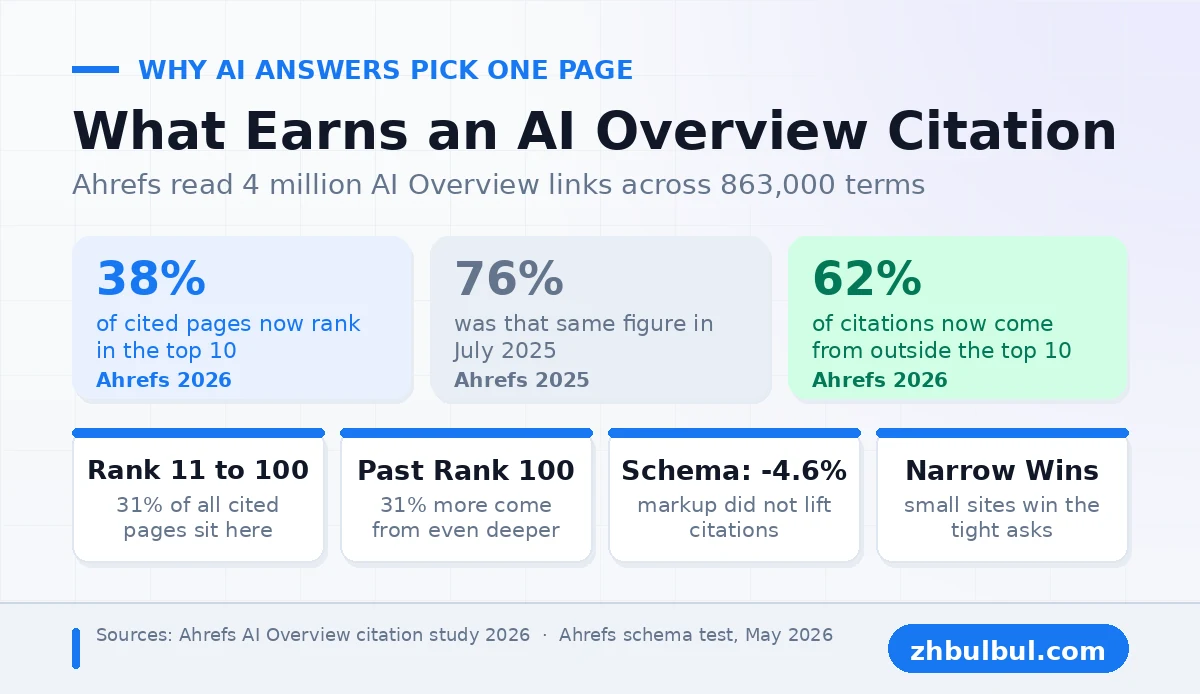
AI answers pull from clear facts, not from strings. Ahrefs read 4 million AI Overview links in 2026. Just 38 percent of cited pages rank in the top 10. Rank alone no longer buys the citation.
AI boxes need a fact they can lift. A page that states a fact in one clean line hands them that lift.
Citation data broke the old rule hard. The table below holds the four numbers that matter.
| Ahrefs finding, 2026 | Share of cited pages |
|---|---|
| Cited pages that rank in the top 10 | 38% |
| Same figure in July 2025 | 76% |
| Cited pages at rank 11 to 100 | 31% |
| Cited pages past rank 100 | 31% |
Row four is the one to read twice. A page that ranks nowhere can still land in the answer box.
Does keyword research still matter?
Key word work still matters, in a smaller role. Volume data still picks which theme to build first. Volume data no longer picks each page. Ask lists pick pages, and asks come from People Also Ask and rival headings.
Volume tools miss the long tail by design. A tool with a 10 search floor hides your best asks.
Key word work now serves the map, not the draft. The order flipped.
The three jobs key word data still holds are listed below.
- Theme Pick: the theme pick uses volume to rank which theme pays first.
- Intent Read: the intent read shows whether buyers want to learn or to buy.
- Gap Find: the gap find shows which rival owns which slice.
A pillars of SEO strategy plan uses volume at the map stage only.
What does each way cost you in time?
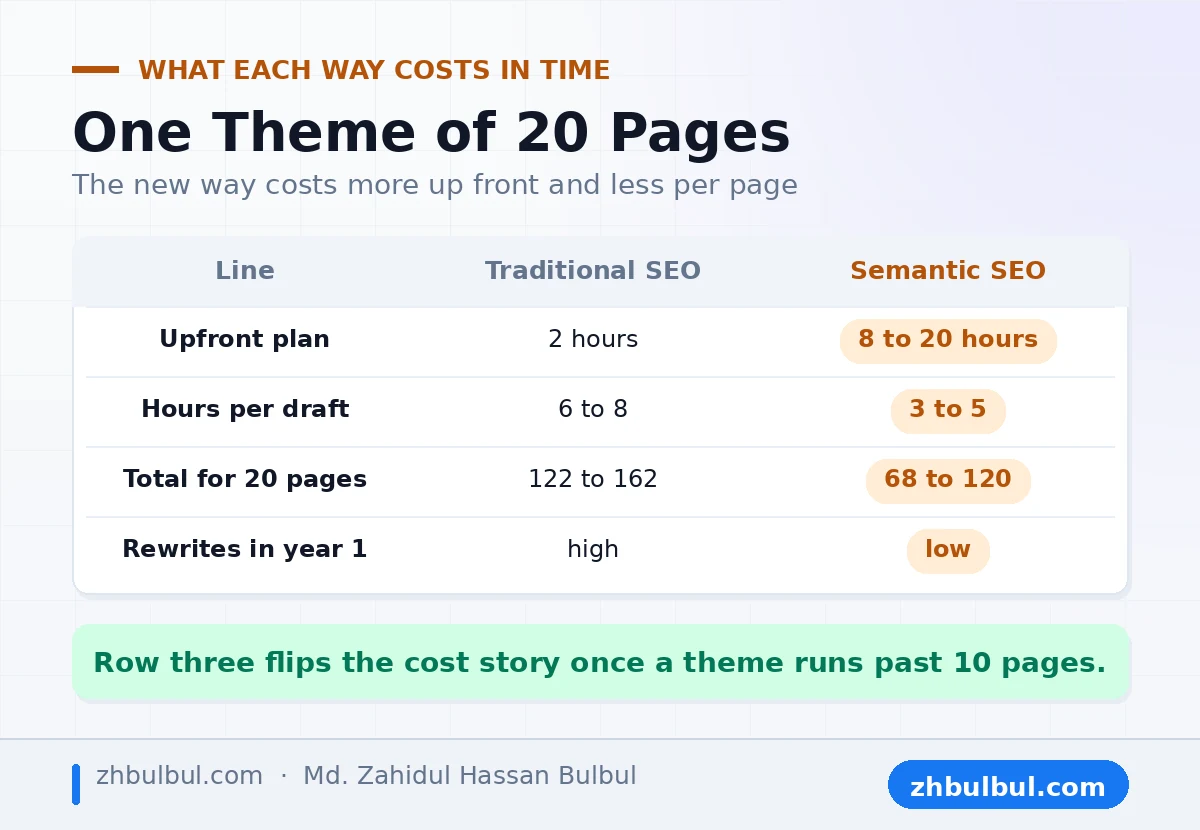
The new way costs more up front and less per page. A first map takes 8 to 20 hours. Each draft then takes 3 to 5 hours, not 6 to 8. Payback lands near page 10.
Map time is the cost owners fear. Map time also carries across each page you write for a year.
Time splits differently between the two ways. The table below sets one theme of 20 pages side by side.
| Line | Traditional SEO | Semantic SEO |
|---|---|---|
| Upfront plan | 2 hours | 8 to 20 hours |
| Hours per draft | 6 to 8 | 3 to 5 |
| Total for 20 pages | 122 to 162 | 68 to 120 |
| Rewrites in year 1 | high | low |
Row three flips the cost story. The new way costs less in total once the theme runs past 10 pages.
A read on how long content marketing takes leads sets the clock on that payback.
Which pages get cited in AI answers?
Markup does not buy a citation. Ahrefs tracked 1,885 pages that added schema code against 4,000 that did not. Schema moved AI Overview citations by minus 4.6 percent. Plain facts beat markup.
Schema still helps a page in other ways. Schema just does not lift the odds of a cite.
Narrow asks carry no Wikipedia page. A page that answers one tight ask owns that slot.
The three traits of a cited page are listed below.
- Clean Answer Line: the clean answer line states the reply in under 25 words.
- Named Source: the named source ties each number to a study and a year.
- Fresh Fact: the fresh fact carries a date that beats the rival page.
A site with real topical authority vs domain authority depth clears all three traits by default.
A done for you semantic SEO service runs this switch for your site.
What do you settle before you switch to semantic SEO?
Settle five things before the switch. Fix the one theme, the ask source, and the answer shape. Fix the source rule and the link rule too. Those five turn the switch into a checklist.
Each answer below is short on purpose. Pin them above your brief template.
Switch terms hold better in writing than in a call. The five asks below cover the ones that stall a team.
Does keyword density still work?
Key word density never worked as a rank rule. Google dropped that model years ago. A page that repeats a term now reads thin. Cover the asks and the term shows up on its own.
Density targets came from old tools, not from Google. No Google staffer has ever named a target rate.
Do you still need exact match terms?
Use the exact term once in the title and once in the first line. Skip it after that. Google matches close forms and plain synonyms. Forced repeats cost you more than they gain.
Exact match still helps a reader scan. A title that mirrors the ask earns the click.
How long does the switch take?
A team switches in one quarter. Week 1 builds the map. Weeks 2 to 4 rewrite the top 5 pages. Months 2 and 3 ship new pages from the map. Rank shifts land near month 4.
Switch speed tracks page count, not team size. A site with 30 pages moves faster than one with 300.
Does semantic SEO work on small sites?
Small sites gain the most from the new way. A narrow theme needs fewer pages to cover. Full cover on one slice beats thin cover on ten. Scope is the small site edge.
Small sites also ship faster with no sign off chain. Speed and scope stack in your favour.
What tools does the new way need?
Search Console and the search page cover most of it. People Also Ask holds the ask list free. Rival headings fill the rest. A paid tool helps at the map stage only.
Free tools carry a small site through the first year. An SEO service adds speed, not a tool you lack.

