
What is internal linking anchor text?
Anchor text is the words you make clickable in a link. On a site link you write both ends. That makes the link text the one rank sign you fully own. Each one tells Google what the target page covers.
Link work sits in the draft, not in a plugin. Each link you place carries one short label.
Anchor text feeds two readers at once. A person reads it to judge the click. Google reads it to judge the target page.
The three parts of one site link are listed below.
- Anchor: the anchor holds the words a reader clicks.
- Target: the target names the page the link points at.
- Near Text: the near text sits before and after the link and shades its sense.
Does anchor text on an internal link still matter?
Yes, and the gap is not close. Zyppy read 23 million site links across 1,800 sites. Pages with one exact match anchor drew at least 5 times the clicks. Google reads it as context for the target page.
Scale makes that read solid. 520,000 URLs sat in the sample, each matched to real click counts.
Anchor data is a tie, not a proof. Zyppy states the point plainly. Pages that already win can just earn better link text from the start.
| Zyppy, 23 million site links | Finding |
|---|---|
| Pages with an exact match anchor | 5x the traffic |
| Links with no anchor at all | 6% of the set, no effect |
| Pages with a bare URL anchor | near 50% more traffic |
| Study type | tie, not cause |
Row two lands hardest. More than 1 link in 20 carries no link text. Those links move nothing.
How many internal links should one page carry?
Sit near 40 links and stop short of 45. Zyppy found pages with under 5 site links drew 2 clicks a month. Pages in the 40 to 44 band drew near 8. Past 45 the count fell again.
Link count is a band, not a fixed mark. A short post with 12 real links beats a long one with 44 padded ones.
Curve shape matters more than the peak. Gains run steep from the low end, then flatten, then turn.
| Site links on a page | Clicks a month |
|---|---|
| Under 5 | 2 |
| 40 to 44 | near 8 |
| 45 or more | falls again |
Row one is the one most blogs sit in. A page with 3 links in is a page Google seldom reaches.
A topical map vs keyword list read tells you which pages deserve those links.
Does anchor text variety beat one fixed anchor?
A mix beats one string. Zyppy ran the mix cut three times because the read was so strong. Clicks rose as a page earned more distinct link text. The gain thinned past 25 of them.
Mix work costs nothing extra. You write the link text once per page anyway.
Fixed anchors come from plugins and habit. One rule swaps a term for a link on each match. Google then sees the same 4 words 60 times.
The three ways to widen a link text set are listed below.
- Term Swap: the term swap route writes the head term one way here and a fresh way there.
- Ask Form: the ask form route writes the link text as the search a reader typed.
- Long Form: the long form route runs to 6 words and names the exact angle.
Why does a second link to the same page get ignored?
Google logs 1 or 2 link texts per target, not each one. Zyppy ran three live tests with the Search Console anchor report. The first text link logged. A twin text link to the same URL did not. An image link logged next to it.
Order sets which link text lands. The first text link to a page takes the slot.
Wasted links are the real cost here, not a ban. Gary Illyes wrote in 2019 that you can abuse site links as much as you want. No ban exists. The extra links just do nothing for the link text.
The three rules that fall out of those tests are listed below.
- First Slot: the first slot rule puts your best link text on the first link to a page.
- One Per Page: the one per page rule keeps the rest of the page clear of twin links.
- Image Slot: the image slot rule uses alt text as a spare link text to the same target.
What are the 9 rules for internal anchor text?
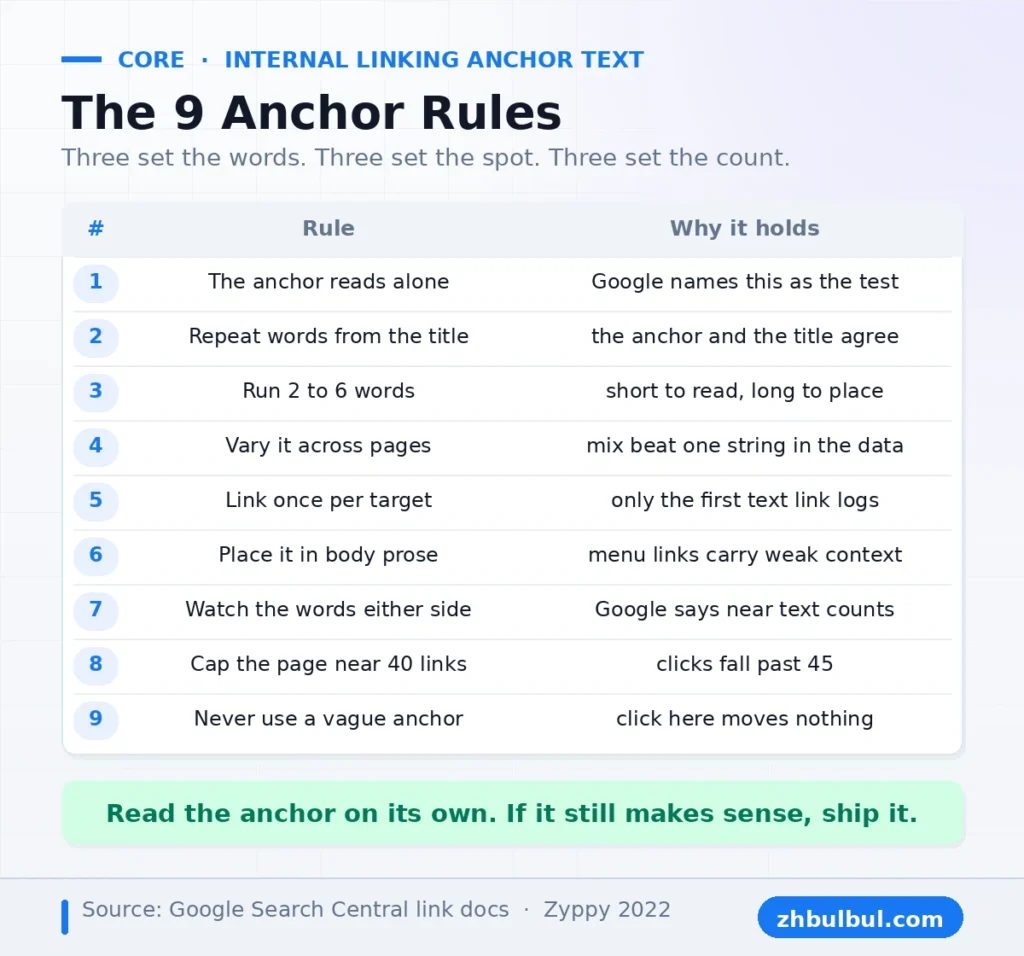
All 9 rules cover one job. Three set the words. Three set the spot. Three set the count. Run a draft past each rule and the link pass takes 10 minutes per post. Google wrote the first rule itself.
Rule work beats taste at scale. Write the 9 on one card and hand it to each writer.
Anchor rules hold across each post. Read the link text on its own and ask whether it still makes sense.
| # | Rule | Why it holds |
|---|---|---|
| 1 | The anchor reads alone | Google names this as the test |
| 2 | Repeat words from the target title | the anchor and the title must agree |
| 3 | Run 2 to 6 words | short enough to read, long enough to place |
| 4 | Vary the anchor across pages | mix beat one string in the Zyppy data |
| 5 | Link once per target per page | only the first text link logs |
| 6 | Place the link in body prose | menu links carry weaker context |
| 7 | Watch the words either side | Google says the near text counts |
| 8 | Cap the page near 40 links | clicks fall past 45 |
| 9 | Never use a vague anchor | click here moves nothing |
Row 7 is the one most guides skip. Google states that the words before and after a link matter.
What do 20 real anchor rewrites look like?
Real pairs beat one rule list. Each pair below takes a weak link text from a live blog. The fix repeats words from the target title. No pair runs past 6 words. Copy the shape, not the words.
Rewrite work moves fast once you see the shape. Most weak anchors lose one thing: the subject.
Anchor pairs carry the lesson better than prose. Read the left side aloud with your eyes shut. You learn nothing about the target.
| # | Weak anchor | Rewrite |
|---|---|---|
| 1 | click here | how to write a content brief |
| 2 | read more | the full SEO pricing breakdown |
| 3 | this post | our topical map build steps |
| 4 | learn more | what topical authority costs |
| 5 | our services | SEO content writing services |
| 6 | here | the 12 field brief template |
| 7 | this page | when to prune an old post |
| 8 | see this | the Ahrefs zero traffic study |
| 9 | more info | how long SEO takes to pay |
| 10 | check it out | our writer vetting checks |
| 11 | the article | the semantic SEO guide |
| 12 | website | the zhbulbul services page |
| 13 | that guide | the content refresh checklist |
| 14 | SEO | technical and content SEO work |
| 15 | link | internal link anchor rules |
| 16 | our blog | the SEO content writing blog |
| 17 | this study | the Zyppy 23 million link study |
| 18 | contact | book an SEO content call |
| 19 | tips | 9 anchor text rules |
| 20 | full guide | the full topical map guide |
Row 14 shows the other fault. A one word link text on a broad term tells Google nothing about which page you mean.
Which anchors should you never use?
Four types earn a hard no. Weak link text and blank link text lead the list. Term stuffed strings and full line links come next. All four fail the read alone test. Google names the first group in its own docs.
Ban lists work better than style notes. Put the four in your brief and the writer stops the guess work.
Blank anchors are the quiet one. Zyppy found more than 1 link in 20 with no link text at all. Those links moved nothing.
The four link text types to ban are listed below.
- Vague: the vague type uses click here, read more, this page or website.
- Blank: the blank type wraps an icon or a bare span with no words in it.
- Stuffed: the stuffed type crams four terms in and reads like a tag cloud.
- Sentence: the sentence type turns a full line blue and buries the target.
Do internal anchors carry an over optimization risk?
Google says no, on the record. Gary Illyes answered the exact ask in 2019. “No, you can abuse your internal links as much as you want AFAIK.” Site links are yours, so Google treats them as a layout choice.
Risk sits in the reader, not the filter. A page with 60 blue phrases reads like spam to a buyer.
Ban risk and waste are two problems, not one. The waste is real and the ban is not. Each twin link past the first costs you a slot. It buys no link text.
A read on semantic SEO vs traditional SEO explains why context beats term count here.
How do internal anchors differ from backlink anchors?
Site link text is yours and off site link text is not. Ahrefs read 384,614 pages across 19,840 terms. Exact match anchors off other sites tracked rank at 0.14, a weak tie. Site link text carries no such cap.
Control is the full gap. You write each site anchor. You rewrite it whenever the target shifts.
Off site anchors also carry risk that site anchors do not. A paid exact match anchor on a rival site breaks Google link rules. The same words on your own page break nothing.
| Anchor type | Who writes it | Rank tie |
|---|---|---|
| Site anchor | you | strong in the Zyppy data |
| Off site anchor | the other site | 0.14 in the Ahrefs data |
| Paid off site anchor | you, against the rules | a link scheme |
Row three is the trap. A bought anchor puts the full domain at risk for one term.
A read on topical authority vs domain authority shows why off site marks tell you less than they promise.
An SEO team runs the site link pass and leaves the off site work be.
A read on source context in SEO shapes the pages you link out to.
How does anchor work change what you publish next?
Link work exposes the holes in your map. A page with no clean link text into it has no clear job. Most teams find 3 or 4 such pages on the first pass. They then cut or merge them.
Anchor gaps read as plan gaps. A page with no 5 word name is a page that will not rank.
Fresh drafts run faster once the link set exists. The writer picks 6 targets off a list and writes each label from the target title.
A read on prune or refresh an old post covers the pages that earn no link text.
What do you settle before your next internal link pass?
Settle five asks before you touch a link. Fix the link text form, the link count, the image rule, the old post rule and the owner. Those five keep the pass from a full rewrite next year.
Each answer here runs short on purpose. Pin them next to your link map.
Anchor rules hold better in writing than in a call. The five asks here stall most teams.
Do you use the exact head term or a close phrase?
Use both. One exact match anchor per target is the floor. The Zyppy data ties that floor to 5 times the clicks. Each later page then uses a close phrase. Never repeat the exact term on two pages.
Exact match work costs you one line in the brief. Name the target and its one exact anchor.
How many links belong in one new post?
Place 6 to 10 links in a fresh post. Each one points at its own target. A post with 10 links into 4 targets wastes 6 of them. Only the first text link to each page logs.
Read how many articles for topical authority for the page count that fills a theme.
Do image links count as anchors?
Alt text works as link text on an image link. Zyppy logged an image anchor next to the first text anchor in each test. A blank alt on a linked image throws that spare slot away.
Alt work costs you 6 words per image. Write the alt as you would write the anchor.
What do you do with old posts that share one anchor?
Rewrite the link text on each page but the strongest one. Leave the exact match anchor on the page that already ranks. Then vary the rest by angle, by ask form and by length.
Read the SEO content refresh checklist for the order of work on an old post.
Who owns the internal link map?
One named person owns the map and signs each pass. That person holds the target list, the link text per target and the count per page. A map with two owners drifts into twin anchors inside a month.
Map files beat plugins for this job. A sheet with one row per target shows a gap at a glance.

