
Most topic plans die at the count. A site owner picks one theme. He writes 8 posts. Then he waits for a lift that never lands.
Topic depth is not a word count. Topic depth is a count of answers. The web hands you that count. You can work it out in an hour.
What is topical authority?
Topical authority is the trust a site earns on one theme. Google reads that trust from deep reach across the theme. A site with deep reach ranks for words it never chased. Depth beats brand size here.
Search engines treat a theme as a set of linked asks. Your site owns the set once it answers most of it. One page answers one ask. Ten pages answer ten.
Topic depth rests on three parts. Page count is just one part. The next two decide if the pages work as a group.
The three parts of topic depth are listed below.
- Query Set: the query set holds each ask buyers type on your theme.
- Page Count: the page count is your share of that set, in whole pages.
- Link Web: the link web joins those pages, so Google reads them as one group.
A topical map vs keyword list sits under all three. The map names the query set. A key word list does not.
How many articles do you need to build topical authority?
Plan 25 pages for a narrow theme. Plan 60 pages for a mid market theme. Plan 150 or more for a broad US wide theme. The count tracks your query set, not your budget.
Cluster data from 5 sources backs those bands. Ahrefs puts a tight niche at 15 to 25 linked pieces. Ahrefs puts a broad theme far past that. HubSpot puts 25 support pages under each pillar page.
Scope sets the band. Scope means how wide the buyer’s query set runs. Scope is not the size of your firm. A one city plumber sits below a US wide brand.
| Topic scope | Pages to plan | What the scope looks like |
| Narrow, one service, one city | 20 to 30 | “emergency drain repair in Austin” |
| Mid market, one service, one state | 50 to 70 | “commercial roof repair in Texas” |
| Broad, full category, national | 100 or more | “project management software” |
| Sub topic inside a live cluster | 8 to 22 | “heatmaps” inside a product blog |
The last row is the one owners miss. Backlinko logged 4 live clusters at 9, 13, 16 and 22 pages. Small groups win inside a site that owns the parent theme.
What do published sources put the article count at?
Five sources land in one range. Narrow themes take 15 to 45 pages. Broad themes take 150 or more. No source names one fixed count, and no honest source can.
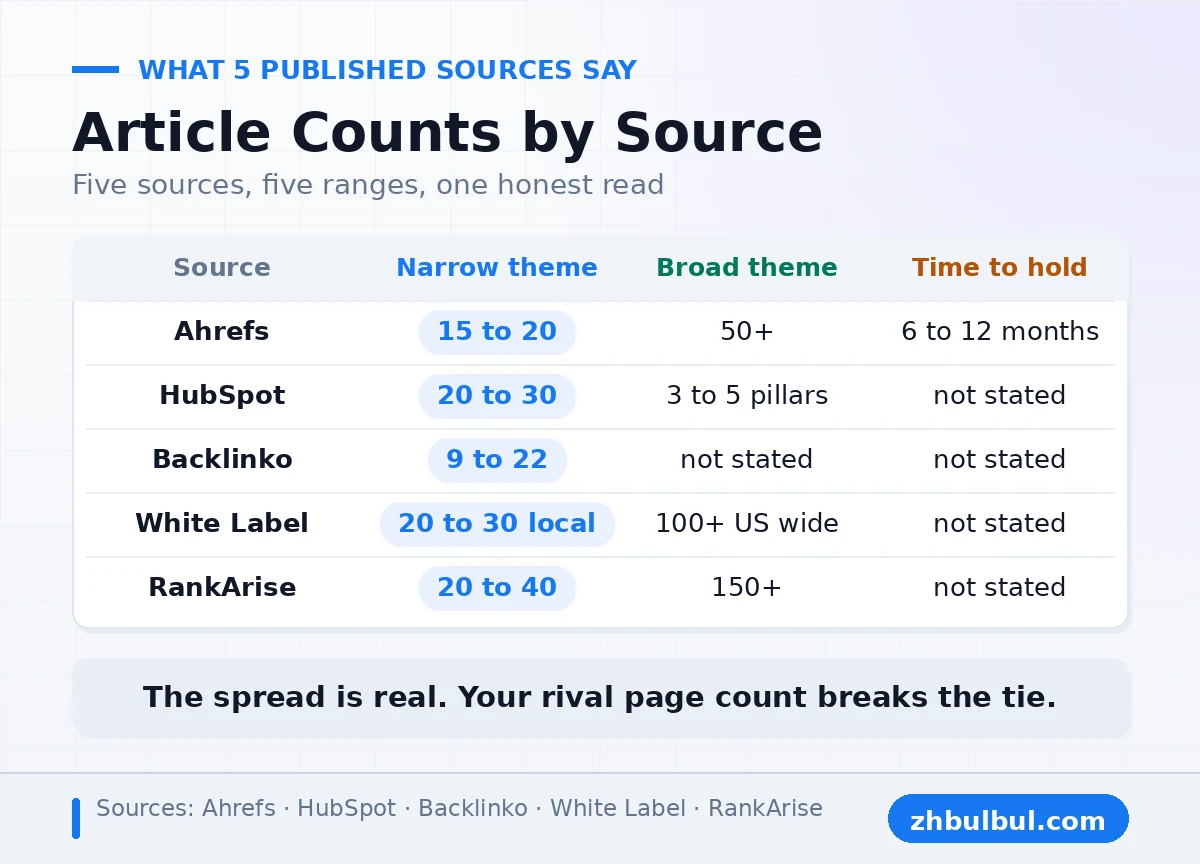
Each source counts a slightly odd thing. Ahrefs counts linked pieces on a theme. HubSpot counts support pages under a pillar. Backlinko counts live groups that rank now.
Source spread is the signal here. The floor sits near 15. The roof sits near 150. Scope fills the gap.
| Source | Year | Narrow topic | Broad topic |
| Ahrefs | 2026 | 15 to 20 pieces | 50 or more |
| HubSpot | 2026 | 20 to 30 per pillar | 3 to 5 pillars |
| White Label Agency | 2025 | 20 to 30 local | 100 or more national |
| RankArise | 2026 | 20 to 40 | 150 or more |
| Backlinko, live clusters | 2025 | 9 to 22 | not stated |
Ahrefs also puts the wait at 6 to 12 months before rank shifts show. That wait weighs more than the count. A 60 page plan at 2 posts a month is a 3 year plan. Few owners hold that line.
How do you count the pages your topic needs?
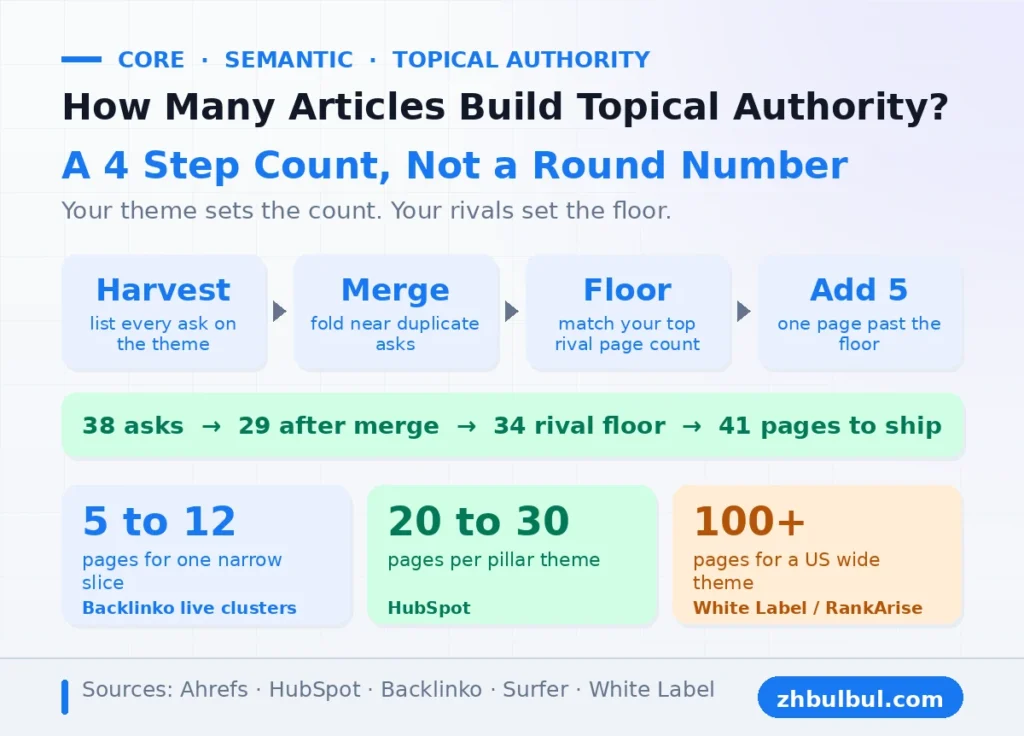
Count the asks first. Then match the count to your top rival. Four steps take about 90 minutes. The output is one count and a ranked build order.
An ask count beats guesswork, because the set is public. Google shows it in People Also Ask. Google shows it in related searches. Your rivals show it in their headings.
The four steps of the count method are listed below.
- Step 1, Harvest: harvest each ask from People Also Ask, related searches, and your sales inbox.
- Step 2, Merge: merge the near twins. Two asks with one answer are one page.
- Step 3, Floor: floor the count against the top rival. Run a site search on their domain.
- Step 4, Add: add a fifth on top of the higher count. That fifth is your gain margin.
| Step | Tool | Time |
| 1. Harvest questions | Google PAA, AlsoAsked, sales inbox | 30 min |
| 2. Merge duplicates | a plain sheet | 20 min |
| 3. Floor against rival | `site:rival.com topic` in Google | 25 min |
| 4. Add the fifth | the same sheet | 15 min |
| Total | 90 min |
Step 3 is the step owners skip. A rival with 46 pages on your theme has drawn the real floor. Your 12 page plan was never short on work. Your plan was short 34 pages.
What is a coverage ratio, and what number wins?
Coverage ratio is the share of a theme’s sub asks your site answers. Surfer read 253,800 search results in 2026. Pages that hit near 74 percent of the sub topics beat pages that hit half.
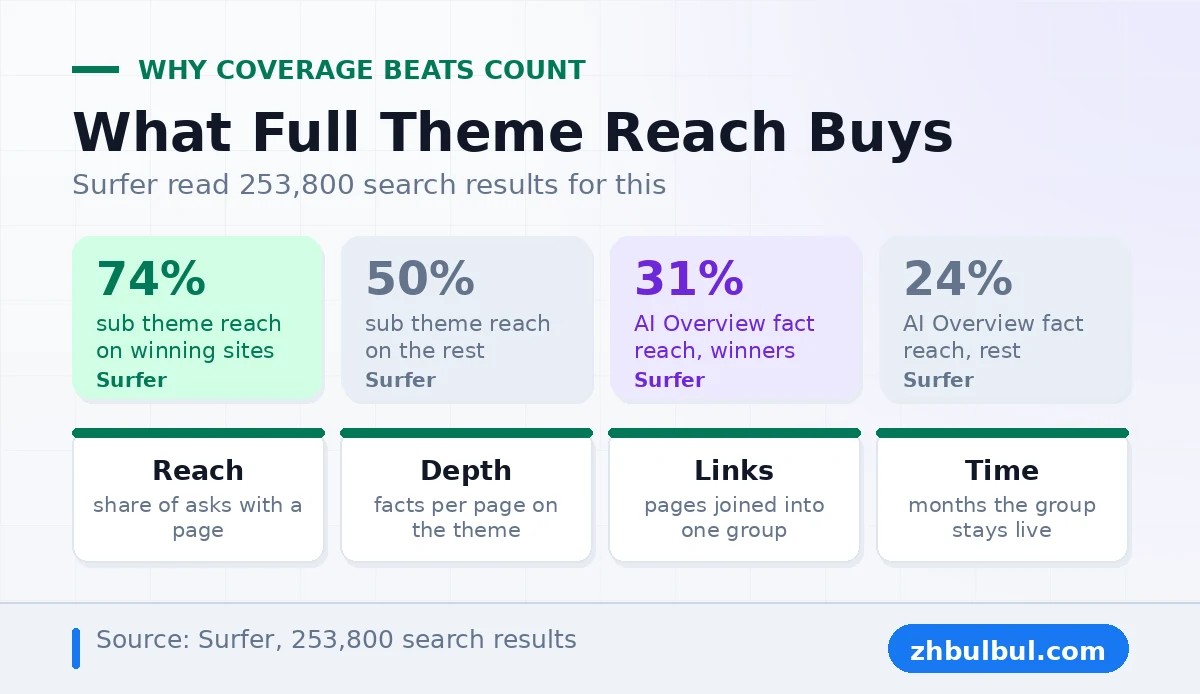
Surfer’s study reframes the count. The target was never a page total. The target is a share of a known set. That set has an edge you can count to.
Coverage ratio also drives AI answers. Surfer found 31 percent fact reach on pages cited in Google AI Overviews. Pages left out held 24 percent.
| Measure | Cited pages | Pages left out |
| Fact coverage, Surfer 2026 | 31% | 24% |
| Sub topic coverage that wins | ~74% | ~50% |
Push your ratio, not your total. A 45 page plan that hits 74 in each 100 sub asks beats a 90 page plan that drifts.
How does competition change the article count?
Rival depth sets your floor. The count moves with the market you picked. A weak theme clears at 25 pages. A theme held by 3 deep sites takes 80 or more. The gap is the rivals, not the word.
Check depth before you set the budget. Run `site:` on each of the top 3 domains with your theme word. Read the result count.
Rival depth splits into three tiers. Each tier carries its own build cost. The tiers below use the top 3 domains only.
| Rival depth on your topic | Your floor | Build cost at 4 posts a month |
| Under 15 pages each | 20 to 25 pages | 6 months |
| 15 to 40 pages each | 45 to 60 pages | 12 to 15 months |
| Over 60 pages each | 80 or more | 20 months or more |
The third tier is a real fork in the road. Pick a thin slice of the theme instead. A site that owns “drain repair for cast iron pipe” beats a site that limps at “drains”.
How long does it take to publish that many articles?
Divide the count by your true monthly pace. A 60 page plan at 4 posts a month runs 15 months. Ahrefs puts the first rank shift at 6 to 12 months on top of that. Plan for the sum.
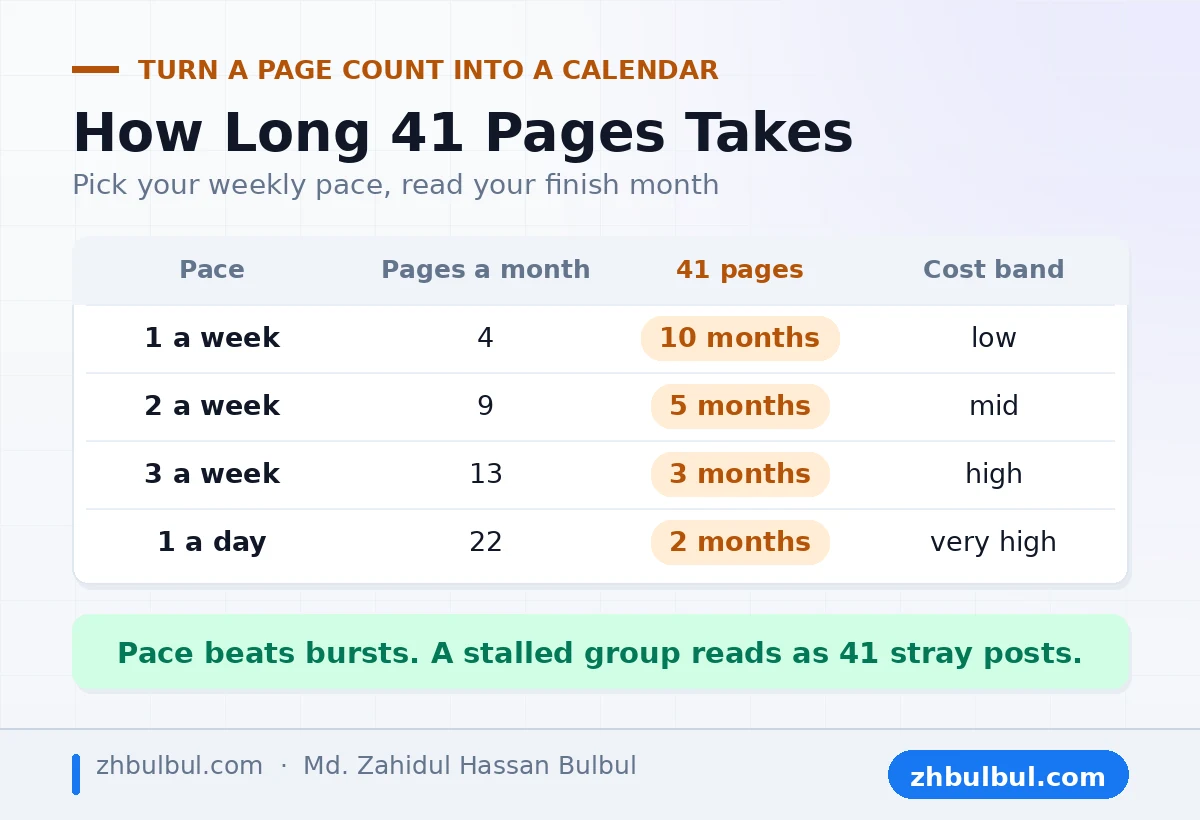
True pace runs below planned pace. Sick weeks, client work and days off cut a 4 post month to 3.
Pace and count give you the clock. The table below runs the two counts against each other. Pick a pair you can hold.
| Pages to publish | 2 a month | 4 a month | 8 a month |
| 25 pages | 13 months | 7 months | 4 months |
| 50 pages | 25 months | 13 months | 7 months |
| 100 pages | 50 months | 25 months | 13 months |
Read the bottom row twice. At 2 posts a month, that plan outlives most small firms’ patience. Cut the scope or raise the pace. The pillars of SEO strategy hold the same rule. Pace and scope move as one.
Does page count matter more than page depth?
Depth wins inside one page. Count wins across a theme. A thin 80 page group loses to a solid 30 page group. Google ranks the page a reader lands on, not the folder.
Depth here means fact load, not word count. A 900 word page with 6 named facts beats a 2,400 word page that repeats the ask.
Page depth and page count trade against each other on a fixed budget. The lists below show where each one earns more.
The two cases where count beats depth are listed below.
- Fresh Topic: a fresh theme with no rival depth rewards count first, since the SERP has room.
- Long Tail Spread: a long tail spread of 200 low volume asks rewards count, since one page cannot hold them.
The two cases where depth beats count are listed below.
- Held SERP: a held SERP with 3 deep rivals rewards depth, since a thin page adds nothing new.
- Money Query: a money query near the sale rewards depth, since the reader buys on detail.
A page built for the money query reads more like SEO copywriting services than like a broad guide.
What does the count look like on a worked example?
Take one theme and run the 4 steps. The theme is “SEO content brief” for a US firm. The harvest gave 38 asks. The merge cut it to 29. The rival floor read 34, so the plan lands at 41 pages.
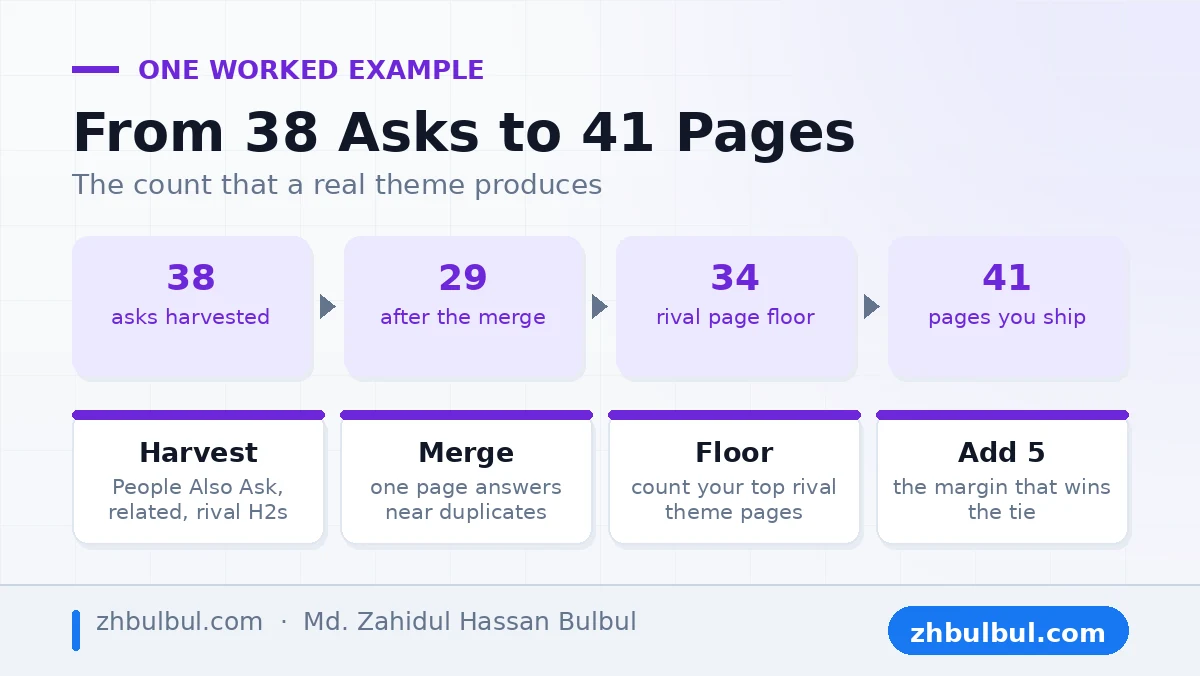
Numbers below come from the live SERP for that word in August 2026. Anyone can rerun the 4 steps. Most land within 3 pages of the same count.
Worked counts read better as a table than as prose. The right column names the step behind each count.
| Input | Count | Step |
| Questions harvested | 38 | 1 |
| Left after the merge | 29 | 2 |
| Top rival’s pages on the topic | 34 | 3 |
| Higher of the two | 34 | 3 |
| Plus a fifth | 41 | 4 |
| Plan | 41 pages |
At 4 posts a month that plan runs 12 months. Add the 6 to 12 month rank lag. The honest promise to a client is 18 months, not 3.
A topical map service sets the exact page count and the publish order.
Which pages do you publish first?
Publish the pillar page first. Then publish the 5 asks closest to the sale. Money pages earn early cash that funds the rest of the plan. Volume pages come last, once the group holds.
Build order changes the cash curve, not the end state. Both orders reach 41 pages. Only one pays for itself on the way.
Publish order runs in three waves for most sites. Each wave has a job. The job is not the same as traffic.
The three waves of a build order are listed below.
- Wave 1, Pillar: the pillar page frames the theme and holds the links for each page after it.
- Wave 2, Money: the money pages answer buyer asks like price, hire and compare.
- Wave 3, Volume: the volume pages answer the wide tail and feed links back up.
Wave 2 is where a small site can still win. A page on how to hire an SEO content writer draws fewer readers than a broad guide. It draws better ones. The questions to ask an SEO content writer belong in that wave too.
Wave 3 pages are where a content writing service earns its keep. Volume pages take the most hours and pay the slowest.
What happens when a plan stops short of the count?
A group that stops at half its count wins next to nothing. Google sees a part map. Google ranks the site as a part source. The waste is real, and most content budgets die this way.
Half a group is worse than a quarter of one. The spend was larger and the payoff is the same. Owners then read the flat chart as proof that SEO failed.
Short plans fail in a pattern. Three signs show up before the traffic chart does. All three sit inside Search Console.
The three signs of a short cluster are listed below.
- Flat Impressions: flat views on the theme word after 8 months point to a coverage hole.
- Odd Query Match: odd query match hits when one page ranks for words meant for the next.
- Zero Deep Rank: zero deep rank, where nothing sits above rank 30, points to a weak pillar.
Owners who read is SEO worth it the wrong way stop at this exact point. The math was never wrong. The plan was half built.
What do you settle before you plan an article count?
Settle five things before you buy a single page. Fix the scope, the rival floor, the monthly pace, the build order, and the review date. Those five turn a page count into a plan.
Each answer below is short on purpose. Write them at the top of your harvest sheet. The count and the terms then stay in one place.
Plan terms hold better in writing than in a call. The five asks below cover the ones that cause fights later.
How many pillar pages does one topic need?
One theme takes one pillar page. HubSpot puts a whole site at 3 to 5 pillars, which means 3 to 5 themes. A second pillar on one theme splits your links and starts a rank fight.
Pillar pages hold the frame and link down to each support page. A site with 5 pillars and 30 support pages each runs 155 pages.
How many articles per month do you publish?
Pick the pace you can hold for a year. Then cut it by a quarter. Most small sites hold 4 posts a month. Most solo owners hold 2. A pace you break in month 3 costs more.
A steady pace beats raw speed. Google reads a steady flow as a live source. Google reads a burst as a one time push.
Does a new site need more articles?
A new site needs the same count and a longer wait. Ahrefs found that pages under one year old make up 13.7 percent of top 10 results. Ahrefs found 72.9 percent of them are over 3 years old.
New sites also lack the link web that makes each new page rank fast. Each page you add fixes a little of that.
Do AI drafts count toward the number?
AI drafts count only once a human adds facts a model cannot hold. Graphite found that 14 percent of top ranked content in 2025 read as AI made. Raw output does not clear the bar.
Draft speed is not the block on a topic plan. Fact work is. A page with 6 named sources takes the same research hours whoever types it.
When do you stop adding pages?
Stop when new asks stop. Rerun the harvest each quarter. Once two rounds in a row return under 3 fresh asks, the set closes. The budget then moves to refresh work.
Refresh work then holds the group. Old pages drift and rival pages improve. A pass each quarter on your top 10 pages guards the rank you paid for. A real SEO service treats that pass as part of the plan.

