
What is an SEO content refresh?
A content refresh rewrites an old post to match what search wants now. A refresh keeps the URL. A refresh swaps old facts, thin parts and dead links for fresh ones. Rank and traffic follow the fix.
A refresh is not a rewrite from blank. A fix keeps what works. A fix cuts what does not.
Refresh work sits between two other jobs. One job writes a new post. The other job kills a dead one.
The three marks of a true refresh are listed below.
- Same URL: the same URL holds each link and each bit of trust the post earned.
- Real Change: the real change touches the facts and the shape, not just the date.
- One Pass: the one pass ships in a half day, not across three weeks.
Why does an old post lose traffic?
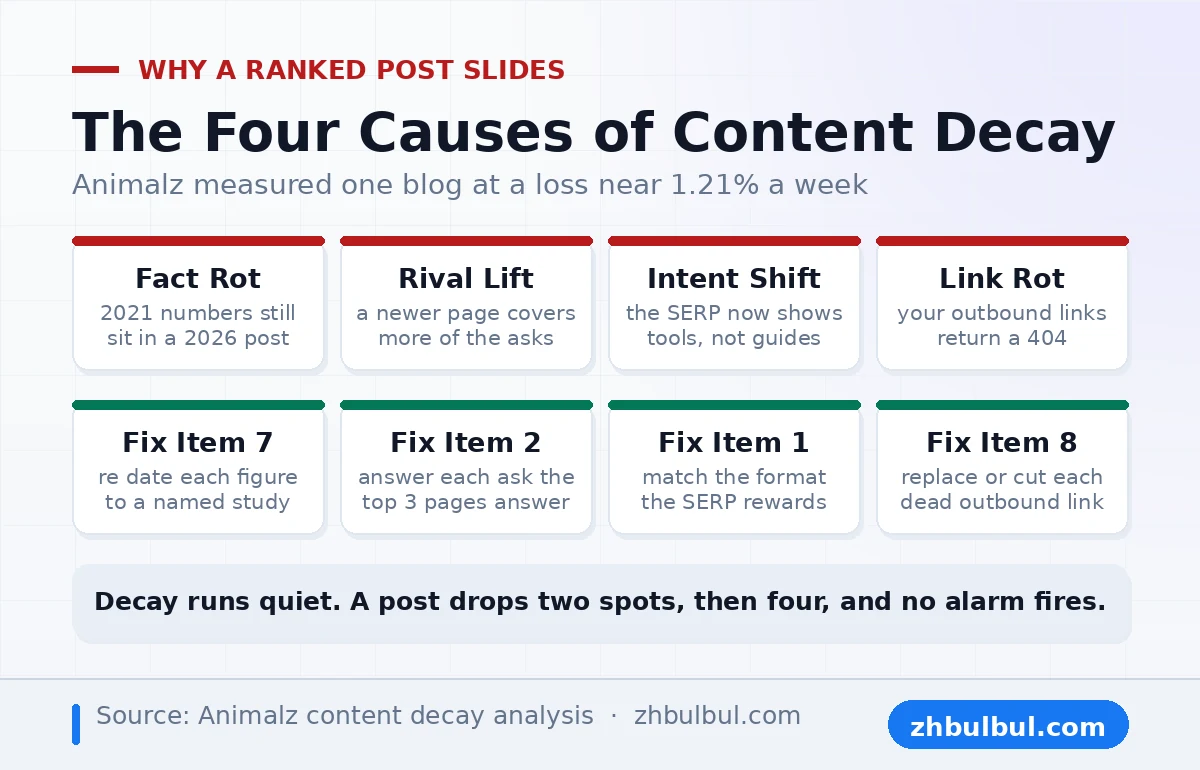
Old posts decay on a clock. Animalz measured one blog and found a loss near 1.21 percent a week. Rivals ship newer pages. Search intent shifts. Your facts age out. Four forces stack up.
Decay runs quiet. A post drops two spots. A post then drops four more. No alarm fires.
Traffic loss has four named causes. The table below names each cause. The table names the fix too.
| Cause of decay | What it looks like | The fix on the checklist |
|---|---|---|
| Fact rot | 2021 numbers in a 2026 post | Item 7 |
| Rival lift | a newer page covers more asks | Item 2 |
| Intent shift | the SERP now shows tools, not guides | Item 1 |
| Link rot | outbound links 404 | Item 8 |
Fact rot is the one readers spot first. An old number costs you trust. The rest of the post pays for it.
Which old posts do you refresh first?
Fix the posts that once ranked and now slide. Pull each page that lost clicks over the last six months. Sort by lost clicks, not by lost rank. Start at the top of that sort.
Priority comes from Search Console, free. Compare the last 3 months against the same months a year back.
Fix order runs on one rule. A page on rank 4 that slid from rank 2 pays back fast. A page on rank 44 does not.
The four sorts worth a look are listed below.
- Big Slide: the big slide list holds pages down by a third or more in clicks.
- Near Miss: the near miss list holds pages stuck on rank 4 to 10.
- Stale Star: the stale star list holds top pages older than 2 years.
- No Click: the no click list holds pages with views and no clicks at all.
A how to increase online presence plan starts with this same sort.
What are the 14 things to update on an old post?
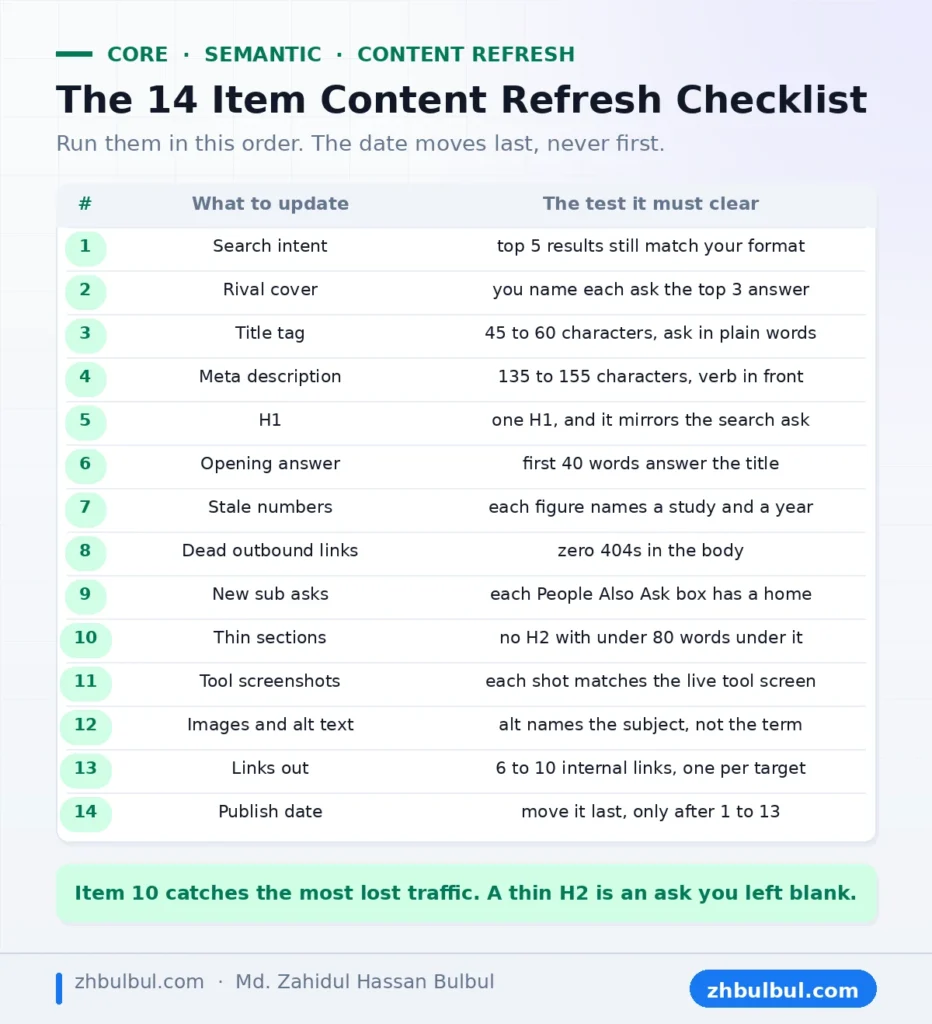
Run the 14 items in order. Items 1 and 2 set the target. Items 3 to 7 fix the top of the page. Items 8 to 12 fix the body. Items 13 and 14 fix the links and the date.
Order matters more than the list. A title fix ahead of an intent check wastes the title fix.
Checklist work runs in four blocks. The table below holds each item. The table holds the test that clears it.
| # | What to update | The test it must clear |
|---|---|---|
| 1 | Search intent | the top 5 results still match your format |
| 2 | Rival cover | you name each ask the top 3 pages answer |
| 3 | Title tag | 45 to 60 characters, the ask in plain words |
| 4 | Meta description | 135 to 155 characters, a verb in front |
| 5 | H1 | one H1, and it mirrors the search ask |
| 6 | Opening answer | the first 40 words answer the title |
| 7 | Stale numbers | each figure names a study and a year |
| 8 | Dead outbound links | zero 404s in the body |
| 9 | New sub asks | each People Also Ask box has a home |
| 10 | Thin sections | no H2 with under 80 words under it |
| 11 | Tool screenshots | each shot matches the live tool screen |
| 12 | Images and alt text | alt text names the subject, not the term |
| 13 | Links out | 6 to 10 internal links, one per target |
| 14 | Publish date | you move it last, and only after 1 to 13 |
Item 10 catches the most lost traffic. A thin H2 marks a full ask. You left that ask blank.
Item 14 is the one owners run first. Item 14 on its own does not move a thing.
How much of a page must change to count as a refresh?
Change enough that a reader spots it. Google prints no percent rule. A safe floor is a fresh answer block, one new section, and a fresh date on each number. Small edits earn nothing.
Change depth beats change count. Ten typo fixes read as no change at all.
Fix scale ties to the gap you face. A post 3 spots off page one needs less work. A post on page four needs much more.
The three refresh depths are listed below.
- Light Touch: the light touch swaps old numbers and dead links in under an hour.
- Half Rebuild: the half rebuild adds 2 new sections and a fresh answer block.
- Full Rewrite: the full rewrite keeps the URL and replaces the whole body.
A semantic SEO vs traditional SEO read shows what the new body shape looks like.
Does a new publish date help rankings?
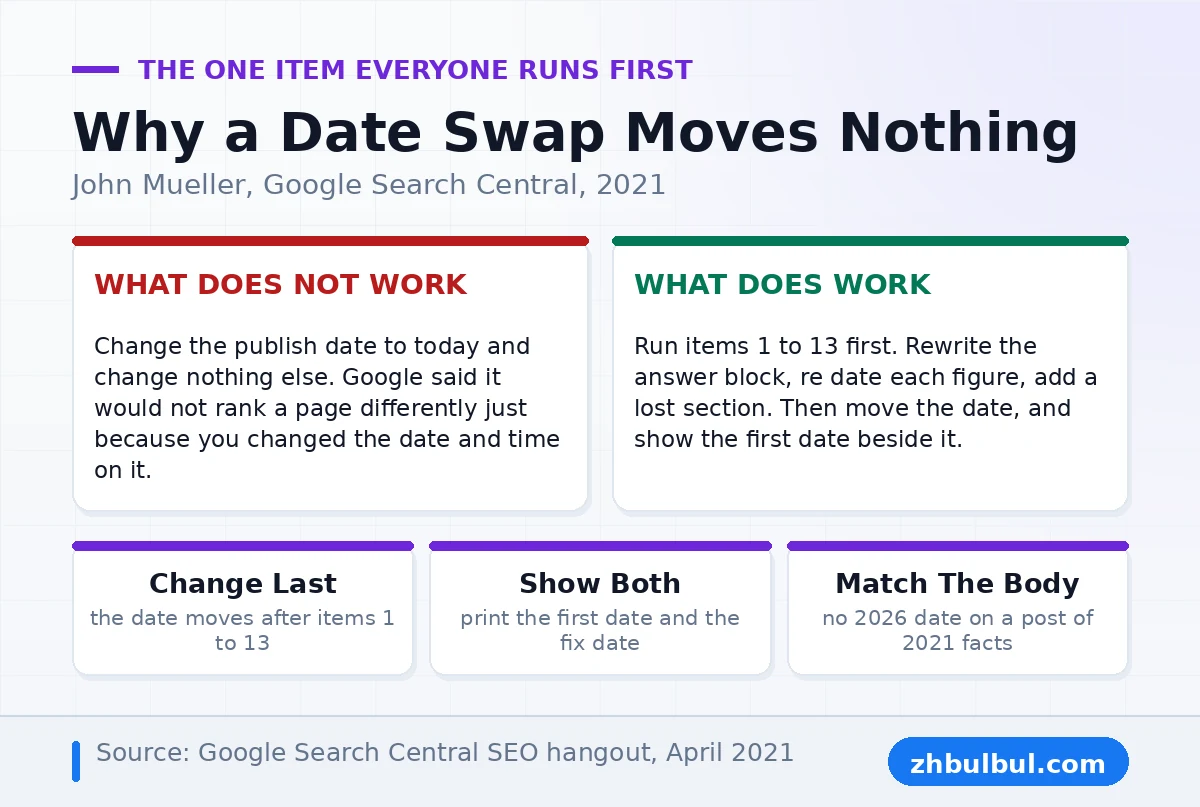
A date swap alone moves nothing. John Mueller said Google would not rank a page higher just because you changed the date and time on it. Google wants a fresh date only after a real change.
Date games are the oldest trick in the trade. Google closed that door in public. Google closed it on the record in 2021.
Dates still carry a real job. A true date tells a reader one thing. The facts in the post match the year on the label.
The three date rules are listed below.
- Change Last: the change last rule moves the date after items 1 to 13, not before.
- Show Both: the show both rule prints the first date and the fix date.
- Match The Body: the match the body rule bars a 2026 date on a post full of 2021 facts.
How long does a refresh take to move rank?
A refresh moves faster than a new post. Google recrawls a known URL in days, not months. Rank shifts land in 2 to 8 weeks. A new post on the same theme waits far longer.
Speed comes from the URL history. Google trusts the page now. The fresh draft skips the cold start.
Fix speed beats the odds on new pages too. Ahrefs read 2 million pages. Just 5.7 percent reach the top 10 inside a year.
| Route | First crawl | Rank shift | Odds of top 10 |
|---|---|---|---|
| Refresh a ranked page | 1 to 7 days | 2 to 8 weeks | high |
| New post, same theme | 3 to 30 days | 4 to 12 months | 5.7% in year one |
Row two holds the honest cost of a new page. A fix skips most of that wait.
A read on how long content marketing takes leads sets the clock on the new post route.
What do old posts earn once you fix them?
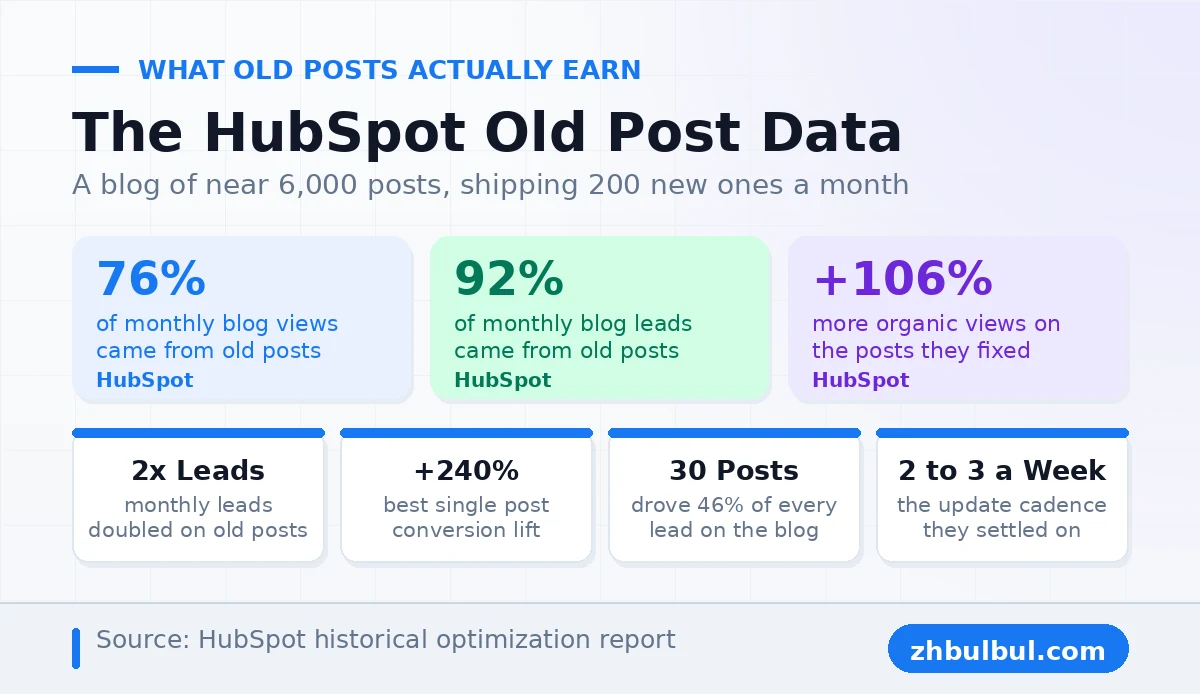
HubSpot ran this at scale and printed the counts. Old posts drove 76 percent of monthly blog views. Old posts drove 92 percent of blog leads. Fixed old posts gained 106 percent more organic views.
Scale makes those counts worth a look. HubSpot held near 6,000 posts. HubSpot shipped 200 new ones a month.
Lead data is the sharper half. HubSpot doubled the leads from old posts it fixed. Just 30 posts drove 46 percent of all leads.
| HubSpot blog, old post program | Result |
|---|---|
| Share of monthly views from old posts | 76% |
| Share of monthly leads from old posts | 92% |
| Lift in organic views on fixed posts | +106% |
| Monthly leads from fixed old posts | 2x |
| Best single post conversion lift | +240% |
Row five came from one page. A fix on one post beat a month of new ones.
How does a refresh feed AI answers?
Fresh facts win cites. Ahrefs read 4 million AI Overview links in 2026. Just 38 percent of cited pages rank in the top 10. Rank alone no longer buys the cite. A dated fact does.
AI boxes lift a clean line with a source on it. A fix is where you plant those lines.
Cite odds shifted hard in one year. The same Ahrefs count sat at 76 percent in July 2025.
The three refresh edits that feed AI answers are listed below.
- Dated Fact: the dated fact ties each count to a named study and a year.
- Clean Answer Line: the clean answer line replies to the H2 ask in under 25 words.
- Named Source: the named source beats a vague claim in each cite test.
A site with real topical authority vs domain authority depth wins more cites on the same theme.
What does a refresh cost against a new post?
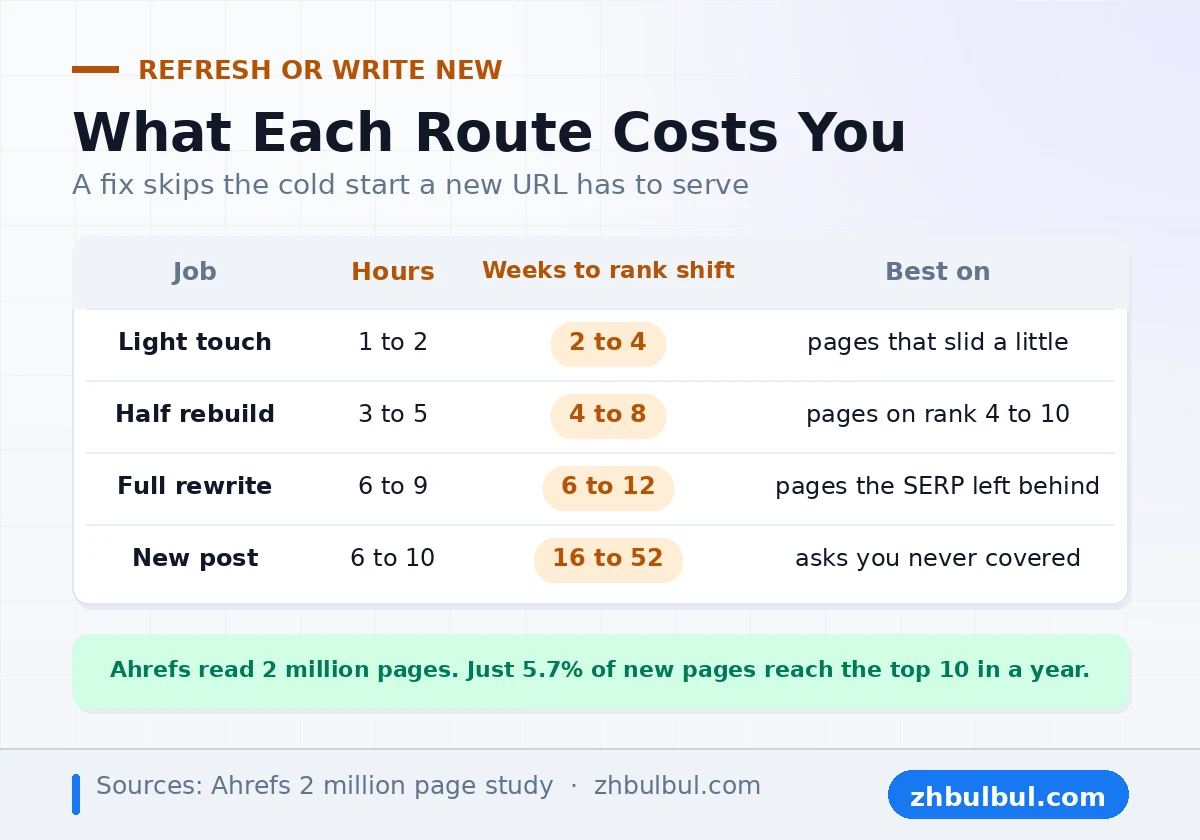
A refresh costs less on each axis. A light fix runs 1 to 2 hours. A half rebuild runs 3 to 5 hours. A new post of the same depth runs 6 to 10 hours. Payback lands sooner too.
Cost math favours fix work until the old post list runs dry. Most blogs hold months of fix work they never touch.
Fix cost splits by depth. The table below sets the three depths against one new post.
| Job | Hours | Weeks to rank shift | Best on |
|---|---|---|---|
| Light touch | 1 to 2 | 2 to 4 | pages that slid a little |
| Half rebuild | 3 to 5 | 4 to 8 | pages on rank 4 to 10 |
| Full rewrite | 6 to 9 | 6 to 12 | pages the SERP left behind |
| New post | 6 to 10 | 16 to 52 | asks you never covered |
Row four is the slowest route on the board. Row four is the one route to a new ask.
A topical map vs keyword list tells you which asks belong in row four.
A technical SEO audit service checks the crawl side before you refresh.
What do you settle before your first refresh cycle?
Settle five asks before the first cycle. Fix the cadence, the URL rule, the delete rule, the risk rule and the owner. Those five turn refresh work into a routine instead of a scramble.
Each answer below runs short on purpose. Pin them beside your checklist.
Fix rules hold better in writing than in a meeting. The five asks below cover the ones that stall a team.
How often do you refresh one post?
Fix a sales page each quarter. Fix a guide once a year. Fix a news post never, and kill it instead. Cadence tracks how fast the facts age, not the clock.
Cadence tracks your rivals too. A theme with 3 new rival pages a month needs a tight loop.
Do you keep the same URL?
Keep the URL in each case. The URL holds the links, the age and the rank log. A new URL throws all three away. Change a URL just when the theme itself changed.
URL swaps cost more than owners expect. A redirect keeps most of the value, though not all.
When do you delete a post instead?
Delete a post with no clicks, no links and no role in the map. Merge it into a stronger page when the theme still matters. A thin page drags the full group down.
Delete calls need the map open on the desk. A post with no home in the map has no job.
Read how many articles for topical authority for the page count a theme needs.
Does a refresh hurt an existing rank?
A fix can drop a rank for a week or two. Rank returns once Google recrawls the page. The risk sits with full rewrites, not with fact swaps. Fix your top page last.
Risk drops when you fix in batches. Ship 5 mid pages first and watch what moves.
Who does the refresh work?
The writer who owns the theme does the fix. A fresh writer spends half the time on catch up. One owner per theme keeps the facts and the voice in one head.
Owner rules matter more as the post list grows. An SEO service adds the cycle, not a tool you lack.

