
What does AI vs human content mean in practice?
Three classes exist, not two. A pure AI page comes straight from a tool with no human edit. A pure human page holds no AI text. A mixed page carries both, and mixed is now the norm.
Class lines matter for each count below. Each study sorts pages into these same three. Skip the lines and the data reads as noise.
AI text sits on a scale, not in a box. A page can run one fifth AI or nine tenths. Both count as mixed.
The three classes of a web page are listed below.
- Pure AI: the pure AI page ships tool output with no human hand on it.
- Pure Human: the pure human page holds no AI text at all.
- Mixed: the mixed page blends a human draft with AI help, or the reverse.
How much of the web is AI written now?
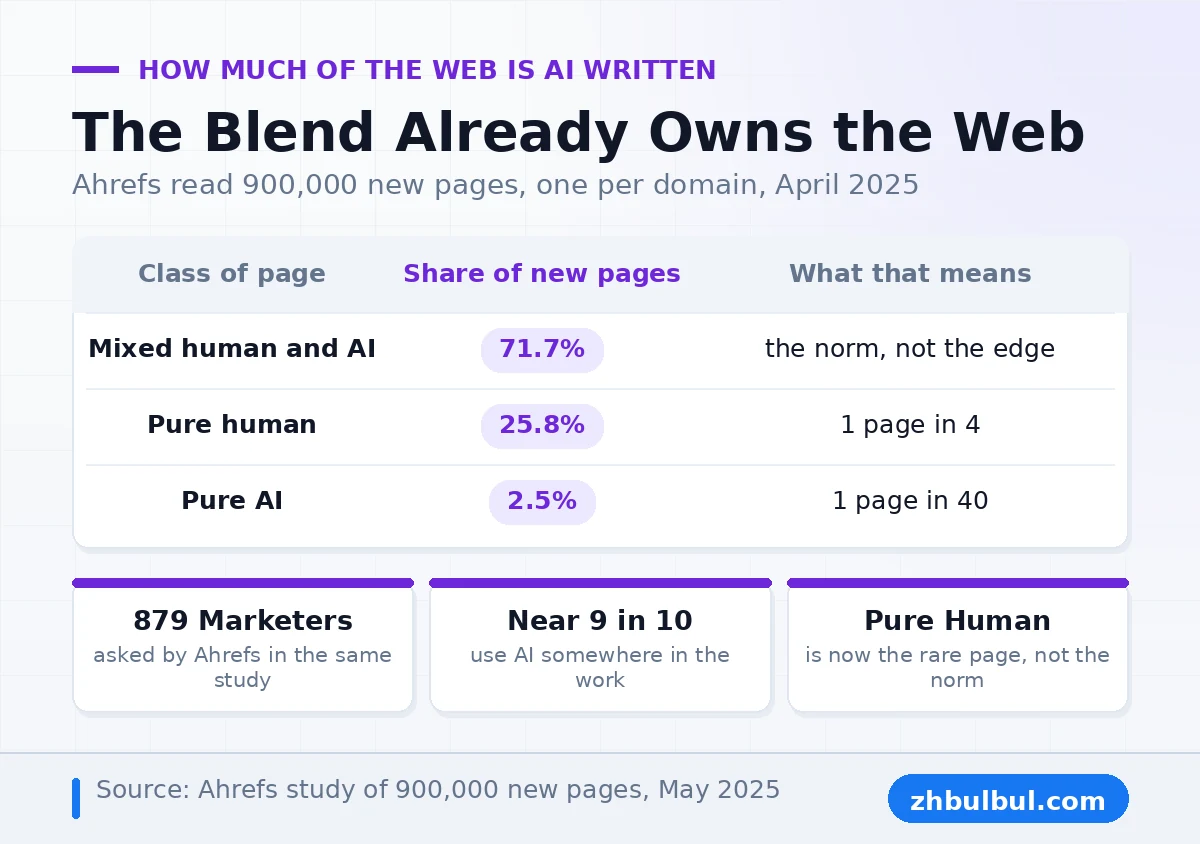
Ahrefs read 900,000 new pages in April 2025. Just 1 page in 40 was pure AI. Pure human pages held 1 in 4. Mixed pages took 7 in 10. The blend already owned the web.
Scale makes that count worth a read. Ahrefs took one page per domain. One big site cannot skew the set.
AI use runs even higher inside teams. Ahrefs asked 879 content marketers. Near 9 in 10 use a tool somewhere in the work.
| Ahrefs, 900,000 new pages, April 2025 | Share of pages |
|---|---|
| Mixed human and AI | 71.7% |
| Pure human | 25.8% |
| Pure AI | 2.5% |
Row one is the honest state of the web. Most pages now hold both hands. The pure human page is the rare one.
Does Google penalise AI written content?
Google bars scaled abuse, not the tool. Google guidance says pages built to game rank break the spam rules. Google says nothing against a tool that helps a good page. Quality is the test.
Rule words matter here. Google names the harm, not the keyboard. Read the rule and the word AI never carries the ban.
Search rules point at intent. A tool that writes 500 thin pages breaks the rule. A tool that drafts one strong page does not.
The two lines Google draws are listed below.
- Scaled Abuse: the scaled abuse rule bars a flood of pages built with no value for a reader.
- Helpful Work: the helpful work rule rewards a page that answers the ask well.
What ranks at position 1, AI or human?
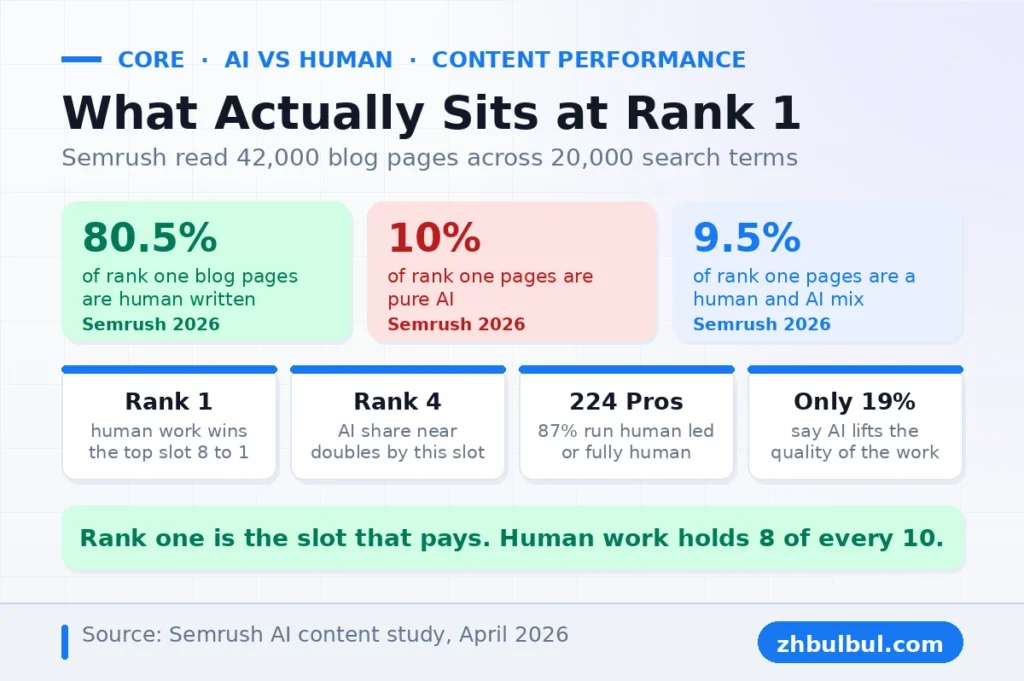
Semrush read 42,000 blog pages across 20,000 terms. Human text held 8 in 10 of rank one. Pure AI took 1 in 10. Mixed took the rest. Human work wins the top slot 8 to 1.
Rank one is the slot that pays. Semrush sampled the top 10 for each term. The sample ran in November 2025.
AI share climbs as you walk down the page. AI pages near double their share by rank 4. The top slot stays the outlier.
| Semrush, rank 1 blog pages, 2026 | Share of rank one |
|---|---|
| Human written | 80.5% |
| Pure AI | 10% |
| Mixed | 9.5% |
Row one looks final. The next study says the story runs deeper.
Why do two big studies seem to disagree?
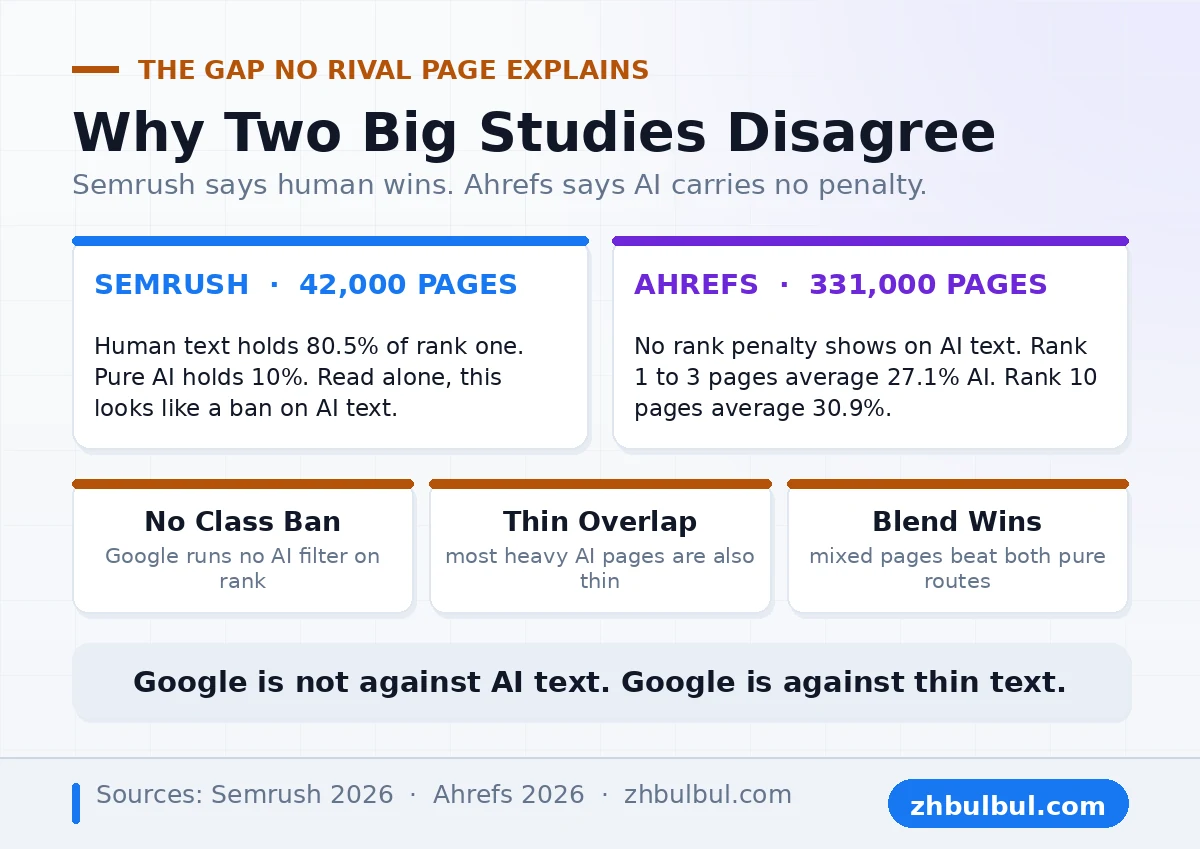
Ahrefs read 331,000 pages and found no rank penalty on AI text. Semrush found human text on 8 in 10 of rank one. Both counts are right. Google hits weak pages, and weak pages skew heavy AI.
Overlap is the word that settles it. Thin pages and heavy AI pages travel together, though not always. One trait rides on the other.
Ahrefs put the point plainly. Google is not against AI text. Google is against thin text.
The three reads that hold both studies together are listed below.
- No Class Ban: the no class ban read shows Google runs no AI filter on rank.
- Thin Overlap: the thin overlap read shows most heavy AI pages are also thin.
- Blend Wins: the blend wins read shows mixed pages beat both pure routes.
A semantic SEO vs traditional SEO read shows what a strong page holds.
What happens to heavy AI pages in the index?
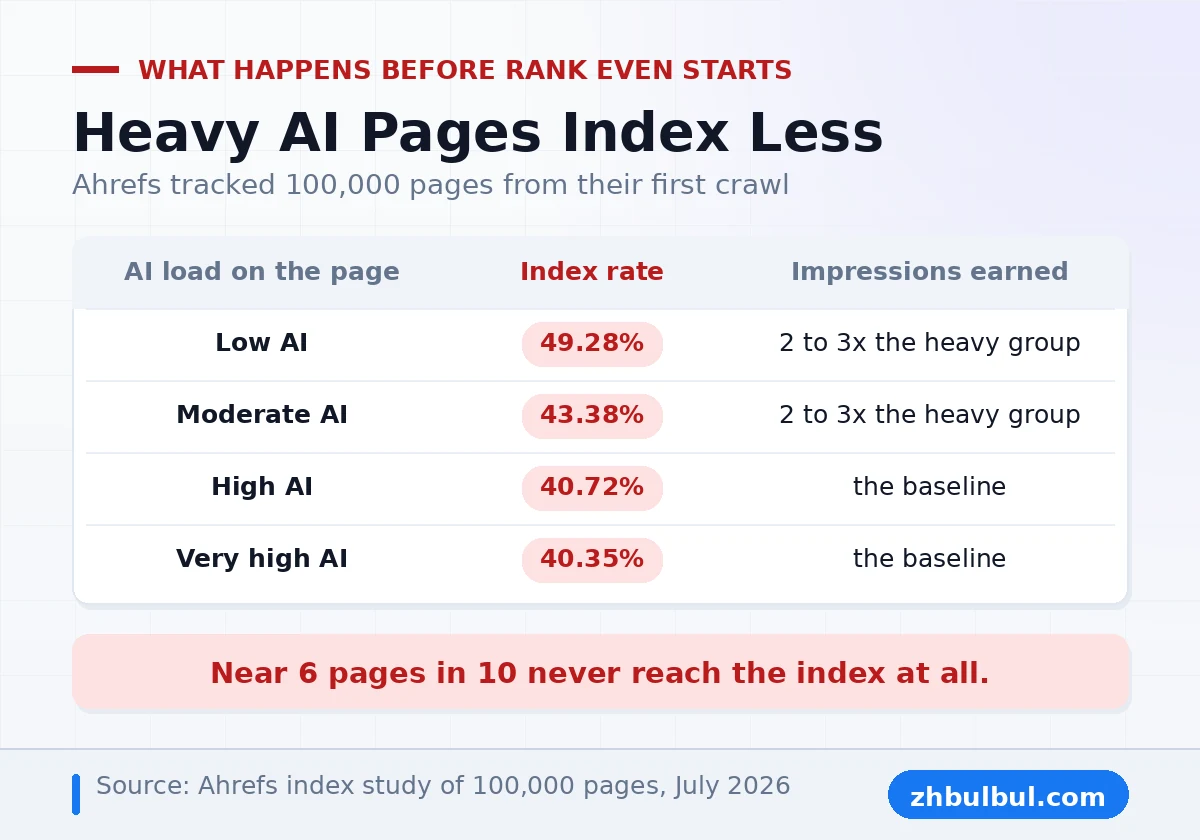
Heavy AI pages index less and earn less. Ahrefs read 100,000 pages. Low AI pages hit a 49.28 percent index rate. Heavy AI pages hit 40.35. Low AI pages drew 2 to 3 times the views.
Index rate is the first gate. A page Google skips earns nothing at all. Rank never enters the frame.
AI load tracks the drop in a clean line. Each step up in AI share costs index odds.
| Ahrefs, 100,000 pages, 2026 | Index rate |
|---|---|
| Low AI load | 49.28% |
| Moderate AI load | 43.38% |
| High AI load | 40.72% |
| Very high AI load | 40.35% |
Row four holds the real cost. Near 6 pages in 10 never reach the index at all.
Do AI answers cite AI written pages?
AI boxes lean toward pages a tool touched. Ahrefs read 1 million SERPs with AI Overviews. Cited pages ran near 9 in 10 mixed against 7 in 10 on the open web. Pure human pages ran under 1 in 10.
Cite data flips the gut read. The AI box cites AI helped pages at a higher rate than the web holds them.
AI Overviews reward a flat, plain, factual line. AI help builds that shape well. Human proof is what makes the line worth a cite.
The three traits that win an AI cite are listed below.
- Flat Shape: the flat shape trait puts one fact in one short line.
- Named Source: the named source trait ties each count to a study and a year.
- Full Cover: the full cover trait answers each sub ask on the page.
An SEO content refresh checklist keeps those cites fresh once they land.
Does AI content convert as well as human content?
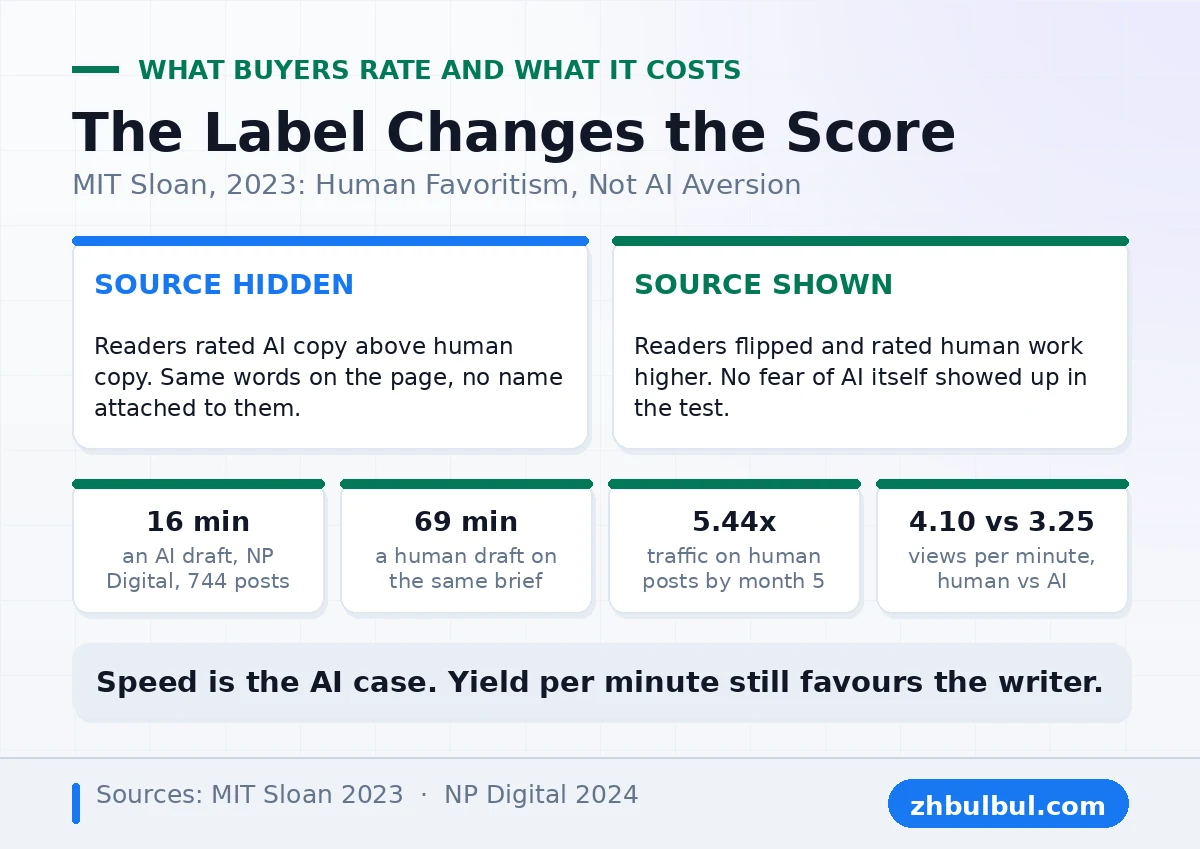
Rank and sales are two asks. MIT Sloan ran a blind test in 2023. Readers with no source label rated AI copy above human copy. Readers who saw the label flipped and rated human work higher.
Label is the whole variable. Same words, two scores. Nothing on the page changed but the name on it.
MIT named the paper “Human Favoritism, Not AI Aversion”. Buyers do not hate AI text. Buyers just pay more for a human name on it.
| MIT Sloan test, 2023 | Result |
|---|---|
| Source hidden from the reader | AI copy scored above human copy |
| Source shown to the reader | human copy scored above AI copy |
| Aversion to AI itself | none found |
Row two is the sales read. A named writer is worth money on the page. Row three kills the fear case.
What does each route cost in time?
NP Digital tracked 744 posts across 68 sites for 5 months. An AI draft took 16 minutes. A human draft took 69 minutes. By month 5 the human posts drew 5.44 times the traffic.
Speed is the AI case, and the case is real. Traffic is the human case, and that case is bigger.
Yield per minute settles the trade. Human posts returned 4.10 views per minute of work. AI posts returned 3.25.
| NP Digital, 744 posts, 5 months | AI draft | Human draft |
|---|---|---|
| Minutes per post | 16 | 69 |
| Traffic at month 5 | 1x | 5.44x |
| Views per minute of work | 3.25 | 4.10 |
Row three kills the speed case. The fast route returns less per minute spent.
A read on how to hire an SEO content writer sets the pay for those 69 minutes.
Which jobs do you give AI and which do you give a writer?
Split the work by risk. Give a tool the bulk jobs with one clear right answer. Give a writer the calls that carry your name. Facts, voice and claims stay with the human.
Job level beats page level. A page can hold both hands with no harm at all. The line runs through the task, not the page.
AI help earns its place on the flat work. Outlines, alt text and meta drafts move fast with a tool.
The four jobs to keep with a human are listed below.
- Fact Checks: the fact check job ties each count to a named study and a year.
- First Answer: the first answer job writes the line an AI box will lift.
- Real Stories: the real stories job carries proof no tool holds.
- Final Call: the final call job signs the page under your name.
An SEO content writing team runs that split by default.
What do you settle before you set an AI content rule?
Settle five asks before the rule goes out. Fix the detect ask, the tell ask, the pass ask, the risk ask and the owner. Those five turn a vague ban into a rule that works.
Each answer below runs short on purpose. Pin them beside your brief.
AI rules hold better in writing than in a meeting. The five asks below stall most teams.
Does Google detect AI writing?
Google runs no public AI detector on rank. Third party tools guess, and the guess is wrong often. Ahrefs and Semrush both used such tools, and both named the error band. Treat a score as a hint.
Tool scores swing hard on short text. A clean human page can flag high with no cause.
Do you disclose AI use to readers?
Name the human, not the tool. Readers reward a named writer with a real bio. MIT found no fear of AI text, just a lift for human work. A named writer beats a tool label.
Law still binds some trades on this. Health and money pages carry their own rules.
Can an AI draft pass as human?
A clean AI draft passes most reader tests. An AI draft fails the proof test. No tool holds your client counts, your screen shots or your call notes. Proof is the tell.
Read SEO content writing portfolio signals for the checks that catch a thin sample.
What breaks first on an all AI blog?
Facts break first. A tool states a count with no study behind it. Rank holds for a while, then slides as rivals ship proof. Trust goes before traffic does.
Read how many articles for topical authority for the page count that holds a theme.
Who signs off on an AI assisted draft?
One named human signs each page. That human owns the facts, the links and the claims. A page with no owner carries no one to blame when a count turns out false.
A set of questions to ask an SEO content writer settles who that owner is.

