
What is an SEO content brief?
A content brief is the one page a writer reads before the first draft. A brief names the search ask, the reader, the shape of the page and the proof to use. A brief is a spec, not a wish.
Brief work sits ahead of the draft, not beside it. A writer with no brief guesses at four things at once. Each guess costs a full round.
Search work feeds the brief. The brief then feeds the draft. Each step hands the next one a smaller job.
The three jobs a brief does are listed below.
- Target Lock: the target lock names the search ask and the reader in one line.
- Shape Lock: the shape lock sets the H2 list, the word range and the format.
- Proof Lock: the proof lock names the sources, the data and the links to use.
Why do most content briefs fail?
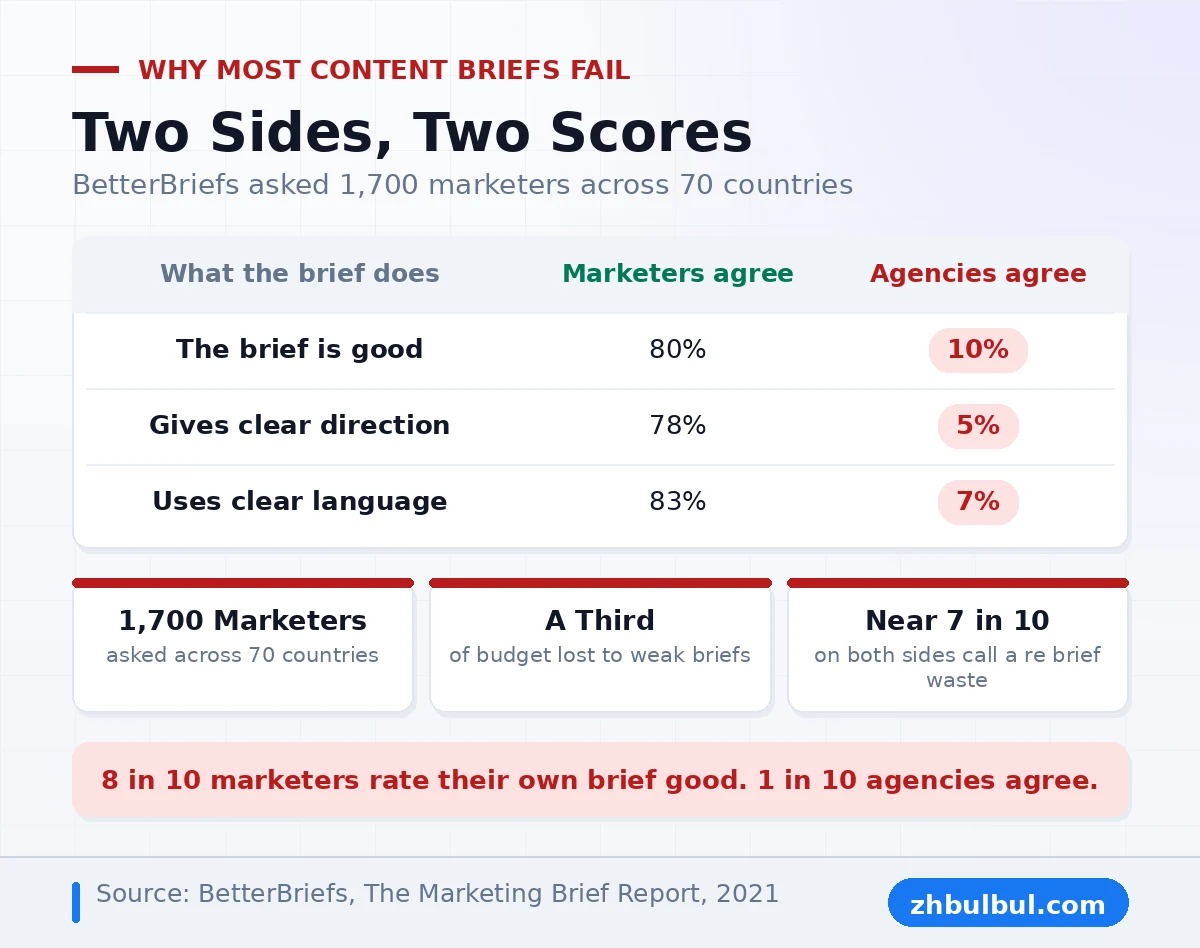
Two sides read the same brief and score it apart. BetterBriefs asked 1,700 marketers across 70 countries. 8 in 10 marketers rate their own briefs as good. Just 1 in 10 agencies agree.
Gap size is the story here. Both sides sit in one meeting and walk out with two plans. No one spots the split until the draft lands.
Brief faults cost real money. BetterBriefs put the waste at a third of the marketing budget.
| BetterBriefs, 1,700 marketers | Marketers who agree | Agencies who agree |
|---|---|---|
| The brief is good | 80% | 10% |
| The brief gives clear direction | 78% | 5% |
| The brief uses clear language | 83% | 7% |
Row three holds the sharpest split. Near 7 in 10 on both sides say a re brief wastes time.
What goes in an SEO content brief?
Twelve fields cover the whole job. Four fields set the target. Four fields set the shape. Four fields set the proof and the links. Cut a field and the writer fills the gap with a guess.
Field count varies by shop. Public templates run from 8 fields to 12. Count matters less than which field you cut.
Target fields carry the most weight. Agencies rank the goal of the page above each other field.
The four target fields are listed below.
- Search Ask: the search ask field holds the exact words a reader types.
- Reader: the reader field names who lands and what they know already.
- Page Goal: the page goal field states the one act the page must drive.
- Rival Set: the rival set field lists the top 3 pages and what each one misses.
What does a filled SEO content brief look like?
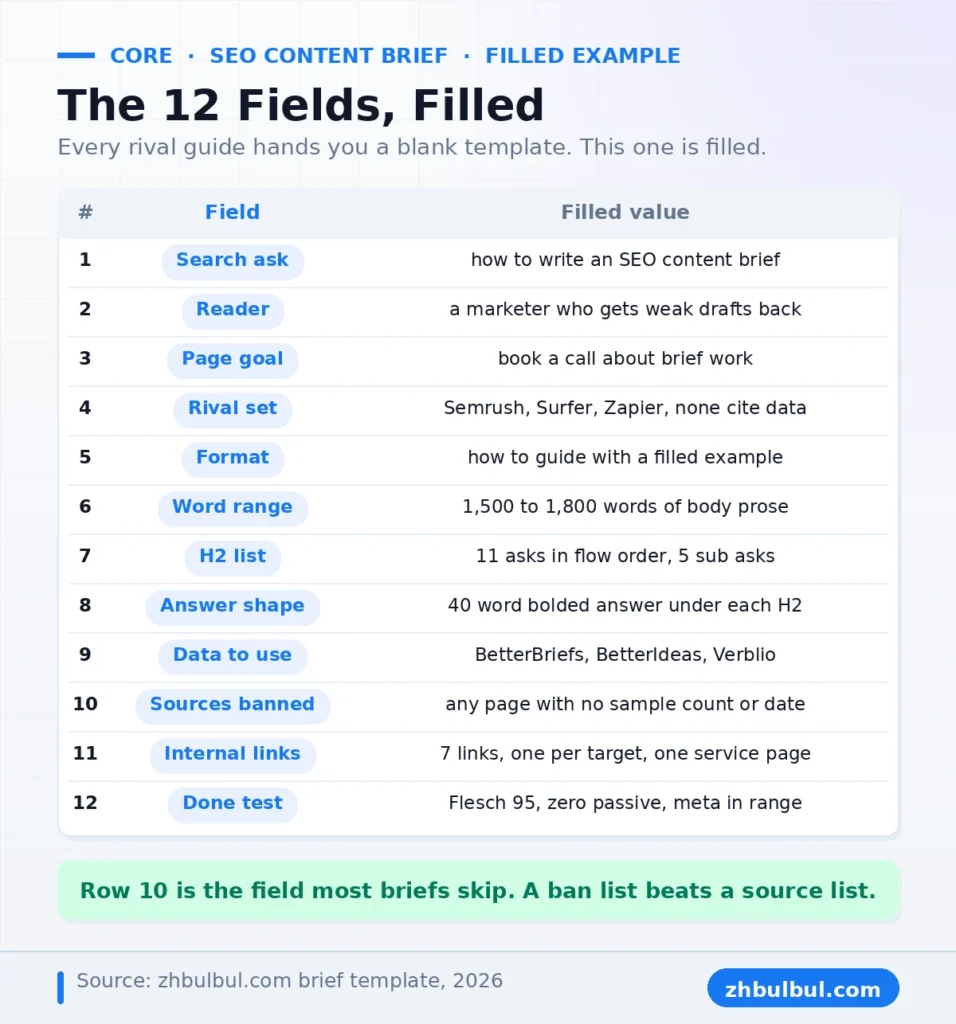
A filled brief runs near two pages. Each field holds one line, not a block. The table below fills all 12 fields for one search ask. Copy the shape and swap the values.
Fill work takes less time than it looks. Most fields hold a phrase, a count or a link. Just row 7 asks for real thought.
Example values below run tight on purpose. A brief that runs long stops a writer from reading it.
| # | Field | Filled value |
|---|---|---|
| 1 | Search ask | how to write an SEO content brief |
| 2 | Reader | a marketer who hires writers and gets weak drafts back |
| 3 | Page goal | book a call about done for you brief work |
| 4 | Rival set | Semrush, Surfer, Zapier, and none cite a study |
| 5 | Format | how to guide with a filled example table |
| 6 | Word range | 1,500 to 1,800 words of body prose |
| 7 | H2 list | 11 asks in flow order, plus 5 sub asks at the end |
| 8 | Answer shape | 40 word bolded answer under each H2 |
| 9 | Data to use | BetterBriefs 2021, BetterIdeas 2025, Verblio 2022 |
| 10 | Sources banned | any page with no sample count and no date |
| 11 | Internal links | 7 links, one per target, one service page |
| 12 | Done test | Flesch 95, zero passive, one H1, meta in range |
Row 10 is the field most briefs skip. A ban list beats a source list when the web runs thick with fakes.
A topical map vs keyword list tells you which search ask belongs in row 1.
How long should a content brief be?
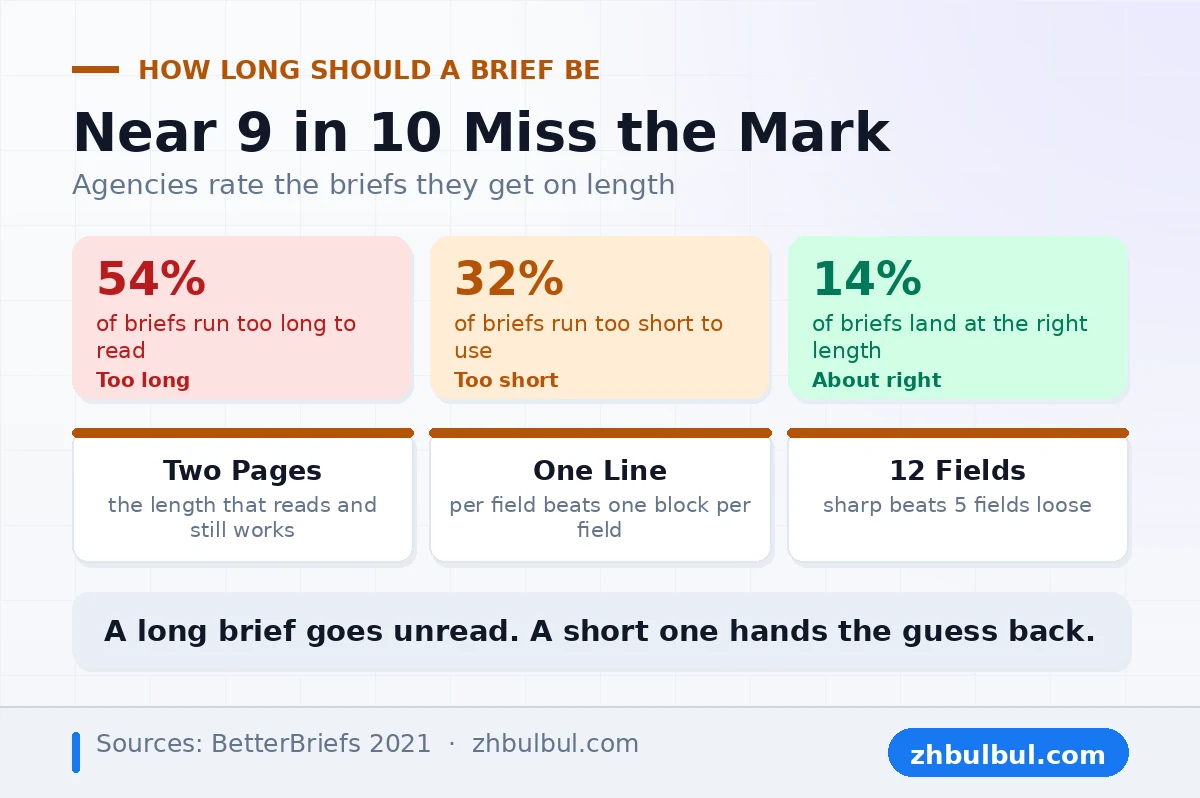
Two pages is the length that works. Agencies say briefs miss on length more than on any other trait. 54 percent call them too long. 32 percent call them too short. Just 14 percent call them right.
Length faults run both ways. A long brief goes unread. A short brief moves the guess work back to the writer. Both cost you a round.
Field depth beats field count. One sharp line under 12 heads beats three loose blocks under 5.
| Agency view of the brief | Share |
|---|---|
| Too long | 54% |
| Too short | 32% |
| About right | 14% |
Row three is the honest score. Near 9 in 10 briefs miss the length mark in one direction or the other.
Who writes the brief, the client or the writer?
The client owns the brief. ANA asked both sides in 2015. 58 percent of clients said the client writes it. Just 27 percent of agencies agreed. A writer who briefs themselves has no target to miss.
Owner rules settle most brief fights before they start. Name the owner in the doc itself. One name beats a team inbox.
Writer input still helps the brief. The writer adds the H2 list and the word range. The client holds the goal and the proof.
The three brief roles are listed below.
- Brief Owner: the brief owner writes the target fields and signs the doc.
- Brief Builder: the brief builder adds the shape fields from live search data.
- Brief User: the brief user writes the draft and flags each blank field.
A read on how to hire an SEO content writer sets who plays each role on your team.
How long does a content brief take to write?
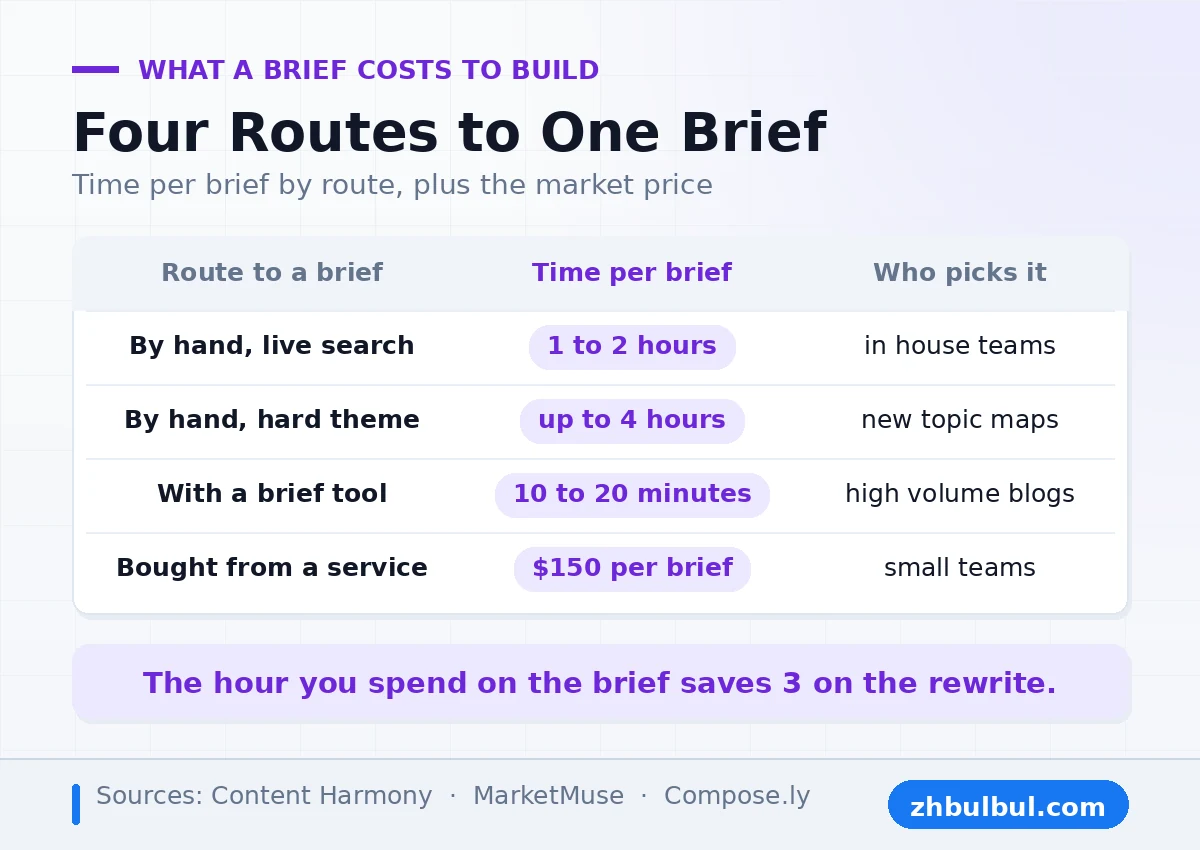
A brief takes 1 to 2 hours by hand. Brief tools cut that to 10 to 20 minutes. A hard theme with thin search data runs to 4 hours. Paid brief work carries a price of its own.
Time cost lands ahead of the draft, so owners feel it more. The same hour saves 3 later.
Tool claims run high, so read them with care. Surfer reports near a 70 percent cut in outline time on its own users.
| Route to a brief | Time per brief |
|---|---|
| By hand, from live search | 1 to 2 hours |
| By hand, hard theme | up to 4 hours |
| With a brief tool | 10 to 20 minutes |
| Bought from a service | $150 per brief |
Row four sets the market price. Most brief services hold a 3 brief floor on the order.
What does a brief cost against the rework it saves?
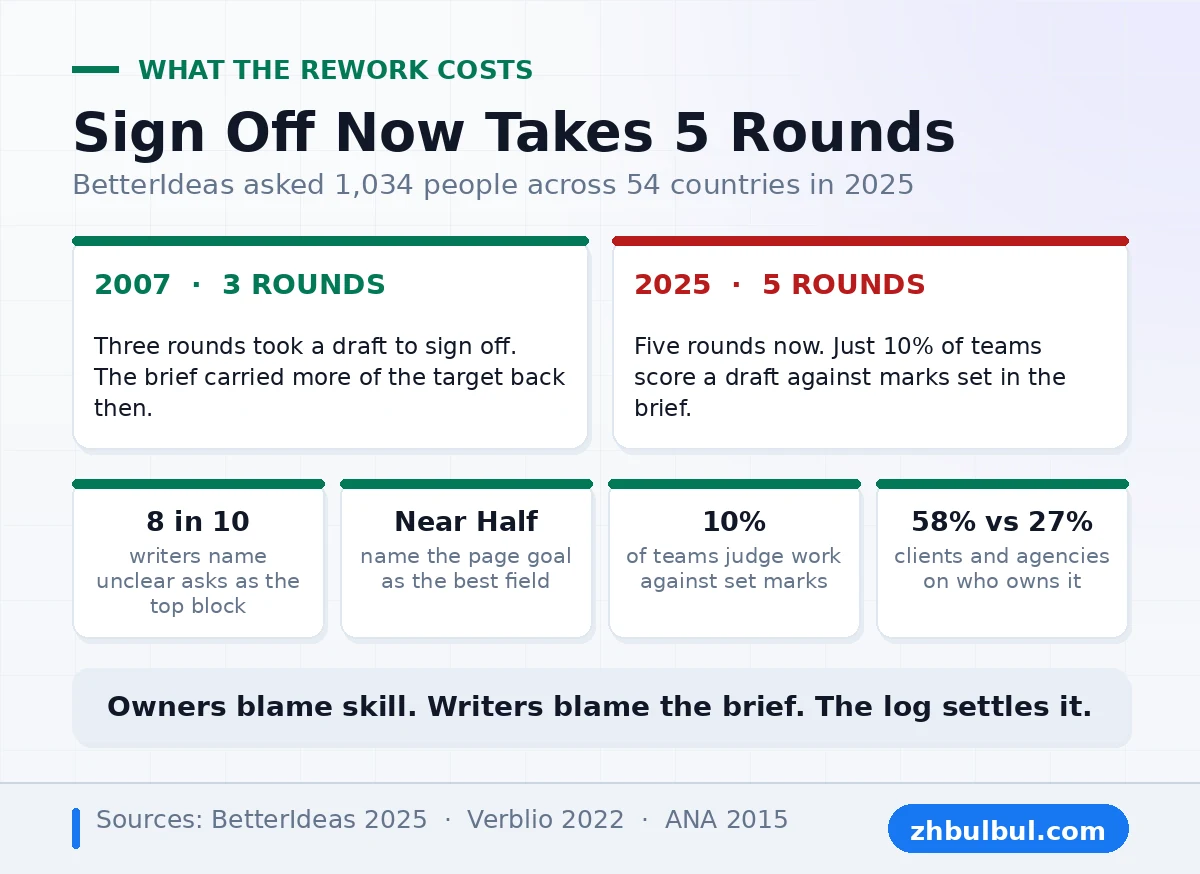
Rework is where the money goes. BetterIdeas asked 1,034 people across 54 countries in 2025. Sign off now takes 5 rounds. In 2007 it took 3. Rounds cost more than briefs do.
Round count is the cleanest cost you can track. Log it for one month and the case writes itself. Five rounds at 2 hours each burns a work day.
Brief work moves the argument to the front. A fight over the goal costs an hour before the draft. The same fight costs a rewrite after it.
| Sign off rounds | Then and now |
|---|---|
| Rounds in 2007 | 3 |
| Rounds in 2025 | 5 |
| Teams who score work against set marks | 10% |
Row three names the real fault. Most teams judge a draft on taste, not on marks set in the brief.
How does a brief change what the writer delivers?
Writers name the brief as their top block. Verblio asked writers in 2022. 8 in 10 say unclear requests are their biggest problem. Near half name the goal of the page as the most useful field.
Writer data flips the usual frame. Owners blame skill, and writers blame the brief. Both read the same draft and name a different fault.
Goal lines carry more weight than word counts. A writer who knows the act the page must drive shapes each section toward it.
A set of questions to ask an SEO content writer covers how a writer uses your brief.
What does a brief look like for AI assisted work?
AI work needs a tighter brief, not a looser one. A tool fills each blank you leave with text it made up. Name the sources, then ban the rest. The brief turns into a fact fence.
Blank fields are the risk with a tool in the chain. A human writer asks. A tool just writes.
Ban lists earn their place here and cost you two lines. Name the domains a draft cannot cite and the fake stats stop at the gate.
The three extra fields for AI work are listed below.
- Source Whitelist: the source whitelist names each study a draft can cite.
- Source Ban List: the source ban list bars stat pages with no sample count.
- Human Only Fields: the human only fields mark the parts a writer must draft.
A read on AI vs human content shows what the rank data says about that split.
What do you settle before you send your first brief?
Settle five asks before the brief goes out. Fix the order, the term count, the sign off, the miss rule and the template rule. Those five stop the brief from a slide into a chat thread.
Each answer below runs short on purpose. Pin them beside your template.
Brief rules hold better in writing than in a call. The five asks below stall most teams.
Do you send the brief before or after the outline?
Send the brief first. The outline is a brief field, not a step ahead of it. A writer who outlines with no brief picks their own target. Fix the target, then fill the H2 list.
Order faults show up as a good draft on the wrong ask. Cost lands on the whole page, not one line. Fix the order once and it holds for each post.
How many keywords go in one brief?
One brief holds one search ask. Sub terms belong in the H2 list, not in a term dump. A brief with 30 terms and no ask sends the writer 30 ways at once.
Read semantic SEO vs traditional SEO for why the ask beats the term list.
Who signs off on the brief?
One named person signs each brief. That person owns the goal, the proof and the ban list. A brief with two owners collects two sets of notes and stalls on both.
Sign off runs before the draft, never during it. A brief that changes mid draft costs a full round.
What do you do when a writer ignores the brief?
Check the brief first, then the writer. Half of all miss cases trace to a blank or vague field. Point at the field, not the person. A second miss on a clear field is a fit problem.
Read SEO content writing portfolio signals for the checks that catch a poor fit early.
Do you reuse one template for every post?
Keep one template and swap the values. Field names stay fixed across the blog. Fixed fields let you spot a blank at a glance. A fresh template each time hides what you left out.
An SEO content writing team runs one template across the whole map.

