
What is the difference between content pruning and content refresh?
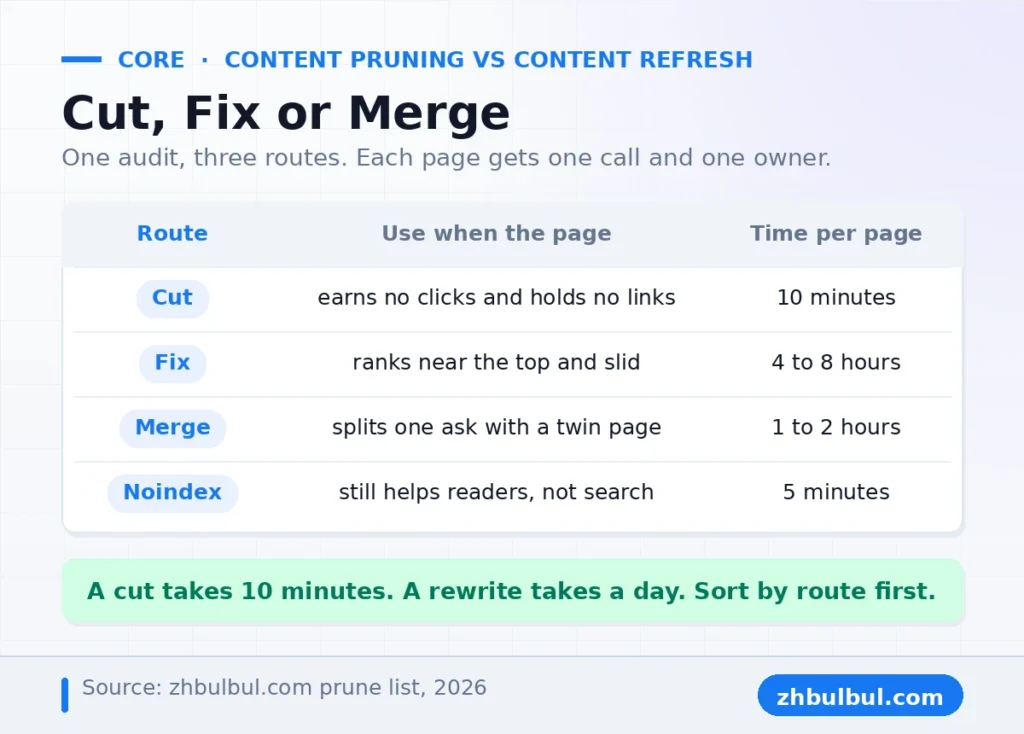
A prune cuts a page. A fix rewrites one. Both start from the same audit and the same ask. Does this page still earn a slot on your site? One answer ends in a cut, the next in a draft.
Prune work and fix work sit on one list, not two. Each page gets one call and one owner.
Prune calls run faster than fix calls. A cut takes 10 minutes. A rewrite takes a day.
The three routes off one audit are listed below.
- Cut: the cut route drops a page that earns no clicks and holds no links.
- Fix: the fix route rewrites a page that ranks near the top and slid.
- Merge: the merge route folds two thin pages into one strong page.
How many of your pages earn nothing?
Ahrefs read 14 billion pages in 2023. 96.55 in each 100 drew no click at all from Google. Near 1 page in 29 earned a visit. Most blogs carry more dead weight than live weight.
Scale sets the frame for each call below. Dead pages are the norm on the web, not the odd case.
Zero click pages still cost you. Each one takes crawl budget, and each one sits in your sample set for a buyer to read. Dead pages read as slack.
| Ahrefs, 14 billion pages, 2023 | Share of pages |
|---|---|
| No traffic from Google | 96.55% |
| 1 to 10 visits a month | 1.94% |
| 11 or more visits a month | 1.51% |
| Sample skew | toward quality pages |
Row four is the honest caveat. Ahrefs sampled their own index, which leans clean, so your own blog can read worse.
Does deleting old pages lift your rankings?
Google says no, twice and in public. Danny Sullivan wrote that a delete for age alone “That’s not a thing!” in 2023. Google docs ask if you remove old pages to look fresh, then answer “No, it won’t”.
Age is not a rank signal in either direction. Google states the point in the helpful content docs word for word.
John Mueller put the same line another way. Blind cuts do not improve your search work.
| Google on deletes, 2023 | The line |
|---|---|
| Danny Sullivan, Search Liaison | deleting for age is “not a thing” |
| Google helpful content docs | removals to look fresh “No, it won’t” |
| John Mueller | blind deletes do not improve SEO |
Row two is the one to quote in a meeting. Google wrote it into the docs, not just a post.
Why did pruning still work in these case studies?
Two agencies pruned and clicks rose. Inflow cut near 200 pages and sessions more than doubled. Seer flagged 14,000 URLs and search clicks rose near a quarter. Neither win came from the fresh look.
Crawl is the real lever. Sullivan named it himself. A cut frees the crawler to reach your good pages more often.
Site wide gains trace to what the cut pages held. Thin pages, near twin pages and dead tag pages drag on the whole set. A cut removes the drag, not the age.
The three real reasons a prune moves clicks are listed below.
- Crawl Shift: the crawl shift reason sends bots to pages that can earn a rank.
- Twin Cut: the twin cut reason ends two pages that fight for one term.
- Thin Load: the thin load reason drops pages that pull your quality mark down.
A semantic SEO vs traditional SEO read explains why two thin pages beat neither.
Which pages do you prune?
Seer used four floor marks on one insurance site. A page under all four lands on the cut list. Sessions, impressions, live links and ranked terms each carried a floor. 14,000 URLs met the bar.
Floor marks beat gut calls at scale. Set them once and the list writes itself in a spreadsheet.
Cut off marks scale with your site. A blog of 200 posts holds a lower bar than a site of 14,000 URLs.
| Seer floor mark | Value | Window |
|---|---|---|
| Organic sessions | under 50 | 12 months |
| Organic impressions | under 50 | 12 months |
| Referring domains | under 5 | all time |
| Ranked keywords, top 100 | under 14 | current |
Row three is the veto row. A page with real links off other sites earns a 301, never a plain cut.
Which pages do you refresh instead?
Old pages pay better than new ones. HubSpot found near 8 in 10 of each month’s blog views came from old posts. Leads ran higher still at 9 in 10. Fixed posts drew twice the views on average.
Fix work has the better return of the two routes. A page with rank history starts from a base a new page lacks.
Decay sets the clock on this. Animalz measured blog decay at 1.21 points a week, so a strong page fades without a hand on it.
| HubSpot, historical optimisation | Result |
|---|---|
| Monthly views from old posts | 76% |
| Monthly leads from old posts | 92% |
| Average lift on an updated post | +106% views |
| Best single post conversion lift | +240% |
Row two is the case for the fix route. Old pages already carry the leads.
An SEO content refresh checklist sets the order of work once you pick a page.
When do you merge two pages rather than cut one?
Merge when both pages chase one ask. Two thin posts on one term split your links and your rank. One strong page takes the slot both missed. Point the weaker URL at the winner with a 301.
Overlap is the test, not word count. Two posts that answer the same ask compete with each other, not with a rival.
Merge work pays twice. Rank climbs on the kept page, and the link worth moves with the 301.
The three merge tests are listed below.
- Same Ask: the same ask test checks whether both pages answer one search.
- Split Rank: the split rank test checks whether both pages rank for one term.
- Link Load: the link load test checks which page holds the links off other sites.
A topical map vs keyword list read shows which asks deserve one page each.
Should you delete, redirect or noindex a page?
Three exits exist and they are not equal. A 301 moves the link worth to a close match page. A noindex keeps a page for readers and drops it from search. A delete suits pages with no links and no readers.
Exit choice hinges on what the page holds. Links point to a 301. Readers point to a noindex. Neither points to a raw cut.
Wrong exits cost you real worth. A cut on a page with 20 live links throws that worth away for nothing.
| Exit route | Use when | What you keep |
|---|---|---|
| 301 redirect | a close match page exists | link value, some rank |
| Noindex | readers still use the page | the page, not the slot |
| Delete, 404 or 410 | no links, no readers, no match | nothing |
| Robots block | a whole low value folder | crawl budget only |
Row one is the default. Most pruned pages have a close cousin worth the 301.
How long does the traffic take to move after a prune?
Give it a full quarter. Inflow measured a doubled session count across four months. Seer needed six months and a near full build out to log the gain. Crawl gains show first.
Lag is the rule on this work. Google has to recrawl the whole set before the shift lands.
Crawl logs move ahead of clicks. Seer logged an 8 point lift in hits to high worth folders within five months.
| Case | Scale of cut | Result | Window |
|---|---|---|---|
| Inflow, Home Science Tools | 200 pages, 10% of blog | +104% sessions | 4 months |
| Inflow, same site | same cut | +102% orders | 4 months |
| Seer, insurance client | 14,000 URLs | +23% clicks | 6 months |
| Seer, crawl logs | same cut | +8% hits to key folders | 5 months |
Row three carries the best context. That site had lost 17.3 points a year for five years straight.
What does a prune and refresh pass cost in hours?
Budget the audit once and the work by page. A pass over 500 URLs takes a day with export data. A cut takes 10 minutes per page. A rewrite takes 4 to 8 hours per page.
Cost sits mostly in the rewrites, not the cuts. A prune list of 200 pages clears in a week.
Route mix drives your total. A blog with 80 dead pages and 5 fix candidates costs far less than the reverse.
An SEO team runs the audit and hands you the call list by page.
How does a prune change what you publish next?
A prune resets your page count, not your plan. Cut pages free hours for depth on the asks that pay. Most teams then write fewer posts and cover each ask in full.
Publish volume is the wrong target after a cut. Reach across the asks that matter is the right one.
Fresh drafts need a tighter spec once you have cut the slack. A brief keeps the next batch off next year’s prune list.
A read on how to write an SEO content brief keeps the new work off that list.
What do you settle before your first prune?
Settle five asks before you cut a page. Fix the link rule, the batch size, the tell rule, the risk cap and the owner. Those five keep one bad cut from a year of lost clicks.
Each answer here runs short on purpose. Pin them beside your prune list.
Prune rules hold better in writing than in a call. The five asks here stall most teams.
Do you prune a page with backlinks?
Never cut a page that holds links off other sites. Point it at the closest live page with a 301. Link value moves. A raw cut throws that worth away and earns you nothing back.
Link checks run before each cut, not after. One export from your link tool covers the whole batch.
How much of a blog is safe to cut at once?
Cut a tenth, then wait a quarter. Inflow cut near a tenth of one blog and clicks doubled. A bigger first swing hides what worked. Small batches keep the cause clear.
Read how many articles for topical authority for the page count a theme needs.
Do you tell Google you removed pages?
Serve a clean 404 or 410 and update the sitemap. Google drops the URL on the next crawl. No form and no request beats the wait. Removal tools suit legal cases, not a prune.
Sitemap files matter more than most teams think. A stale sitemap keeps dead URLs in the crawl queue for weeks.
What breaks when you prune too hard?
Reach breaks first. A theme with holes in it loses the depth that held your rank. Rank then slides on the pages you kept. Cut the weak page, never the whole branch.
Read AI vs human content for why thin pages cluster in the first place.
Who signs off on a delete?
One named person signs each batch. That person owns the link check, the exit route and the rollback plan. A batch with two owners gets half a link check and no rollback at all.
Rollback plans cost you one export. Save the URL list, the exit route and the date before the batch runs.

