
What is source context in SEO?
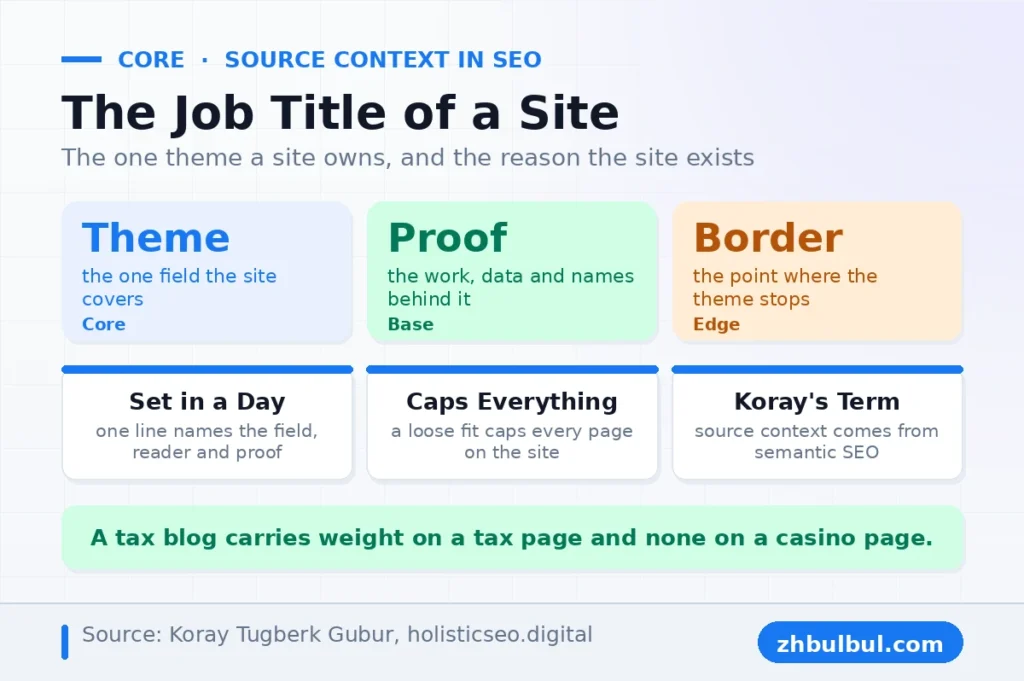
Source context is the one theme a site owns and the reason it exists. Koray Tuğberk Gübür named the term. The fit between that theme and a fresh page sets what the page can rank for.
Source fit sits above your key words. A site ranks a page only when the site works as the source.
Source context reads like a job title for a site. A tax blog carries weight on a tax page. The same blog carries none on a casino page.
The three parts of a source context are listed below.
- Core Theme: the core theme names the one field the site covers.
- Proof Base: the proof base holds the work, data and names that back that field.
- Border: the border marks the point where the theme stops.
Why does source context decide what you rank for?
Google reads the source before it reads the page. A tight fit lifts each page on the theme. A loose fit caps them all. Koray ties a lost core update to a site with no clear aim.
Source fit is the cheap lever most blogs skip. You fix it once and each later post gains from it.
Source context beats page work at scale. A tight site with 25 pages beats a loose one with 250.
| Source fit | What Google does |
|---|---|
| Tight and clear | each page on the theme gains |
| Loose or mixed | the whole site caps out |
| Rented to an outside firm | the folder risks a manual action |
Row three now carries a written rule from Google. That rule has a name.
How does Google read the fit between a source and a theme?
Google builds a theme profile for the full site, then scores each page against it. The 2024 leak named two fields for this job. One field, siteFocusScore, reads how tight a site holds one theme. A second, siteRadius, reads how far a page drifts from it.
Leak fields are not proof of live use. Google never confirmed either one.
Source context maps onto both fields in plain terms. A tight theme raises the score. A stray post widens the radius.
| Leak field | What it reads |
|---|---|
| siteFocusScore | how much a site holds one theme |
| siteRadius | how far a page sits from the site theme |
| siteAuthority | a site wide strength mark |
Row three matters because Google denied a site wide mark in public for years.
A topical map vs keyword list read shows you how to set that theme before you write.
Did Google turn source context into a written rule?
Yes, in 2024. Google added site reputation abuse to its spam rules. The rule bans third party pages placed on a host site to use that host’s rank signs. Google made the fit the test.
Spam rules turn theory into a live risk. Koray wrote about source fit years before this.
Source context now sits inside a Google rule in plain words. The rule reads that a host earns its rank signs from its own pages. A page from an outside firm borrows them.
| Google’s rule on site reputation abuse | The wording |
|---|---|
| What it bans | third-party content published mainly for the host’s ranking signals |
| On first-party oversight | “regardless of first-party involvement or oversight” |
| Not a breach | forums, wire copy, columns, ad units, affiliate links |
| Enforcement start | 5 May 2024, by manual action |
Row two is the one that caught the big sites. Editors checked the pages and still lost them.
Which sites lost pages when the source no longer fit?
Google banned folders on the largest news brands in the US. CNN Underscored fell to about 10 indexed URLs. Forbes Advisor lost whole folders. USA Today Reviewed, Newsweek Vault and WSJ Buyside took the same hit.
Brand size bought none of them a pass. Each folder sold rank, not fit.
Source context broke the same way on each site. A news brand rented a folder to a deals firm. Google read the fit and cut the folder.
| Site | Folder hit |
|---|---|
| CNN | Underscored |
| Forbes | Advisor |
| USA Today | Reviewed |
| Newsweek | Vault |
| Wall Street Journal | Buyside |
| LA Times, Fortune, Daily Mail, SFGATE | deals and promo folders |
Row shape tells the story. Each folder sat far outside the news theme.
What are the 6 signs of a weak source context?
Six signs show up before a drop. Mixed themes lead the list. Rented folders and outside bylines come next. A blank about page and a thin proof base close it. Each one widens the gap between a site and its pages.
Sign counts beat gut calls. Run the six on your own site in an hour.
Source context leaks through small things first. A stray post on a hot theme is the classic first crack.
| # | Sign | What it looks like |
|---|---|---|
| 1 | Mixed themes | an SEO blog runs a crypto post |
| 2 | Rented folder | a deals folder run by an outside firm |
| 3 | Outside bylines | no writer works at the brand |
| 4 | Blank about page | no name, no field, no proof |
| 5 | Thin proof base | no data, no client work, no first hand test |
| 6 | Chase posts | the theme follows the news cycle |
Row 6 is the quiet killer. A blog that chases each trend owns no theme at all.
A prune or refresh an old post pass clears the stray pages fast.
How do you write your source context in one line?
Write one line that names the field, the reader and the proof. Keep it under 15 words. Put it on your about page and at the top of each brief. Test each fresh theme against that line.
One line beats a brand deck. The writer reads it before the first draft.
Source context lives in that line or it lives nowhere. A team with no line writes what the tool says to write.
The three parts of the line are listed below.
- Field: the field names the one theme you own.
- Reader: the reader names who you write for.
- Proof: the proof names what backs each claim.
A sample line runs short. We write SEO text for US firms, backed by live client work. Swap in your field, reader and proof. [BULBUL: use your own line here].
What is a contextual bridge in semantic SEO?
A contextual bridge is a page set that links your core theme to a fresh one. Koray uses it for growth past the border. An energy site that adds loans needs the bridge first. A jump with no bridge reads as a stray theme.
Bridge work is slow and cheap. You write 5 pages that hold both themes at once.
Source context grows through a bridge, not a leap. Each bridge page names the tie in plain words.
| The move | With no bridge | With a bridge |
|---|---|---|
| Energy site adds loans | a stray theme | pages on the cost of power bills |
| SEO blog adds paid ads | a stray theme | pages on search share across both |
| Recipe site adds gear | a stray theme | pages on the tools each recipe needs |
Row one comes from a live Koray case study. The site built the tie before the jump.
A semantic SEO vs traditional SEO read covers why the tie beats a term match.
How does source context differ from topical authority?
Source context is the claim and theme depth is the proof. You set the fit in one line on day 1. You earn the depth over months of pages. A site can hold a clear fit and still hold no depth.
Order runs one way only. Fit comes first and depth follows.
Source context caps how much depth you can earn. A blog with 3 themes splits its depth 3 ways.
| Term | What it is | How fast it moves |
|---|---|---|
| Source context | the theme a site claims | one day |
| Topical authority | the depth a site earns | months |
| Domain authority | a third party score | not a Google mark |
Row three is the one most teams still chase. John Mueller stated that Google uses no domain authority.
A topical authority vs domain authority read splits the two for you.
An SEO team sets the fit before it writes a single page.
How does source context change what you publish next?
Source fit cuts your theme list before you cost it. Each theme outside the border drops off. Most lists lose their weakest rows on the first pass. The rest then earns more per post.
List work runs faster once the line exists. You test a fresh theme in 10 seconds.
Source context also sets your link map. Pages inside one theme link to each other with clean labels.
The three checks on a fresh theme are listed below.
- Field Check: the field check asks whether the theme sits inside your line.
- Proof Check: the proof check asks what you hold that no rival holds.
- Border Check: the border check asks whether a bridge page comes first.
A read on internal anchor text rules shows how to write those labels.
What do you settle before your next theme call?
Settle five asks before you add a theme. Fix the one line and the two site rule. Then fix the guest post rule, the AI rule and the owner. Those five stop a slow drift.
Each answer here runs short on purpose. Pin them next to your theme list.
Source context holds better in writing than in a call. The five asks here stall most teams.
Can one site hold two source contexts?
No, not on one domain. A second theme splits the fit and widens the radius. Run the second theme on its own domain or build a bridge. A sub folder with a fresh name works only when the tie is real.
Read how many articles for topical authority for the page count one theme needs.
Do guest posts break your source context?
Guest posts break nothing on their own. Google states that third party pages alone are no breach. The breach starts when you run them mainly to rent your rank signs. Keep each guest post on your core theme.
Guest work costs you one check. Read the draft and ask whether your brand would write it.
Does an AI written draft shift the fit?
AI drafts shift the fit when no one adds the proof. A tool writes the shape of your theme and none of your work. Search data ties top ranks to human edits. Add your own data to each draft.
Read AI vs human content performance for the rank splits across 42,000 pages.
How long does a source context reset take?
Plan for two quarters, not two weeks. Cut the stray pages first. Rewrite the about page next. Then post on one theme for 6 months. Google re-reads the site across the next crawl rounds.
Reset work has no switch. The old pages sit in the index until you clear them.
Who owns the source context call?
One named person owns the line and signs each fresh theme. That person holds the one line, the border list and the bridge plan. A site with two owners drifts into a mixed theme inside a year.
Owner files beat a shared doc. A single sheet with the line at the top settles most asks.

